
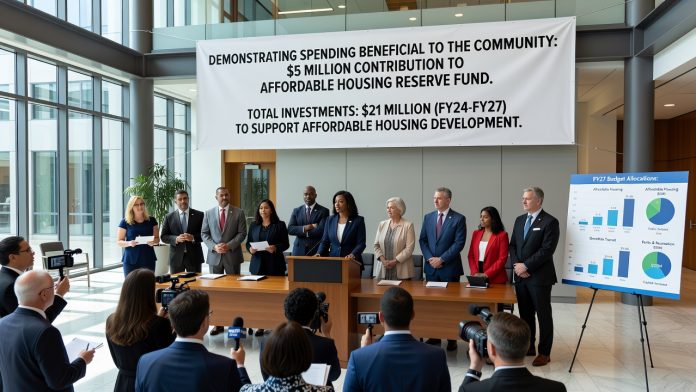
Prince William County officials have finalized the fiscal year 2027 budget, which includes a notable five million dollar contribution to the local Affordable Housing reserve fund. This latest financial commitment brings the total county investment in affordable housing initiatives to twenty-one million dollars spanning from fiscal year 2024 to fiscal year 2027. Local leaders designed this sustained funding strategy to support the ongoing development of accessible housing options across the rapidly growing community. The allocation represents a key component of a broader municipal spending plan that balances residential tax relief with targeted community investments.
The Prince William County Board of Supervisors, responsible for reviewing and approving the annual budget, navigated extensive public engagement sessions before finalizing the fiscal year 2027 allocations. The current board includes Chair Deshundra Jefferson, Victor Angry, Andrea Bailey, Kenny Boddye, Margaret Franklin, Tom Smith, Yesli Vega, and Bob Weir. These elected officials deliberated over various funding priorities, ultimately deciding to shift a portion of the tax burden away from local homeowners. Their collaborative efforts resulted in a comprehensive financial blueprint that addresses both immediate infrastructure needs and long-term community development goals.
Balancing Tax Relief and Community Investment
As part of the newly adopted budget, the Board of Supervisors approved a reduction in the real estate tax rate for local property owners. The residential property tax rate will decrease from the previous fiscal year 2026 rate of 90.6 cents to 86.5 cents per one hundred dollars of assessed value. County financial projections indicate this rate adjustment will yield an average residential tax bill savings of fifty-six dollars compared to the previous year. To offset this reduction in residential revenue, officials authorized an increase in the computer and peripherals tax rate. This specific commercial tax adjustment primarily impacts the regional data center industry operating within the county borders.
The computer and peripherals tax rate will rise from 4.15 dollars to 4.50 dollars per one hundred dollars of valuation under the new spending plan. The Occoquan District Supervisor noted that following days of deliberation and public engagement, the board crafted a budget that delivers more for the people of Prince William County. The supervisor described the approved budget as progress, specifically highlighting the decision to lower the property tax rate while shifting more of the tax burden off residents and onto data centers. This strategic tax shift provides the necessary capital to fund essential public services without placing additional financial strain on local families.
Expanding Public Services and Infrastructure
Beyond affordable housing and tax adjustments, the fiscal year 2027 budget includes substantial financial support for the Prince William County Public Schools system. The county will transfer a record 1.1 billion dollars to the public school district, representing a 12.5 percent increase over the previous funding cycle. This educational allocation provides an additional 123.5 million dollars compared to the fiscal year 2026 budget to support local students and educators. Additionally, the spending plan fully funds the local subsidy for the OmniRide public transit system. The county dedicated a 29.9 million dollar commitment to the transit agency to maintain and expand regional mobility networks.
Municipal parks and recreational facilities will also experience significant upgrades through a newly approved twenty million dollar capital investment increase. This expanded funding will directly benefit community green spaces, including planned improvements for the Charlie Boone Memorial Park. Public safety departments across the county are similarly slated to receive continued financial support to maintain emergency response capabilities and community protection. The budget ensures adequate operational funding for the Fire and Rescue Department, the Police Department, the local Sheriff’s Office, and the Commonwealth’s Attorney’s Office.
Long-Term Housing Strategy
The Office of Housing and Community Development will oversee the implementation of the newly expanded Affordable Housing reserve fund. The five million dollar contribution for fiscal year 2027 builds upon previous multi-million dollar allocations, including 5.5 million dollars designated in both fiscal years 2025 and 2026. By accumulating these funds over several years, the county aims to attract private developers and secure matching state or federal grants for large-scale housing projects. Regional housing advocates have consistently emphasized that dedicated reserve funds are critical for bridging the financing gaps that often stall affordable residential construction.
The strategic investments outlined in the fiscal year 2027 budget reflect a deliberate effort by county officials to address the evolving socioeconomic needs of Prince William County. By pairing residential tax relief with targeted spending in housing, education, and public safety, the local government aims to foster sustainable economic growth. As the new fiscal year approaches, municipal departments will begin executing these funded initiatives to deliver tangible improvements to public services. The twenty-one million dollar cumulative investment in affordable housing stands out as a long-term commitment to ensuring the region remains accessible to residents across diverse income levels.
Email the Board of Supervisors At:
Chair At-Large (Deshundra Jefferson) – djefferson@pwcgov.org,
Brentsville (Tom Gordy): tgordy@pwcgov.org,
Coles (Yesli Vega): yvega@pwcgov.org,
Occoquan (Kenny Boddye): kboddye@pwcgov.org,
Potomac (Andrea Bailey): abailey@pwcgov.org,
Woodbridge (Jeannie LaCroix): jlacroix@pwcgov.org,
General Board: bocs@pwcgov.org,