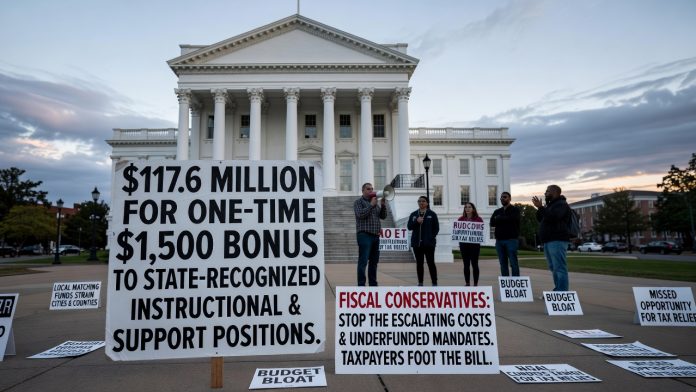
Governor Abigail Spanberger and Democratic leaders in Richmond have finalized a state budget that drastically expands the size and scope of Virginia government. The newly approved spending plan features a record-shattering $2 billion in new public education funding and creates massive new entitlement programs at the expense of taxpayers. While proponents argue these measures are necessary to combat federal spending cuts, fiscal conservatives are raising alarms about severe overspending and the long-term financial stability of the Commonwealth. This budget relies heavily on new taxes and unprecedented spending levels that threaten to burden hard-working families for generations.
**Targeting Job Creators with New Taxes:** A major point of contention in this sprawling budget is the implementation of a first-of-its-kind statewide energy consumption tax on data centers. The new levy imposes a tax of $0.011 per kilowatt-hour, which is capped at $600 million annually. Governor Abigail Spanberger praised the tax, boasting that it positions Virginia as a national leader while extracting massive revenue from the technology sector. However, conservative critics warn that penalizing job creators with aggressive new taxes will ultimately drive lucrative data center investments out of the Commonwealth and into more business-friendly states.
Hoarding Taxpayer Funds for a Slush Fund
Perhaps the most alarming feature of the new budget is the allocation of $1 billion in contingency funding to protect against anticipated federal funding cuts. Delegate Amy Laufer defended the move by claiming the state is simply responding to what is happening in Washington and preparing for federal belt-tightening. Fiscal watchdogs view this massive unassigned reserve as a taxpayer-funded slush fund designed to backfill federal reductions from the legislation signed by President Trump. Instead of matching federal efforts to reduce waste and trim bloated budgets, Virginia Democrats are choosing to hoard taxpayer money to sustain unsustainable government programs.
Exploding Entitlements and Bureaucracy
The budget also includes a staggering $2.4 billion General Fund investment to fully fund Medicaid and CHIP forecasts. This represents a massive increase in departmental spending that places an enormous burden on the state’s financial resources. Furthermore, the plan allocates millions for the administrative implementation and staffing of sweeping new Paid Sick Leave and Paid Family and Medical Leave programs. Expanding these government mandates not only balloons the state bureaucracy but also imposes heavy compliance costs on small businesses struggling to survive in a challenging economy.
Misplaced Priorities and Questionable Spending
In a move that raises serious moral and public safety concerns, the budget provides dedicated funding to establish a regulatory framework and infrastructure for a newly created legal recreational marijuana retail marketplace. Alongside this controversial initiative, the state is pouring hundreds of millions of dollars into various housing programs, including a $25 million revolving loan fund for mixed-income housing. The budget also allocates $17 million for eviction prevention assistance programs and another $17.6 million to support rapid rehousing efforts. Critics argue that these massive public subsidies artificially manipulate the housing market rather than allowing free-market principles to lower costs naturally.
Expanding Government Payrolls Instead of Savings
Public education and government payrolls are also seeing massive infusions of taxpayer cash under the new agreement. Teachers and school support staff will receive 4% annual raises in each year of the biennium, while state employees are slated for 3.5% annual increases. The budget sets aside an additional $577 million for childcare and early childhood education, alongside an unusual $25 million pilot program subsidizing private employers for providing childcare benefits. While Speaker Don Scott claims these provisions solve problems and lower costs, conservatives argue that perpetually expanding the public payroll is a recipe for catastrophic future tax hikes.
Budget Gimmicks and Paltry Rebates
To pacify frustrated taxpayers footing the bill for this massive expansion, the budget authorizes a paltry tax rebate of $100 for single filers and $200 for joint filers. This minor concession totals $499 million, which is merely a drop in the bucket compared to the billions being funneled into new government programs. Meanwhile, lawmakers utilized a concealed administrative spending maneuver to delay the implementation of a single pharmacy benefit manager system until July 2027. Senate Finance Committee Chair Louise Lucas admitted she would have preferred another method but insisted they had to get a budget passed to avoid a government shutdown.
A Dangerous Path Forward
The incorporation of over $585.5 million from the FY2026 surplus directly into the FY2027 starting balances further exemplifies the state’s refusal to return excess revenue to the people. House Appropriations Chair Luke Torian described the conference report as maintaining fiscal discipline, a claim that deeply contradicts the reality of this historic spending spree. Virginia taxpayers deserve a government that respects their hard-earned money by eliminating waste, fraud, and overspending instead of inventing new ways to expand state power. Until lawmakers embrace true fiscal conservatism, the Commonwealth will remain on a dangerous path of unchecked government growth and escalating financial liabilities.