
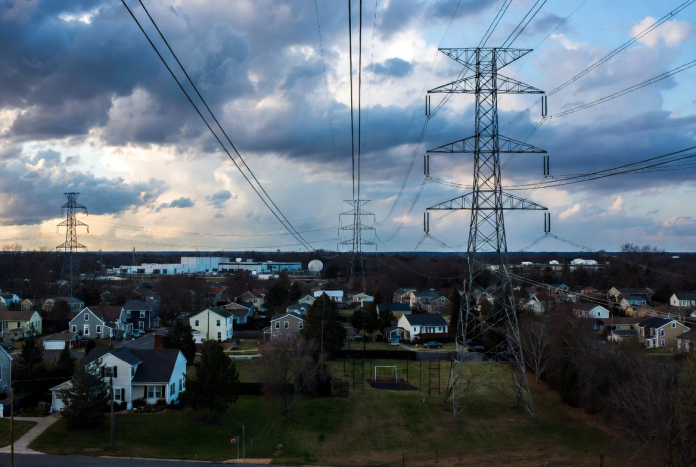
Loudoun County and broader Northern Virginia face escalating demands for high-voltage transmission infrastructure to support the region’s dense concentration of data centers. Dominion Energy has advanced several projects, including elements of the Loudoun Reliability Loop linking the Aspen, Golden, Mars, and Wishing Star substations near Ashburn. These lines, operating at 500 and 230 kilovolts, are designed to address projected reliability shortfalls and must enter service by mid-2028 in some cases. The Virginia State Corporation Commission has reviewed multiple route options and approved certain above-ground alignments after evaluating environmental, residential, and cost factors. Partial underground configurations examined by the utility carried estimated costs exceeding $1.2 billion, leading regulators to conclude that full burial under standard methods is not practicable for the timelines and budgets involved. Overhead construction for comparable high-voltage lines is estimated at roughly $6 million per mile.
Local governing bodies have engaged extensively with the issue. The Loudoun County Board of Supervisors consists of Chair Phyllis Randall, Vice Chair Michael Turner representing the Ashburn District, Juli Briskman of the Algonkian District, Sylvia Glass of the Broad Run District, Caleb Kershner of the Catoctin District, Matthew Letourneau of the Dulles District, Kristen Umstattd of the Leesburg District, Laura TeKrony of the Little River District, and Koran Saines of the Sterling District. The board has formally supported burial of line segments located within 500 feet of residential areas and schools. Separately, the Loudoun County School Board has opposed specific routes that would cross or closely approach school properties, citing potential impacts on educational facilities. Resident groups and homeowner associations have submitted petitions seeking reconsideration of approved routes and greater emphasis on underground alternatives.
Evaluating Costs and Technical Feasibility of Underground Options
Traditional methods for burying high-voltage alternating-current transmission lines present significant engineering and financial challenges. Dominion Energy feasibility studies have identified constraints related to entry and exit points, water management, and the limited existing inventory of comparable underground installations in Virginia. Historical data indicate that underground transmission remains a small fraction of the state’s high-voltage network. Cost estimates for conventional underground construction at these voltages have varied widely in past analyses, often ranging substantially higher than overhead equivalents when accounting for specialized cable, trenching or tunneling, and restoration. A separate Dominion proposal for a longer 186-mile high-voltage direct-current underground line has been estimated at approximately $4.8 billion, illustrating the scale of investment required for extensive burial under standard approaches.
Alternative tunneling technologies developed by private firms offer a different cost profile. The Boring Company has publicly targeted construction costs near $10 million per mile for its tunnel systems through iterative machine development and process efficiencies. That rate is only $4 million more per mile than the estimated $6 million per mile cost of conventional overhead high-voltage lines. Applying the Boring Company figure to a hypothetical 100-mile network of priority transmission corridors yields a total of roughly $1 billion. Loudoun County’s recent budget appropriations have totaled in the range of $5 billion or more across general fund and related categories, placing such an investment at approximately one-fifth of that annual scale. Data center-related tax revenues have contributed substantially to county finances, with figures reported in the range of $875 million to more than $1 billion in recent periods, helping fund schools, roads, and other services while supporting lower residential property tax rates relative to some neighboring jurisdictions.
Regional Power Demand and Regulatory Context
Northern Virginia hosts a significant share of global data center capacity, driving rapid growth in electricity consumption. Projections indicate that power demand associated with the sector could rise sharply over the next decade, necessitating both generation and transmission upgrades. PJM Interconnection, the regional grid operator, has identified specific reliability needs that the new lines are intended to meet. State legislation enacted in recent sessions has created limited pathways for additional underground 500-kilovolt projects, including provisions that could involve shared cost responsibility with localities. These measures post-date some of the active applications currently under review or recently decided by the State Corporation Commission. Appeals and petitions remain active in certain dockets, with homeowners’ groups arguing for greater consideration of underground options and potential cost allocation toward the commercial users generating the incremental load.
County planning efforts have included comprehensive plan amendments addressing electrical infrastructure corridors. Phase one of a recent effort focused on mapping existing and potential transmission features and reinforcing preferences for collocation within established rights-of-way. Subsequent phases examine proactive identification of future routes to accommodate projected load growth. Dominion continues to advance multiple projects across the region, some involving rebuilds of existing corridors and others requiring new alignments. Community input has consistently highlighted concerns over visual impacts, proximity to homes and schools, and effects on conservation areas. Technical testimony submitted by county engineering staff has contended that burial remains feasible under certain conditions despite utility findings to the contrary.
Infrastructure Choices and Long-Term Implications
The selection between overhead and underground configurations involves trade-offs among cost, reliability, construction timelines, and land-use effects. Overhead lines generally offer lower initial capital costs, estimated near $6 million per mile, and simpler maintenance access, while underground installations can reduce visual intrusion and certain weather-related vulnerabilities at higher expense. Advanced tunneling approaches aim to narrow that cost differential, with the Boring Company target of $10 million per mile representing an incremental $4 million per mile over standard overhead construction. Whether such techniques can be adapted to the specific voltage, capacity, and routing requirements of Northern Virginia transmission projects would require detailed engineering studies, regulatory approvals, and contractual arrangements. Rate structures ultimately determine how infrastructure investments are recovered from residential, commercial, and industrial customers across the service territory.
Ongoing discussions among state regulators, the utility, local governments, and residents will shape the final configuration of these critical facilities. The volume of data center development already approved or in the pipeline continues to influence load forecasts and the urgency of transmission solutions. County budgets reflect both the fiscal benefits of the industry and the broader service demands of a growing population. Future decisions on burial, cost allocation, and technology selection will determine the physical form of the expanded grid and its relationship to existing neighborhoods. Transparent evaluation of all available options, including emerging lower-cost tunneling methods that add only $4 million per mile relative to overhead lines, remains essential to informed public policy in a region balancing economic expansion with community priorities.
Email the Board of Supervisors at:
Phyllis J. Randall (Chair, At-Large) – Phyllis.Randall@loudoun.gov,
Michael R. Turner (Vice Chair, Ashburn District) – Mike.Turner@loudoun.gov,
Juli E. Briskman (Algonkian District) – Juli.Briskman@loudoun.gov,
Sylvia R. Glass (Broad Run District) – Sylvia.Glass@loudoun.gov,
Caleb Kershner (Catoctin District) – caleb.kershner@loudoun.gov,
Matthew F. Letourneau (Dulles District) – Matt.Letourneau@loudoun.gov,
Kristen C. Umstattd (Leesburg District) – Kristen.Umstattd@loudoun.gov,
Laura A. TeKrony (Little River District) – Laura.TeKrony@loudoun.gov,
Koran Saines (Sterling District) – Koran.Saines@loudoun.gov