
Navigating a Complex Budgetary Landscape
The Fairfax County Board of Supervisors recently adopted the fiscal year 2027 budget, navigating significant financial hurdles to fund essential services, public schools, and county staff. The finalized fiscal plan addresses a previously projected budgetary shortfall while implementing new revenue streams to offset homeowner tax burdens. County officials engaged in extensive public debates over spending priorities, ultimately balancing personnel investments against deferred device refreshes and programmatic cuts. This complex budget reflects ongoing local government efforts to maintain high service levels in a challenging economic environment.
Leadership and Governing Boards
The budget adoption involved the entirety of the Fairfax County Board of Supervisors, which includes Chairman Jeffrey McKay, Walter Alcorn, James Bierman, James Walkinshaw, Dalia Palchik, Andres Jimenez, Daniel Storck, Rodney Lusk, Pat Herrity, and Kathy Smith. Additionally, the fiscal decisions heavily impact the Fairfax County School Board, comprised of Karl Frisch, Sandy Anderson, Marcia St. John-Cunning, Robyn Lady, Ricardy Anderson, Seema Dixit, Kyle McDaniel, Ryan McElveen, Ilryong Moon, Mateo Dunne, Rachna Sizemore Heizer, and Melanie Meren. Both boards navigated competing policy priorities to finalize funding levels across various local government sectors. The collaboration and occasional friction between these governing bodies highlighted the inherent difficulty of distributing limited municipal resources equitably.
Substantial Compensation Adjustments
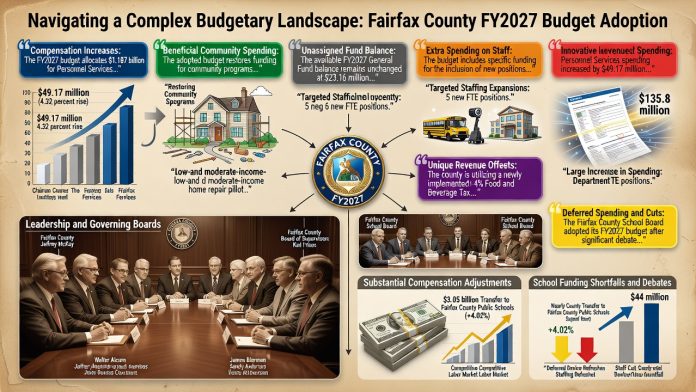
A major component of the fiscal year 2027 budget is the allocation of over $1.187 billion for Personnel Services across multiple critical county departments. This funding supports a two percent cost of living adjustment, routine merit increases, and additional compensation adjustments mandated by public sector collective bargaining agreements. The personnel spending represents a net increase of more than $49.17 million, or a 4.32 percent rise, compared to the revised fiscal year 2026 budget plan. County Executive Bryan Hill justified these substantial increases by stating they will ensure the local government remains highly competitive in an increasingly tight labor market.
Targeted Staffing Expansions
Beyond broad compensation adjustments for existing employees, the budget includes specific funding to cover the full-year financial impact of recent staff expansions. Officials allocated exactly $652,092 to fund five full-time equivalent positions that were initially added during the third quarter review of the previous fiscal year. These specific administrative and operational roles are directly dedicated to supporting the county photo enforcement and school bus arm camera programs. Budget documents indicate these positions were recommended early to ensure the vital public safety enforcement programs are fully staffed at the start of the new fiscal year.
Restoring Community Programs
Despite the heavy financial focus on personnel costs, the adopted budget also restores targeted funding for several beneficial community programs that previously faced potential elimination. Lawmakers successfully restored $250,000 for the low- and moderate-income home repair pilot program, which directly assists vulnerable residents with essential property maintenance. Furthermore, the budget includes a $200,000 restoration for the county part-time preschool program, ensuring continued access to early childhood education for local families. The Board of Supervisors stated these critical restorations were made directly in response to community input and with a strict focus on aligning resources with actual utilization rates.
Addressing the Funding Gap
These municipal spending decisions occurred against the backdrop of a significant financial hurdle, as the county originally projected a combined net budgetary shortfall of $131.5 million for the fiscal year. In early budget forecasts drafted in December, County Executive Bryan Hill noted that while county revenues were estimated to increase by $225.5 million, the structural funding gap remained incredibly substantial. Despite grappling with this massive shortfall throughout the planning process, the available fiscal year 2027 General Fund balance remains completely unchanged at $23.16 million. Lawmakers were ultimately forced to find unique revenue solutions and implement strategic cuts to close the gap without depleting emergency reserves.
Innovative Revenue Offsets
To help balance the budget and offset homeowner tax burdens, the county is heavily utilizing revenues from a newly implemented four percent food and beverage tax. This specific meals tax, which took effect on the first day of 2026, is expected to generate an impressive $135.8 million during its first full fiscal year of collection. Board Chairman Jeffrey McKay credited this alternative revenue stream for making a quarter-cent real estate tax rate cut mathematically possible for property owners. Lawmakers noted the meals tax has successfully begun to deliver on its intended purpose of diversifying the municipal revenue base and lessening reliance on residential real estate taxes.
School Funding Shortfalls and Debates
Even with the new meals tax revenue, the budget process featured significant debate regarding deferred spending and financial cuts to the local public school system. The adopted budget transfers $3.05 billion to Fairfax County Public Schools, which represents a 4.02 percent increase over the previous year but still falls nearly $44 million short of the school system request. Supervisor Walter Alcorn voted against the budget markup, arguing that cuts to vulnerable community programs did not justify a tax reduction, especially with a $44 million funding gap for the schools. Consequently, the school board was forced to adopt its own budget after intense internal deliberations regarding cuts to staffing reserves and deferred technology device refreshes.