
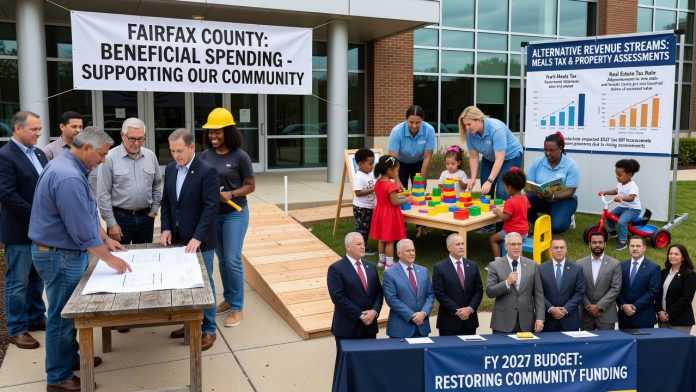
The Fairfax County Board of Supervisors recently finalized key elements of the fiscal year 2027 budget, focusing heavily on community support by restoring funding for vulnerable populations. Following significant public input, local officials decided to partially reinstate financial backing for both the low- and moderate-income home repair pilot program and part-time preschool services. These targeted budget adjustments aim to maintain essential community services while ensuring the local government operates within a more efficient financial footprint. The final decision highlights the ongoing challenge of balancing countywide fiscal responsibility with the pressing everyday needs of local residents.
The current Fairfax County Board of Supervisors consists of Chairman Jeffrey McKay, James Walkinshaw, Walter Alcorn, and James Bierman. They are joined on the governing body by district representatives Rodney Lusk, Andres Jimenez, Daniel Storck, Dalia Palchik, Patrick Herrity, and Kathy Smith. Together, these local leaders debated various agency reductions for months before ultimately agreeing to protect these specific community development and educational initiatives. The approved fiscal blueprint represents the fourth consecutive year of agency reductions, bringing total cuts over that extensive period to nearly one hundred twenty-four million dollars.
Supporting Housing and Homeownership
One of the primary beneficiaries of the restored funding is the low- and moderate-income home repair pilot program, which was initially facing complete elimination during early budget drafts. The board successfully restored two hundred fifty thousand dollars to the initiative, directly offsetting a previously proposed cut of three hundred fifty thousand dollars. This vital program, managed in part through the Department of Housing and Community Development and utilizing Community Development Block Grant funds, was only in its first year of implementation. County documents explicitly warned that eliminating the pilot removes essential support for vulnerable households, potentially undermining their ability to maintain and preserve homeownership.
Maintaining affordable housing and supporting existing homeowners remains a critical priority for the local government as regional living costs continue to rise exponentially. By partially restoring the budget, the county ensures that residents who lack the financial means to make necessary structural repairs can still access municipal assistance when emergencies arise. The Board of Supervisors stated that in response to community input and with a focus on aligning resources with actual utilization, they are partially restoring funding to benefit residents. They further noted that these targeted restorations will allow these programs to continue in a right-sized form while still operating within a more efficient footprint.
Preserving Early Childhood Education
In addition to housing support, the board prioritized early childhood education by preserving the highly utilized part-time preschool program. Supervisors restored two hundred thousand dollars to the educational service, successfully mitigating a proposed reduction of three hundred thousand dollars. This vital academic program currently provides educational capacity for one hundred fifty children distributed evenly across thirteen classrooms within the county. Advocates for the program consistently emphasized during public hearings that early childhood education is crucial for long-term academic success and provides necessary daily support for working families.
The partial restoration of preschool funds ensures that dozens of young learners will not suddenly lose access to foundational educational environments. According to statements from the board, overwhelming community input played a major role in the final decision to right-size the program rather than eliminate it entirely. Operating within this adjusted framework allows the county to maintain high educational standards without overextending the heavily constrained fiscal year budget. Families relying on these part-time classrooms can now plan for the upcoming academic year with much greater certainty regarding available local resources.
Revenue Streams and Tax Implications
To facilitate these vital community investments, local officials relied heavily on alternative revenue streams to generate the necessary budget flexibility. Board Chairman Jeffrey McKay explicitly noted that people are suffering right now due to the current economic climate. He subsequently credited the newly implemented four percent meals tax as the primary alternative revenue stream that provided the financial leeway to restore these specific programs. Concurrently, the board approved a real estate tax rate reduction of a quarter cent, bringing the rate from its previous level down to one dollar and twelve cents per one hundred dollars of assessed value. Despite this fractional decrease in the overall rate, the average homeowner will still see their tax bill increase by approximately three hundred thirty-seven dollars due to a nearly four percent jump in local property assessments.
The fiscal year 2027 budget ultimately reflects a highly complex balancing act between providing broad tax relief and funding essential county services. By salvaging the home repair pilot and the part-time preschool program, Fairfax County leaders have demonstrated a clear commitment to supporting their most vulnerable local populations. As the new fiscal year approaches, government agencies will be heavily tasked with implementing these right-sized programs efficiently to maximize the impact of the restored funds. Residents and local advocates will likely continue to closely monitor the long-term outcomes of these initiatives to ensure they meet the continually evolving needs of the community.
Email Fairfax County Supervisors At:
Jeff McKay – chairman@fairfaxcounty.gov,
Kathy Smith (Sully District) sully@fairfaxcounty.gov,
Rachna Heizer (Braddock District) braddock@fairfaxcounty.gov,
James Bierman (Dranesville District) dranesville@fairfaxcounty.gov,
Rodney Lusk (Franconia District) franconia@fairfaxcounty.gov,
Walter Alcorn (Hunter Mill District) huntermill@fairfaxcounty.gov,
Andres Jimenez (Mason District) mason@fairfaxcounty.gov,
Daniel Storck (Mount Vernon District) mtvernon@fairfaxcounty.gov,
Dalia Palchik (Providence District) providence@fairfaxcounty.gov,
Pat Herrity (Springfield District) springfield@fairfaxcounty.gov,