
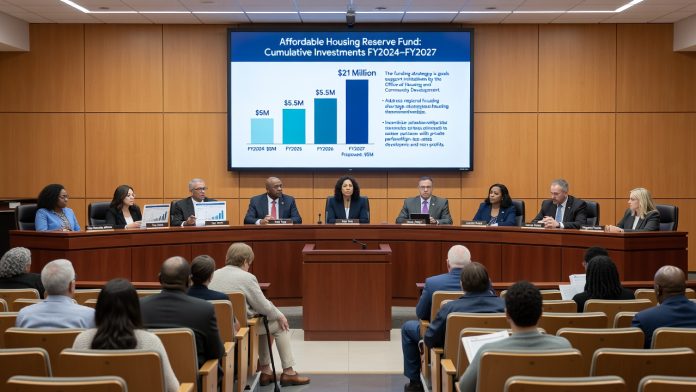
Prince William County officials have proposed a $5 million contribution to the Affordable Housing reserve fund as a central component of the upcoming fiscal year 2027 budget. This latest financial commitment brings the total local investment in the housing reserve to a significant $21 million over the period spanning from fiscal year 2024 to fiscal year 2027. The funding strategy aims to support the ongoing implementation of affordable housing initiatives managed by the Office of Housing and Community Development. Local leaders emphasize that this funding represents a continued, deliberate effort to address the growing demand for accessible residential options within the rapidly expanding community.
The Prince William County Board of County Supervisors is directly responsible for reviewing, amending, and ultimately authorizing these critical budgetary appropriations. The current board consists of Chair Deshandra Jefferson, Tom Smith, Yesli Vega, Bob Weir, Victor Angry, Kenny Boddye, Andrea Bailey, and Margaret Franklin. According to the official budget introduction, specific housing projects funded by this reserve are yet to be determined and will require formal authorization from these board members before any capital is deployed. This stringent oversight mechanism ensures that the multi-million dollar investments remain closely aligned with the long-term strategic planning goals of the county government.
Establishing and maintaining a dedicated reserve fund allows local governments to accumulate capital for large-scale housing projects that might otherwise be impossible to finance in a single fiscal year. By setting aside millions of dollars annually, Prince William County creates a reliable financial foundation that can be used to incentivize private developers or preserve existing affordable units. The steady accumulation of these funds provides the municipality with the necessary agility to respond to unexpected real estate opportunities or shifting market conditions. Furthermore, having a robust reserve fund often makes local governments more competitive when applying for supplementary state and federal housing grants.
Strategic Budgetary Goals
In her budget transmittal letter, Chair Deshandra Jefferson described the fiscal year 2027 financial plan as a responsible and balanced approach that effectively meets the needs of a growing community. She noted that the proposed budget adheres to sound fiscal policies while simultaneously making necessary investments in schools, public safety personnel, parks, economic development, and affordable housing. Jefferson stated that providing these essential services for vulnerable residents allows Prince William County to enhance its overall quality of life while improving service delivery to the community. The integration of housing funds alongside other community investments reflects a comprehensive legislative strategy to maintain economic stability within the region.
Multi-Year Funding Strategy
The recent $5 million allocation continues a sustained, multi-year funding strategy that systematically builds upon previous financial commitments to the regional housing sector. Earlier budget cycles saw similar substantial investments, including an initial $5 million appropriation in fiscal year 2024 and a subsequent $5.5 million allocation in fiscal year 2025. Occoquan District Supervisor Kenny Boddye expressed his strong support for the continued funding, noting his pride in targeted community investments across housing, parks, and community development. Boddye specifically highlighted the $5 million dedicated to the Affordable Housing Reserve Fund as a critical and foundational component of the broader community development framework.
Implementation and Future Development
The Prince William County Office of Housing and Community Development will play a central and guiding role in determining how these accumulated reserve funds are eventually utilized. While the specific projects remain unannounced at this stage, the department routinely evaluates regional housing gaps to recommend the most viable and impactful development opportunities. The impressive accumulation of $21 million over four fiscal years provides the county with substantial financial leverage to partner with non-profit housing organizations and private commercial developers. Officials anticipate that these combined institutional resources will significantly expand the availability of workforce and low-income housing throughout the entire jurisdiction.
Addressing Regional Economic Pressures
As the broader Northern Virginia region continues to experience rapid population growth and rising property values, the demand for affordable living arrangements remains a pressing issue for local policymakers. Escalating rent prices and high mortgage rates have increasingly priced out essential workers, young professionals, and lower-income families from the local housing market. The steady annual contributions to the Affordable Housing reserve fund demonstrate a consistent legislative priority aimed directly at mitigating these severe regional housing shortages. By proactively funding this reserve, the county acknowledges the intrinsic link between housing affordability and long-term regional economic vitality.
Conclusion and Next Steps
Residents and community stakeholders will now look to the Board of County Supervisors for the forthcoming identification and approval of specific housing development projects. The transparent allocation of these funds will require ongoing public hearings and detailed project proposals to ensure community needs are adequately met. As the fiscal year 2027 budget moves toward final implementation, the focus will shift from accumulating capital to executing tangible construction and preservation initiatives. Ultimately, the successful deployment of this $21 million investment will serve as a key metric for evaluating the county’s progress in fostering an inclusive and economically diverse community.
Email the Board of Supervisors At:
Chair At-Large (Deshundra Jefferson) – djefferson@pwcgov.org,
Brentsville (Tom Gordy): tgordy@pwcgov.org,
Coles (Yesli Vega): yvega@pwcgov.org,
Occoquan (Kenny Boddye): kboddye@pwcgov.org,
Potomac (Andrea Bailey): abailey@pwcgov.org,
Woodbridge (Jeannie LaCroix): jlacroix@pwcgov.org,
General Board: bocs@pwcgov.org,