Virginia Taxpayers Face Massive Bill for New Union Bureaucracies
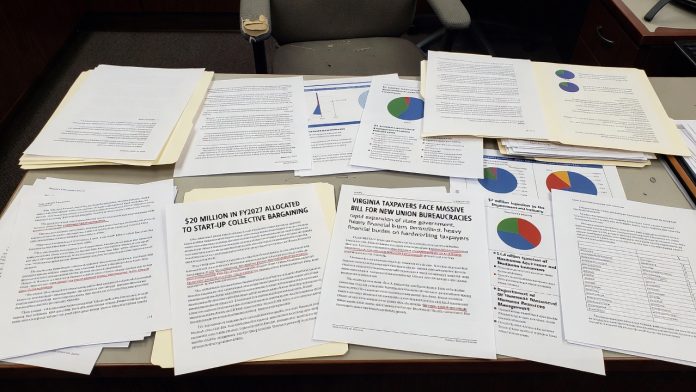
The state budget for fiscal year 2027 includes a staggering $20 million allocation designed exclusively to fund the start-up costs for public sector collective bargaining. This massive expenditure will finance the creation of entirely new government entities, including the Public Employee Relations Board and the Virginia Home Care Authority. Fiscal conservatives are raising the alarm over this rapid expansion of state government and the heavy financial burden it places on hardworking taxpayers. Lawmakers must carefully scrutinize this unprecedented spending to prevent inevitable government waste and bureaucratic bloat.
The origin of this costly initiative traces back to House Bill 1263, which advanced through the 2026 General Assembly. This legislation radically alters the traditional employment framework of the state by allowing groups of state employees and home health care workers to engage in collective bargaining. For decades, collective bargaining by public employees was explicitly prohibited in Virginia, a policy that helped maintain strict fiscal discipline. Reversing this long-standing prohibition introduces a costly new era of government operations that threatens to drain public resources.
The financial impact of these new labor mandates extends far beyond the initial start-up costs for unionization. Over the current biennium, total state investments in labor initiatives amount to an astonishing $45.6 million. This broader spending package includes expensive provisions for minimum wage increases and paid sick leave for state workers, constitutional employees, and state-funded home health care workers. Taxpayers will ultimately foot the bill for these expansive new mandates, leaving less money available for essential public services and infrastructure.
Bureaucratic Expansion and Departmental Spending
A detailed breakdown of the $20 million allocation reveals how these funds will be distributed across various state departments to facilitate union activities. The Department of Labor and Industry is slated to receive a massive $7 million injection to enforce these new labor laws. Budget documents attempt to justify this massive increase by claiming the department has been chronically underfunded in previous years. However, funneling millions into labor enforcement primarily serves to protect union interests rather than generating tangible benefits for the average taxpayer.
The newly established Virginia Home Care Authority also requires significant financial backing, drawing heavily from state healthcare budgets. Consequently, the Department of Medical Assistance Services will receive $5.5 million to manage collective bargaining for state-funded home health care workers. Creating an entirely new authority adds another complex layer of bureaucracy to an already expensive state healthcare system. Critics argue that establishing such redundant government entities rarely leads to efficiency and almost always results in bloated administrative budgets.
Additional administrative costs are spread throughout other state agencies to ensure the implementation of these collective bargaining agreements. The Department of Human Resource Management will absorb $1.6 million to handle the increased personnel complexities associated with unionized state workers. Furthermore, the Department of Planning and Budget will hold the remaining balance of approximately $5.9 million to distribute for any additional start-up costs. Such massive, vaguely defined start-up expenses represent a significant risk of overspending and lack the strict oversight required to protect public funds.
Reversing Virginia’s Competitive Economic Traditions
Virginia has historically thrived economically by maintaining a highly competitive, business-friendly environment that strictly prohibited public sector collective bargaining. The newly approved $20 million allocation represents a 100 percent increase from previous years for these specific line items, as the funding is entirely unprecedented. Abandoning these traditional conservative policies threatens the fiscal restraint that has long kept state taxes manageable for residents and businesses alike. Introducing public sector unions into state government operations fundamentally alters the balance of power and drives up the cost of governance.
The newly minted Public Employee Relations Board will play a central role in facilitating union activities among state employees. Establishing this board requires substantial overhead, including new office spaces, staffing, and administrative resources that heavily drain public coffers. Public sector unions historically push for even more government spending, creating a vicious cycle of continuous taxpayer burden and expanding budgets. Funding the very mechanisms that will demand higher future taxes is a deeply flawed approach to responsible state governance.
Similarly, the Virginia Home Care Authority represents another layer of unnecessary government bureaucracy designed to unionize independent care providers. This authority will manage the collective bargaining process for state-funded home health care workers, heavily complicating the delivery of vital services. Bureaucratic expansions of this nature inevitably divert critical funding away from actual patient care and into the pockets of union administrators. Taxpayers deserve a streamlined government that prioritizes direct services over the creation of expensive new regulatory authorities.
A Call for Fiscal Responsibility and Budget Reductions
The conservative imperative to reduce the budget and save taxpayer money must remain a top priority in light of these new expenditures. Spending $20 million simply to start up collective bargaining entities is a highly questionable use of public funds during times of economic uncertainty. Lawmakers have a moral obligation to scrutinize these appropriations and actively seek ways to eliminate wasteful spending across all state departments. Rolling back these expensive labor initiatives would represent a crucial first step toward restoring fiscal sanity in the state capital.
The vague nature of the $5.9 million allocated to the Department of Planning and Budget is particularly concerning for fiscal watchdogs. Open-ended funding categories labeled as additional start-up costs are historically ripe for government waste, fraud, and financial mismanagement. Every single taxpayer dollar must be strictly accounted for with total transparency to prevent bureaucrats from squandering public resources. Without rigorous oversight, these slush funds will undoubtedly be exhausted on frivolous administrative expenses rather than genuine public needs.
Ultimately, the massive $45.6 million total cost of the biennium labor initiatives serves as a stark warning to fiscal conservatives. The initial $20 million for union start-up costs is likely just the beginning of a long-term, structural financial drain on the state budget. Taxpayers cannot afford to bankroll the perpetual expansion of union bureaucracies and the associated administrative bloat. A swift return to conservative fiscal principles is desperately needed to protect the state budget and ensure that taxpayer money is respected and preserved.