
Virginia taxpayers are facing a massive financial commitment following the approval of a revised state budget that significantly expands government spending. Lawmakers recently finalized a spending plan that guarantees a 3.5 percent annual pay raise for state employees across the board for both fiscal years 2027 and 2028. This sweeping measure replaces a more modest initial proposal, locking the Commonwealth into hundreds of millions of dollars in recurring financial obligations. Fiscal conservatives are raising the alarm over this permanent inflation of the state bureaucracy’s baseline budget at the expense of hardworking citizens.
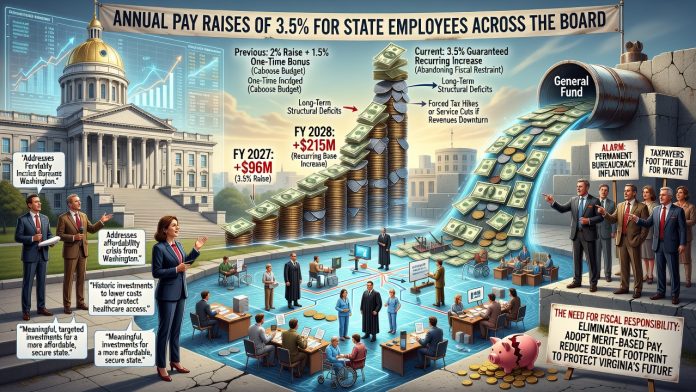
The monetary impact of this legislative decision represents a steep increase in taxpayer-funded expenditures. Originally, the introduced fiscal year 2027 budget proposed a sensible two percent salary increase for public workers. However, lawmakers amended the budget to push the raise up to 3.5 percent, demanding an additional $96 million from the General Fund for the first year alone. By fiscal year 2028, the cost of this recurring base pay increase will balloon to an astonishing $215 million from the General Fund.
Expanding Government Bureaucracy
The broad scope of these mandated wage hikes extends far beyond standard administrative staff working in Richmond. The pay increases will universally affect state employees, state-supported local employees, constitutional officers, home healthcare workers, and adjunct faculty members. Furthermore, the budget includes an additional $47.7 million investment specifically earmarked to raise wages for these various government-aligned sectors. Distributing taxpayer funds across such a wide array of departments guarantees a massive, permanent expansion of the state payroll without requiring any corresponding cuts or efficiency improvements.
This new fiscal strategy marks a troubling departure from more cautious compensation methods utilized in the recent past. During the previous fiscal year, the caboose budget provided state employees with a two percent raise alongside a 1.5 percent one-time bonus. Utilizing one-time bonuses allows the state to reward employees during times of inflation without permanently inflating the baseline pension and salary obligations. By shifting to a guaranteed 3.5 percent recurring base pay increase, the current administration is abandoning fiscal restraint and risking long-term structural deficits.
Democratic Leaders Defend Historic Spending
Proponents of the newly minted budget are defending the massive spending increases as necessary measures to combat current economic difficulties. Governor Abigail Spanberger praised the agreement, stating it addresses the affordability crisis created by reckless policies out of Washington. Senate Finance Appropriations Chair Louise Lucas and House Appropriations Chair Luke Torian echoed this sentiment, declaring the conference report makes historic investments to lower costs and protect access to healthcare. The Virginia House Democratic Caucus also released a public statement arguing that the budget delivers meaningful, targeted investments to make the state more affordable and secure.
Despite these optimistic declarations from Democratic leaders, conservative watchdogs argue that aggressively expanding the state payroll does nothing to make life more affordable for private-sector taxpayers. Across-the-board pay raises inherently fail to distinguish between high-performing employees and those who merely meet minimum expectations, which inevitably leads to institutional waste. Rewarding the entire bureaucracy with identical percentage increases removes the incentive for excellence and ignores the pressing need to streamline government operations. Taxpayers are ultimately left footing the bill for a bloated public sector that refuses to implement the same rigorous cost-saving measures required of private businesses.
The Need for Fiscal Responsibility
The newly approved salary adjustments are officially scheduled to take effect on July 25, 2026, giving the state a brief window before the heaviest financial burdens materialize. As the implementation date approaches, fiscal conservatives are urging lawmakers to reconsider the long-term sustainability of such sweeping financial commitments. If state revenues experience a sudden downturn, these locked-in baseline salary increases will force the government to either raise taxes or drastically slash essential public services. Responsible governance requires prioritizing the financial security of the taxpayers who fund the government rather than continuously expanding the generous compensation packages of public officials.
Protecting the economic future of Virginia demands a renewed focus on eliminating government waste and curbing unnecessary public expenditures. Lawmakers must shift away from indiscriminate, across-the-board spending mandates and adopt merit-based compensation structures that respect the taxpayer’s hard-earned money. Reducing the overall budget footprint is the absolute most reliable method to ensure long-term prosperity and prevent future tax hikes on hardworking families. Until Richmond prioritizes genuine fiscal discipline, the residents of the Commonwealth will remain burdened by an ever-expanding and increasingly expensive state government apparatus.