
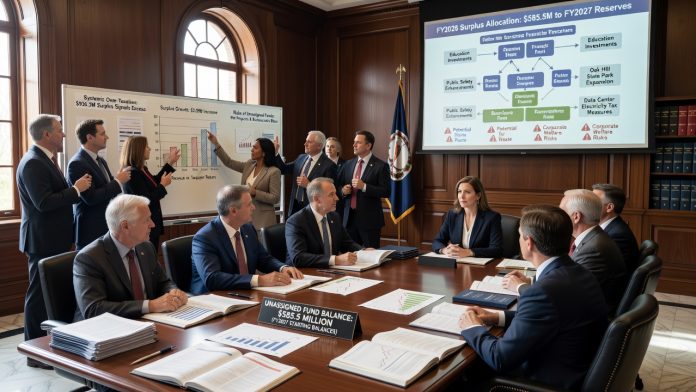
The state of Virginia recently announced a staggering $936.3 million general fund surplus for Fiscal Year 2026, driven by an aggressive 6.7 percent growth in state revenues. This massive influx represents a $2.09 billion increase over the previous fiscal year, highlighting just how heavily state government is taxing its citizens. Instead of returning these over-collected funds directly to the hardworking taxpayers, officials plan to incorporate $585.5 million of this surplus into the Fiscal Year 2027 starting balances. This maneuver functions as an unassigned fund balance, which essentially parks hundreds of millions of taxpayer dollars in government coffers rather than private bank accounts.
Governor Abigail Spanberger has framed this decision as a commitment to fiscal responsibility and long-term economic positioning. The administration claims that banking the $585.5 million rather than spending it down immediately reflects a prudent approach to state finances. However, conservative watchdogs point out that a surplus of this magnitude is not a victory of government efficiency, but rather a clear sign of systemic over-taxation. When the state collects nearly a billion dollars more than it needs to operate, the moral and fiscally responsible action is to issue tax rebates or permanently lower tax rates.
The Danger of Unassigned Fund Balances
Placing $585.5 million into an unassigned fund balance for Fiscal Year 2027 carries significant risks for government bloat and potential waste. Unassigned funds frequently become irresistible targets for lawmakers seeking to fund pet projects, expand bureaucratic programs, or satisfy special interest groups. Without strict statutory limitations on how these rollover funds can be utilized, taxpayers remain vulnerable to future spending sprees that permanently inflate the baseline budget. Fiscal conservatives strongly advocate for tying these reserves to mandatory tax relief mechanisms to prevent the money from being quietly absorbed into the ever-growing state apparatus.
Scrutinizing Proposed Spending Initiatives
The remaining portions of the surplus and the broader budget are slated for investments in education, public safety, and economic development. While maintaining robust public safety remains a core function of government, conservatives consistently warn that increased education and economic development spending often fails to yield measurable results. Pumping more money into the state education bureaucracy rarely equates to better classroom outcomes unless it is paired with structural reforms and school choice initiatives. Furthermore, state-led economic development programs frequently devolve into corporate welfare, picking winners and losers in the free market using taxpayer dollars.
The administration has also highlighted specific initiatives involving Oak Hill State Park and new data center electricity tax measures. Expanding state parks requires careful scrutiny, as acquiring and maintaining new public lands creates perpetual financial obligations for the state maintenance budget. Meanwhile, the data center electricity tax initiatives must be closely monitored to ensure they do not stifle one of Virginia’s most critical free-market industries through excessive regulation or hidden fees. Lawmakers must guarantee that these tax initiatives are designed to foster business growth rather than serving as a backdoor mechanism to extract even more revenue from private enterprises.
A Path Toward Genuine Fiscal Responsibility
True fiscal conservatism requires more than simply saving excess cash; it demands an aggressive posture against waste, fraud, and overspending across all state agencies. The massive $2.09 billion surge in revenue should trigger comprehensive audits of existing state programs to identify inefficiencies before a single new dollar is appropriated by the legislature. Every unspent dollar parked in the Fiscal Year 2027 reserve represents capital that private citizens could have used to invest in their families, small businesses, and local communities. A bloated government treasury ultimately deprives the private sector of the resources necessary for organic, sustainable economic growth, proving that excessive taxation harms the overall economy.
Moving forward, Virginia lawmakers face a critical choice regarding the management of the $585.5 million unassigned fund balance. They can either allow these funds to become a slush fund for future bureaucratic expansion, or they can champion legislation that returns this money to the taxpayers. Protecting the financial liberty of Virginia residents means recognizing that surplus revenues belong to the people, not the government. Committing to permanent tax reductions and rigorous spending caps is the only proven method to secure long-term prosperity and rein in the endless appetite of state government.