
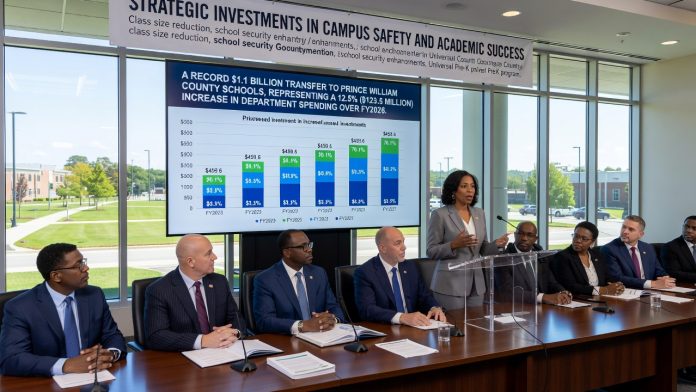
The Prince William County government has officially advanced a record-breaking $1.1 billion funding transfer to the local public school system for the upcoming fiscal year. This unprecedented financial commitment represents a 12.5 percent increase in department spending, adding $123.5 million over the previous year’s adopted budget. The massive allocation is driven by a longstanding revenue-sharing agreement that dedicates 57.23 percent of projected county revenues directly to educational services. Local officials noted that this funding level marks the largest single-year dollar increase ever directed toward the school division.
The historic budget measure was reviewed and advanced by the current Prince William County Board of Supervisors, which includes Chair Deshundra Jefferson alongside district representatives Tom Smith, Yesli Vega, Bob Weir, Victor Angry, Kenny Boddye, Andrea Bailey, and Margaret Franklin. These elected leaders have faced the ongoing challenge of balancing broad municipal needs with the escalating costs of operating one of the largest school divisions in Virginia. During the past five years, the board has overseen a continuous upward trajectory in education investments, reflecting the growing population and evolving needs of the region. This sustained financial strategy highlights the local government’s commitment to prioritizing educational infrastructure and student resources.
STRATEGIC INVESTMENTS IN CAMPUS SAFETY AND ACADEMIC SUCCESS
County leadership has clearly outlined its primary spending priorities for the upcoming academic year through detailed budget transmittal documents. These targeted financial goals focus heavily on immediate student success, long-term campus safety, and the retention of highly qualified instructional staff.
A substantial portion of the newly approved $1.1 billion transfer will be directed toward several key operational and capital improvement initiatives across the school district. According to the official budget message, education remains a top priority, with the historic funding increase designed to ensure a successful future for local children. Specific allocations within the budget will fund comprehensive class size reduction initiatives aimed at improving the student-to-teacher ratio in crowded facilities. Additionally, the capital will support critical school security enhancements and cover the ongoing debt service requirements for the recently constructed Gainesville High School.
Occoquan District Supervisor Kenny Boddye emphasized that the adjustments made during the budget markup process were essential for reaching this historic funding milestone. He publicly stated that the $1.1 billion transfer will help maintain the school division’s impressive 95 percent graduation rate while funding much-needed teacher pay raises. Furthermore, the financial injection is expected to help the county make significant strides toward implementing a comprehensive Universal Pre-K program for local families. These targeted investments are widely viewed by county administrators as necessary steps to remain competitive in recruiting educators throughout Northern Virginia.
ANALYZING THE UNPRECEDENTED FIVE-YEAR FINANCIAL GROWTH TREND
The latest budget documents reveal a staggering accumulation of educational funding over recent fiscal cycles driven by the local revenue-sharing agreement. Budget analysts note that this formulaic approach provides the school division with a predictable, albeit aggressively growing, revenue stream to plan long-term strategic initiatives.
When examining the broader historical context, the Fiscal Year 2027 transfer represents the culmination of a massive half-decade surge in local education spending. Between Fiscal Year 2023 and Fiscal Year 2027, the increased financial investment in Prince William County Public Schools has totaled an astonishing $459.6 million. This multi-year accumulation translates to a 70.1 percent growth rate in local education funding over just a five-year period. Financial experts and municipal planners often point to this steep trajectory as a reflection of both inflationary pressures and a deliberate policy shift toward expanding comprehensive student services.
IMPLEMENTATION STRATEGIES AND THE FUTURE ECONOMIC OUTLOOK
As the school division prepares to integrate this $1.1 billion transfer, administrators face the complex task of executing the promised educational enhancements efficiently. County residents and educational advocates will closely monitor these rollouts to ensure the historic funding translates into measurable academic improvements across all grade levels.
The planned teacher pay raises are expected to take effect at the start of the new academic year, providing immediate financial relief to instructional staff. Meanwhile, the expansion of Universal Pre-K will require careful logistical planning, including the acquisition of suitable classroom spaces and specialized early childhood educators. The successful execution of this budget will ultimately test the sustainability of the current revenue-sharing model as Prince William County continues to grow and diversify. For now, the local government has decisively signaled its intent to spare no expense in elevating the quality of its public education system, setting a critical benchmark for future community investments.
Email the Board of Supervisors At:
Chair At-Large (Deshundra Jefferson) – djefferson@pwcgov.org,
Brentsville (Tom Gordy): tgordy@pwcgov.org,
Coles (Yesli Vega): yvega@pwcgov.org,
Occoquan (Kenny Boddye): kboddye@pwcgov.org,
Potomac (Andrea Bailey): abailey@pwcgov.org,
Woodbridge (Jeannie LaCroix): jlacroix@pwcgov.org,
General Board: bocs@pwcgov.org,