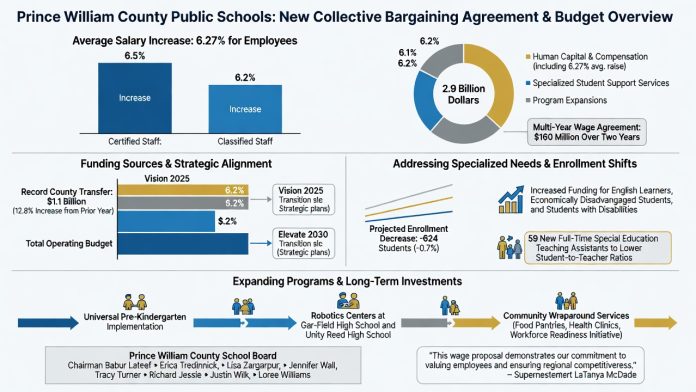
Prince William County Public Schools employees are set to receive an average salary increase of 6.27 percent following the implementation of a new collective bargaining agreement. The compensation adjustment is a central component of the newly proposed 2.9 billion dollar budget for the upcoming fiscal year. This financial plan aims to maintain the school division’s regional competitiveness while addressing ongoing staffing and retention challenges. The comprehensive spending package emphasizes significant investments in both human capital and specialized student support services across the district.
The compensation package includes specific negotiated adjustments for various employee groups within the school system. Certified staff members will see a salary increase of 6.5 percent, while classified staff will receive a raise of 6.2 percent. Superintendent LaTanya McDade stated that the wage proposal demonstrates a commitment to ensuring employees feel valued and are compensated competitively within the region. These raises represent a broader multi-year wage agreement totaling 160 million dollars spanning two years.
Historic Budget and County Transfers
Funding for these salary adjustments stems from a record-setting county transfer to the local public school system. The upcoming budget features a transfer of 1.1 billion dollars from the county government, marking a 12.8 percent increase from the previous fiscal year. This massive financial injection supports a total operating budget of 2.9 billion dollars for the school division. The increased funding allocation is designed to bridge the transition from the previous Vision 2025 strategic plan to the newly adopted framework known as Elevate 2030.
The financial strategies and educational priorities are overseen by the Prince William County School Board. The current board consists of Chairman Babur Lateef, Erica Tredinnick, Lisa Zargarpur, Jennifer Wall, Tracy Turner, Richard Jessie, Justin Wilk, and Loree Williams. These elected officials are responsible for balancing the expansive budget against the evolving needs of the diverse student population. Their oversight ensures that the historic funding levels align with the long-term strategic goals established for the county’s educational facilities.
Addressing Specialized Student Needs
Despite a slight projected decrease in overall student enrollment, the district is increasing its financial commitment to specialized educational support. Enrollment is expected to drop by 624 students, representing a 0.7 percent decrease from the previous year. However, demographic shifts have led to a growing need for resources dedicated to English learners, economically disadvantaged students, and students with disabilities. The budget specifically allocates new funds to ensure these vulnerable populations receive adequate attention and educational resources.
Special education services will see a direct benefit from the increased budget allocations this year. The spending plan includes funding for 59 new full-time teaching assistants dedicated to supporting special education classrooms. Board Chairman Babur Lateef noted that the budget begins funding the strategic plan by continuing to provide crucial supports in the classroom for both students and teachers. This staffing increase is expected to lower student-to-teacher ratios in specialized learning environments across the county.
Expanding Educational Programs and Services
Beyond staff compensation and special education, the budget directs substantial capital toward expanding early childhood education and advanced technology programs. A primary focus of the new strategic plan is the implementation of universal pre-kindergarten to better prepare young learners for their academic careers. Additionally, the district is funding the creation of specialized robotics centers at Gar-Field High School and Unity Reed High School. These program expansions are intended to foster early cognitive development and provide high school students with advanced technical skills.
The school division is also investing heavily in community-focused wraparound services to support families outside of traditional classroom instruction. New funding will establish a student and family workforce readiness initiative aimed at improving post-secondary outcomes. Furthermore, the district plans to expand school-based food pantries and health clinics to address the fundamental physical needs of the student body. These holistic support structures are designed to remove external barriers to education and ensure students arrive at school ready to learn.
Long-Term Strategic Commitment
The comprehensive budget and the accompanying collective bargaining agreement represent a significant shift in how the district manages employee relations. The agreement with the Prince William Education Association formalizes the negotiation process for certified and classified staff. Investing 160 million dollars over the next two years for teacher and support staff raises is viewed as a testament to the district’s commitment to its educators. This structured approach to compensation is expected to provide greater financial stability for thousands of public school employees.
Ultimately, the multifaceted budget aims to secure the future of public education in Prince William County through targeted investments. By prioritizing competitive compensation, the district hopes to attract and retain top-tier educational talent in a highly competitive regional market. The combination of staff raises, expanded early childhood education, and enhanced family support services creates a comprehensive blueprint for the coming years. Administrators and board members anticipate that these historic financial commitments will yield measurable improvements in student achievement and overall division performance.
Email the School Board at:
Babur B. Lateef, M.D. (Chairman At-Large) blateef@pwcs.edu,
Richard M. Jessie (Vice Chairman, Occoquan District) rjessie@pwcs.edu,
Erica C. Tredinnick (Brentsville District) etredinnick@pwcs.edu,
Lisa A. Zargarpur (Coles District) lzargarpur@pwcs.edu,
Jennifer T. Wall (Gainesville District) jwall@pwcs.edu,
Tracy L. Blake (Neabsco District) tblake@pwcs.edu,
Justin David Wilk (Potomac District) jwilk@pwcs.edu,
Loree Y. Williams (Woodbridge District) lwilliams@pwcs.edu,