
The educational landscape in Prince William County, Virginia, is experiencing a significant shift in funding priorities as district leaders finalize a comprehensive financial plan. With a proposed school budget reaching nearly three billion dollars, administrators are emphasizing specialized academic programs and diverse athletic opportunities over traditional infrastructure expansion. This strategic pivot highlights a growing trend in public education where targeted investments are prioritized to meet evolving student interests and demographic realities.
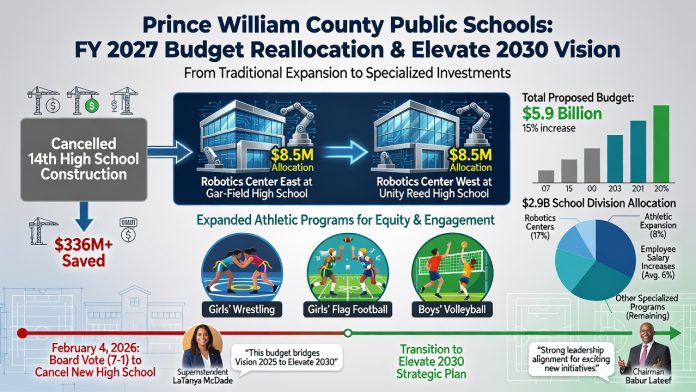
The current Prince William County School Board includes Chairman Babur Lateef, Adele Jackson, Lisa Zargarpur, Jennifer Wall, Diane Raulston, Richard Jessie, Justin Wilk, and Loree Williams. These elected officials are tasked with navigating complex financial decisions during a period of fluctuating enrollment and economic challenges. Superintendent LaTanya McDade recently emphasized that the proposed Fiscal Year 2027 budget represents a pivotal moment for the entire school division. She explained that this financial framework serves as the crucial bridge transitioning the district from the expiring Vision 2025 strategic plan to the newly developed Elevate 2030 initiative.
Reallocating Funds from Traditional Construction
A defining moment for this new financial direction occurred during a board meeting on February 4, 2026, when officials made a substantial change to the capital improvement program. The board voted decisively, with a seven to one margin, to officially cancel the planned construction of a fourteenth high school within the county. This major decision was driven by anticipated division-wide enrollment declines linked to regional out-migration and steadily decreasing birth rates. Furthermore, escalating construction costs that were projected to exceed three hundred thirty-six million dollars made the traditional expansion financially unfeasible for the district.
By halting the massive high school construction project, district administrators successfully freed up significant capital to redirect toward highly specialized educational facilities. A major beneficiary of this reallocation is the creation of two state-of-the-art robotics centers designed to enhance technology and engineering education. The budget explicitly dedicates eight and a half million dollars to fund the Robotics Center East Project located at Gar-Field High School. Simultaneously, an identical allocation of eight and a half million dollars will finance the Robotics Center West Project at Unity Reed High School, ensuring equitable access to advanced technological training across different geographic regions of the county.
Pioneering New Athletic Programs
Beyond the significant investments in science and technology infrastructure, the budget also introduces unusual and unique educational spending directed at high school athletics. The district is actively expanding its sports offerings to include officially sanctioned programs for girls’ wrestling, girls’ flag football, and boys’ volleyball. Funding these specific sports reflects a broader movement toward increasing athletic equity and providing diverse extracurricular options that appeal to a wider range of the student body. These additions to the athletic department are expected to foster increased student engagement and promote physical wellness among demographics that may not have participated in legacy sports programs.
Comprehensive Financial Overview and Employee Compensation
The localized school funding is part of a much larger economic package encompassing the entire municipal government structure. The total proposed budget for both the county government and the public school system stands at an unprecedented five billion nine hundred million dollars. This massive financial package represents a notable fifteen percent increase over the previous fiscal year’s approved budget. Within the specific two billion nine hundred million dollar allocation for the school division, administrators have prioritized human capital by including a substantial average employee salary increase of over six percent to remain competitive in the regional labor market.
School Board Chairman Babur Lateef has publicly voiced strong approval for the collaborative efforts that shaped this complex financial document. He expressed deep appreciation for all the extensive work that the district staff and the superintendent dedicated to formulating this year’s budget. Lateef noted that the district has several very exciting new initiatives lined up in the strategic plan, and he is enthusiastic that this budget will begin the active funding of those goals. He concluded his remarks by stating his full support for the budget, signaling strong leadership alignment behind the new strategic direction.
Looking Toward the Elevate 2030 Vision
The comprehensive Fiscal Year 2027 to 2031 Capital Improvement Program ultimately reflects a modernized approach to managing public education resources. By choosing to invest heavily in specialized facilities like the new robotics centers rather than pursuing costly traditional building projects, Prince William County is adapting to its changing demographic realities. The simultaneous expansion of inclusive athletic programs further demonstrates a commitment to holistic student development under the Elevate 2030 framework. As these financial plans move toward final implementation, the district appears firmly positioned to navigate future educational challenges with a highly targeted and adaptable resource allocation strategy.