
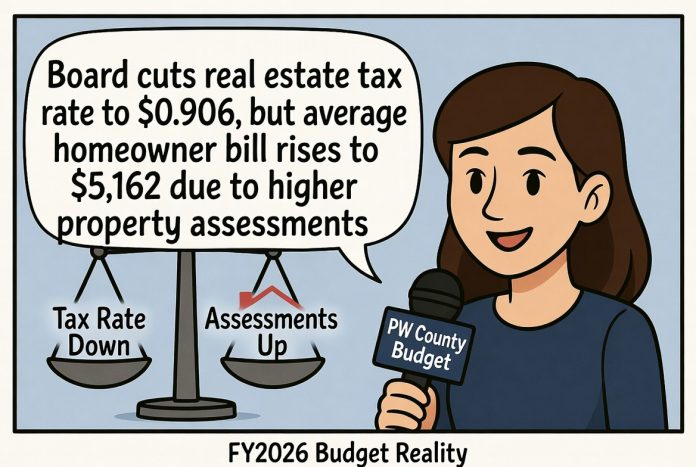
The Prince William County Board of County Supervisors approved its Fiscal Year 2026 budget on April 22, 2025, including a reduction in the real estate tax rate designed to partially offset rising property assessments. Despite the rate cut, most homeowners will pay more in property taxes this year due to strong growth in home values across the county.
The adopted real estate tax rate for FY2026 is $0.906 per $100 of assessed value, down from $0.920 the previous year. According to county budget documents, this results in an average residential tax bill of $5,162, representing an increase of $273, or about 5.6%, compared to FY2025.
The increase stems from higher property assessments reflecting continued appreciation in the local housing market. During calendar year 2024, residential properties in Prince William County saw notable value growth, consistent with broader trends in the Washington metropolitan region. County officials noted that the rate reduction helps mitigate what would have been an even larger jump in tax bills.
The FY2026 budget maintains overall fiscal balance while supporting key priorities. The General Fund totals approximately $1.98 billion, with general revenues projected to increase by about 8.8% over the prior year. A significant portion of funding goes toward education, with a record transfer approaching $992 million to Prince William County Schools.
Other notable tax adjustments in the budget include:
- The first reduction in the personal property tax rate on vehicles since 1990 (from $3.70 to $3.50 per $100).
- An increase in the business personal property tax rate on computer equipment and peripherals to $4.15 per $100, expected to generate additional revenue primarily from data center operations.
- A planned reduction in the meals tax rate from 4% to 3%, effective January 1, 2026.
Board Chair Deshundra Jefferson and other supervisors described the budget as striking a balance between providing services for a growing population and exercising fiscal responsibility. The county continues to follow its Principles of Sound Financial Management, including limits on debt service and investments in the Capital Improvement Program for schools, public safety facilities, and transportation projects.
Rising property values present both opportunities and challenges for local governments. Higher assessments increase the tax base without rate hikes, allowing funding for schools, emergency services, parks, and infrastructure. However, they also create affordability pressures for long-time residents, particularly seniors and moderate-income families.
Public reaction to the budget has been mixed. Some residents appreciate the rate reduction and new investments, while others express frustration that their tax bills continue to rise despite the adjustment. County staff have made tools available online to help homeowners estimate their individual tax bills based on current assessments.
This situation is not unique to Prince William County. Many jurisdictions in Northern Virginia and across the country face similar dynamics: strong economic growth driving up property values while local governments manage increasing demands for services from population growth.
The budget also includes funding for public safety enhancements, mental health services, affordable housing initiatives, and environmental programs. Officials emphasize that these investments support the county’s strategic goals of maintaining quality of life amid rapid development.
As FY2026 begins on July 1, 2025, county leaders will monitor revenue collections and economic conditions closely. Future budgets may face decisions about whether to continue adjusting tax rates in response to assessment trends or pursue other revenue and spending strategies.
Homeowners with questions about their assessments or tax bills are encouraged to contact the Prince William County Department of Finance. The full FY2026 Adopted Budget is available on the county’s website for public review.
This outcome illustrates the complex relationship between property values, tax policy, and local government funding in one of Virginia’s fastest-growing counties.
Email At:
Chair At-Large (Deshundra Jefferson) – djefferson@pwcgov.org,
Brentsville (Tom Gordy): tgordy@pwcgov.org,
Coles (Yesli Vega): yvega@pwcgov.org,
Occoquan (Kenny Boddye): kboddye@pwcgov.org,
Potomac (Andrea Bailey): abailey@pwcgov.org,
Woodbridge (Jeannie LaCroix): jlacroix@pwcgov.org,
General Board: bocs@pwcgov.org,