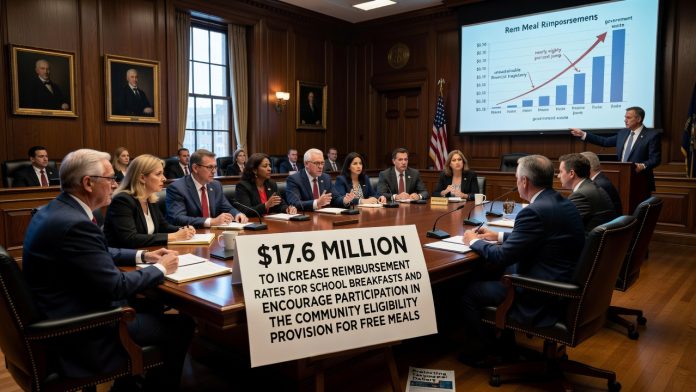
Virginia lawmakers have approved a significant spending increase in the state budget, allocating $17.6 million from the General Fund across the biennium to expand school meal programs. The funding targets the Virginia Department of Education and Direct Aid to Public Education to increase reimbursement rates for school breakfasts. However, a primary goal of this multimillion-dollar expenditure is to push more school divisions into the federal Community Eligibility Provision, which provides universal free meals to all students regardless of their family income. Fiscal conservatives are raising alarms over this broad expansion of government subsidies, arguing that taxpayer funds should be strictly targeted toward children who genuinely need financial assistance.
The newly passed compromise budget proposal explicitly outlines a massive jump in the state reimbursement rate for school breakfasts. Previously, the state reimbursed schools at a rate of $0.28 per meal, but this new allocation hikes that figure to $0.50 per meal. This represents a direct $0.22 per meal increase, which equates to a nearly eighty percent jump over the previous biennium base reimbursement rate. Critics of the budget argue that such steep, sudden increases in reimbursement rates create an unsustainable financial trajectory for Virginia taxpayers.
PUSHING UNIVERSAL ENTITLEMENTS OVER TARGETED AID
The push toward universal free school meals represents a significant philosophical shift regarding the fundamental responsibilities of the family versus the role of the government. Historically, providing daily nutrition has been the basic duty of parents, with state assistance stepping in only as a vital safety net for those facing genuine economic hardship. By allocating millions to ensure every child receives free meals regardless of household income, the state risks fostering an unhealthy reliance on public institutions. Conservative analysts argue that this erosion of personal responsibility subtly expands the welfare state and conditions citizens to look to the government for their most basic daily needs.
The Community Eligibility Provision is a federal program that allows qualifying schools to serve free breakfast and lunch to the entire student body without collecting individual household applications. While the program aims to reduce administrative burdens, it fundamentally shifts the burden of feeding children from parents to the state and federal government. By incentivizing schools to adopt universal free meals, the state is effectively using taxpayer dollars to subsidize breakfast for students from affluent families who can easily afford their own food. Fiscal watchdogs maintain that broad entitlement programs inevitably lead to government waste, as limited public resources are distributed to those who have no actual financial need.
BUDGET JUSTIFICATIONS AND ADMINISTRATIVE LOBBYING
The official language in the state budget notes that the $17.6 million allocation originated in the Senate to increase reimbursement rates and specifically encourage more school divisions to participate in the universal free meal provision. Education advocates aggressively lobbied for these funds during recent budget negotiations, framing the massive spending increase as an absolute necessity. Sarah Calveric, board president for the Virginia Association of School Superintendents, emphasized the critical nature of K-12 funding during the budget impasse. She stated that the urgency of passing these school meal supports simply cannot be overstated as lawmakers deliberated the final financial package.
Beyond the philosophical concerns, removing individual household income applications opens the door to potential systemic waste and a lack of proper financial oversight. When school districts are no longer required to verify the specific economic needs of the families they serve, accountability for how taxpayer funds are utilized is severely diminished. Without rigorous income verification protocols, millions of state and federal dollars can be easily misallocated toward feeding populations that possess ample resources. Fiscal watchdogs warn that eliminating these essential administrative checks removes the primary safeguard against fraud and overspending in public assistance programs.
PROTECTING THE GENERAL FUND AND TAXPAYERS
Pulling $17.6 million directly from the General Fund places an additional strain on the state budget at a time when taxpayers are already grappling with inflation and economic uncertainty. Every dollar spent on expanding universal meal entitlements is a dollar that cannot be returned to hard-working Virginians through tax relief or applied to essential infrastructure projects. Conservative policy advocates argue that government spending must be reined in to prevent creeping bureaucratic bloat within the Virginia Department of Education. They suggest that returning to a targeted approach, where meal assistance is strictly verified and provided only to low-income households, would save millions in taxpayer money.
The decision to utilize the General Fund for this massive biennium expenditure also raises serious questions about the broader prioritization of state resources. Virginia taxpayers expect their hard-earned money to be allocated toward core government functions, such as public safety, road maintenance, and foundational academic instruction. Diverting massive sums toward universal breakfast entitlements distracts from the primary educational mission of the state and unnecessarily inflates the overall budget. Lawmakers dedicated to shrinking the size of government must heavily scrutinize these peripheral spending initiatives to identify areas where immediate budget cuts can be realized.
As Virginia implements this expansive new funding structure, the long-term financial consequences of subsidizing universal meals will become a focal point for future legislative sessions. Lawmakers who champion fiscal responsibility will need to closely monitor the Community Eligibility Provision to ensure it does not spiral into an unchecked financial drain. Protecting the taxpayer requires a firm commitment to eliminating wasteful spending and ensuring that state resources are reserved exclusively for the truly vulnerable. Ultimately, rolling back these broad entitlement expansions in upcoming budgets may be necessary to restore fiscal discipline and safeguard the economic future of the Commonwealth.