
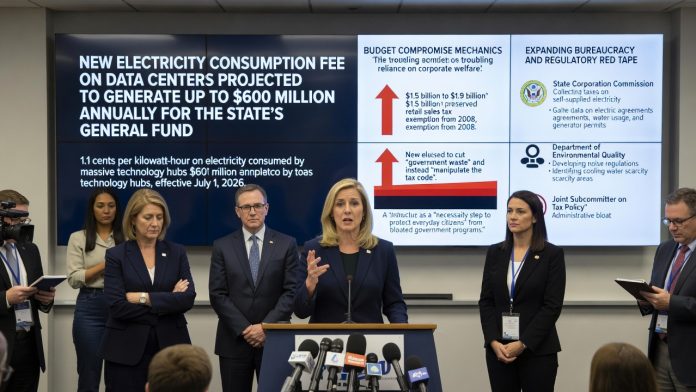
Virginia lawmakers have passed a new state budget that introduces a first-of-its-kind electricity consumption tax on data centers, raising serious questions about fiscal responsibility and government overspending. Taking effect on July 1, 2026, the provision levies a fee of 1.1 cents per kilowatt-hour on electricity consumed by these massive technology hubs. The new tax is projected to generate up to $600 million annually for the Virginia General Fund, with any excess collections refunded pro rata to data center operators. While proponents champion this as a victory for everyday citizens, fiscal conservatives warn that creating new revenue streams often serves to fund bloated government programs rather than providing genuine taxpayer relief.
The underlying mechanics of this budget compromise highlight a troubling reliance on corporate welfare and convoluted tax schemes instead of straightforward spending cuts. Historically, Virginia has lured data centers using a massive retail sales and use tax exemption enacted in 2008, which currently costs the state between $1.5 billion and $1.9 billion annually. Rather than entirely eliminating this costly corporate subsidy to balance the budget, lawmakers opted to preserve the exemption and simply layer a new electricity tax on top of it. This approach reflects a fundamental refusal to reduce government waste, choosing instead to manipulate the tax code to mask the true cost of unchecked state spending.
Expanding Bureaucracy and Regulatory Red Tape Creates New Burdens
Beyond the immediate financial implications, the new budget mandate significantly expands the reach and regulatory power of state agencies. The State Corporation Commission is now tasked with collecting the tax on self-supplied electricity while gathering extensive data on electric service agreements, water usage, and generator permitting. Simultaneously, the Department of Environmental Quality has been directed to develop noise regulations for data centers and identify areas facing cooling water scarcity. Empowering these agencies with new regulatory mandates inevitably requires more funding and staff, expanding the size of government and creating more opportunities for bureaucratic waste.
Furthermore, the legislation establishes a brand new Joint Subcommittee on Tax Policy to further study data center impacts and evaluate future tax strategies. Creating another government committee is a classic hallmark of administrative bloat that rarely leads to actionable reductions in government spending. Adding to the complexity, this new electricity consumption tax is only a temporary measure designed for the two-year budget cycle spanning from fiscal year 2027 to 2028. The tax is scheduled to sunset on July 1, 2028, meaning lawmakers will likely use the intervening years to debate further tax hikes rather than identifying areas to slash the budget.
Lawmakers Defend the Last-Minute Compromise Amid Budget Pressures
Governor Abigail Spanberger praised the budget agreement, framing the new tax as a necessary step to protect everyday citizens from bearing the brunt of infrastructure costs. She stated she was proud to get a budget across the finish line that includes the energy consumption tax, arguing that the industry must pay its fair share without driving up costs for Virginia families. She further described the measure as a compromise proposal that builds a strong foundation for future discussions regarding the environmental and community impacts of the industry. However, from a fiscally conservative standpoint, true protection for Virginia families would involve slashing state expenditures and lowering broad-based taxes rather than selectively targeting industries to feed the General Fund.
Other legislative leaders expressed a more pragmatic, albeit reluctant, view of the tax addition, highlighting the rushed nature of state budget negotiations. Senate Finance Committee Chair Louise Lucas admitted she did not love the data center compromise and would have preferred another method to handle the revenue shortfall. She noted that lawmakers had to get a budget passed because they were not going to let the government shut down, calling the final deal a good start. State Senator Danica Roem echoed a similar sentiment regarding the $600 million revenue generation, simply stating that the substantial sum was not nothing.
The Urgent Need for True Fiscal Restraint Remains Clear
The introduction of this $600 million data center tax underscores a persistent problem in Richmond, where lawmakers consistently prioritize revenue generation over fiscal restraint. Virginia taxpayers deserve a government that rigorously audits its own spending, eliminates wasteful programs, and rejects the premise that state budgets must perpetually grow. Funneling hundreds of millions of new dollars into the General Fund without corresponding spending cuts only encourages further government expansion and future financial mismanagement. Until lawmakers commit to reducing the massive $1.9 billion corporate tax exemptions and shrinking the state bureaucracy, hardworking Virginians will continue to finance a bloated and inefficient government apparatus.