
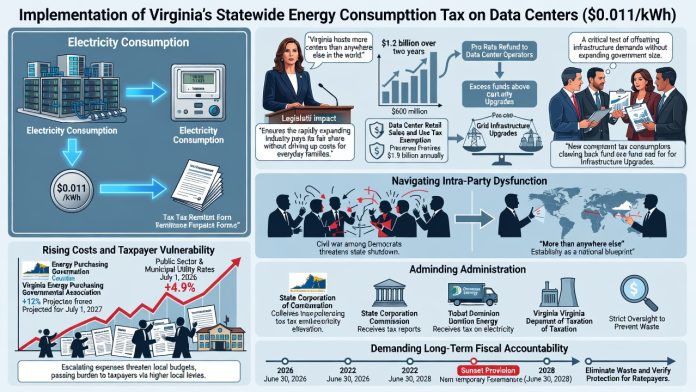
Virginia has officially implemented a first-of-its-kind statewide energy consumption tax on data centers as part of the FY2027-FY2028 biennial budget. The new policy levies a $0.011 per kilowatt-hour charge on electricity consumed by facilities housing massive server and network systems. Governor Abigail Spanberger championed the measure, stating it ensures the rapidly expanding industry pays its fair share without driving up costs for everyday families. For conservative watchdogs, this represents a critical test of whether the state can offset exorbitant infrastructure demands without expanding the size of government.
The implementation of this consumption tax is projected to generate $1.2 billion over the two-year budget cycle, with an annual revenue cap of $600 million. If tax collections exceed this massive threshold in a single fiscal year, the excess funds will be refunded pro rata to the data center operators. This structure emerged as a legislative compromise after earlier proposals attempted to completely repeal the Data Center Retail Sales and Use Tax Exemption. By preserving that specific sales tax exemption, which saves the industry an estimated $1.9 billion annually, lawmakers chose a path that maintains corporate subsidies while attempting to claw back funds for grid infrastructure.
Navigating Intra-Party Dysfunction
The journey to pass this novel tax was marred by intense political infighting that nearly jeopardized the fiscal stability of the Commonwealth. House Speaker Don Scott bluntly referred to the legislative conflict over data center taxation as a civil war among Democrats that threatened a complete state government shutdown. Such partisan dysfunction highlights the dangers of unchecked spending and the desperate need for responsible, conservative budgeting principles in Richmond. Taxpayers are too often left footing the bill when lawmakers prioritize ideological battles over efficient government operations and practical economic solutions.
Despite the chaotic legislative process, the final compromise firmly establishes Virginia as a national focal point for managing the fiscal impact of massive technology hubs. Senator Scott Surovell noted that Virginia hosts more data centers than anywhere else in the world, making this policy a blueprint for the rest of the country. This unprecedented move shifts away from the previous paradigm where data centers operated without a direct electricity consumption tax and were viewed solely as an unquestioned economic boon. The new framework specifically targets facilities housing artificial intelligence and server systems, while wisely excluding telecommunications, internet access, and VoIP providers from the new levy. Moving forward, conservative leaders must ensure this new revenue stream is strictly applied to infrastructure costs rather than being diverted into wasteful bureaucratic programs.
Rising Costs and Taxpayer Vulnerability
While the new tax aims to address grid demands, the broader energy landscape reveals deeply concerning cost spikes for public entities. Public sector and municipal accounts are facing a staggering 24.9 percent overall rate increase starting July 1, 2026, with an additional 12 percent hike projected for July 1, 2027. Organizations like the Virginia Energy Purchasing Governmental Association and the Virginia Association of Counties are currently scrambling to manage these massive utility rate spikes. These escalating expenses represent a direct threat to local budgets and highlight the hidden costs of rapid, unchecked infrastructure expansion. Ultimately, when local governments and schools face skyrocketing operational costs, the financial burden is inevitably passed down to hard-working taxpayers through higher local levies.
Administering this complex new tax framework will require strict oversight to prevent administrative waste and bureaucratic bloat. The State Corporation Commission is now responsible for receiving tax reports and remittances, while electric utilities like Dominion Energy are tasked with collecting the tax on supplied electricity. Meanwhile, the Virginia Department of Taxation will continue monitoring the fiscal impact of the remaining data center exemptions. Fiscal conservatives must demand complete transparency from these agencies to guarantee that the administrative costs of collecting this tax do not consume the revenues intended to protect the electrical grid.
Demanding Long-Term Fiscal Accountability
It is crucial to recognize that this new consumption tax features a strict sunset provision, making it a temporary measure rather than a permanent fixture of the state tax code. The tax applies exclusively to the upcoming two-year budget cycle and is legally set to expire on June 30, 2028. This built-in expiration date provides a necessary safeguard against the perpetual expansion of government taxation and spending. Lawmakers must use this limited window to thoroughly audit the program, eliminate associated waste, and determine if the tax actually delivers on its promise to protect everyday ratepayers.
Ultimately, the implementation of this $0.011 per kilowatt-hour tax underscores the delicate balance between fostering economic development and protecting the financial interests of Virginia citizens. Governor Abigail Spanberger has framed this budget as a way to position the Commonwealth as a national leader while building a strong foundation for future discussions on community impact. However, true leadership requires an unwavering commitment to reducing the overall budget, slashing wasteful spending, and ensuring that massive corporate subsidies do not bankrupt the public. As this policy takes effect, conservatives must remain vigilant to ensure that every dollar collected is managed with absolute fiscal integrity.