
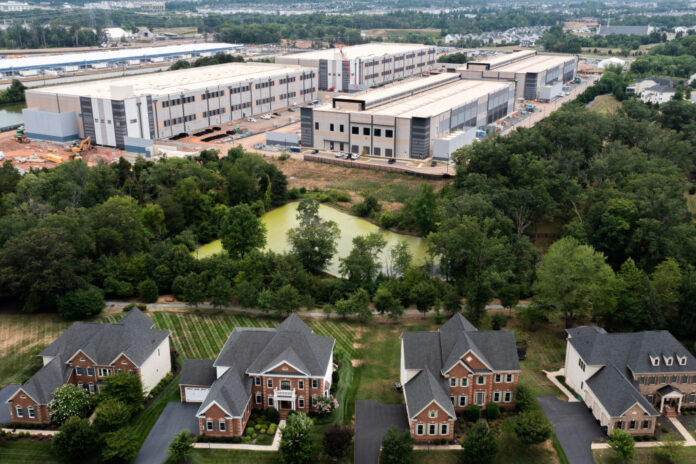
But we could do with data centers slowing their jackrabbit pace of reproduction in congested suburbs and, instead, building where they could fill a need and do more economic good.
Our romance with data centers has cooled in Virginia, home to the world’s greatest concentration of these power-glutton behemoths. They threaten the sufficiency of our electrical grid, they pollute and they bogart an extraordinary amount of water.
But amenities we take for granted — social media, streaming entertainment, cloud services and artificial intelligence to name a few — wouldn’t exist without them. From the time these words left my keyboard until they hit your screen, they had a digital odyssey through data centers.
The souring courtship with data centers was evident in a serious legislative effort to end the sales and use tax exemption the General Assembly gave data centers 16 years ago. Data center owners include the tech leviathans Google, Amazon, Microsoft and Meta to name some of the most prominent.
Starting in the early ’90s, Big Tech prized Virginia for its proximity to Washington and access to the internet’s spinal cord. Virginia’s generous 25-year tax break (35 years if they hit certain investment benchmarks) put data center expansion on steroids.
Since then, these structures — each of which could easily encompass dozens of football fields — have sprung up in Virginia’s suburbs like toadstools after a summer rain.
That has been particularly true in Northern Virginia and down the Interstate 95 corridor toward Richmond and east toward Hampton Roads. Often, they uncomfortably abut property lines of homes in residential subdivisions.
In addition to destroying the bucolic charm that beckoned homeowners to make life’s most significant investment there, data centers are the subject of complaints about noise and diesel exhaust from on-site electrical generators that augment their power needs. The net effect is cratering residential real estate valuations.
It’s angered enough people that elected representatives who recognize a political opportunity when they see one have begun heeding their voters despite the money tech barons spend on lobbying and political action committees to grease the skids.
Normally somnolent zoning boards and boards of supervisors meetings the past few years have turned into loud and contentious forums where desperate families begged their governments to deny permits to locate data centers near them.
Last year, James City, York and Loudoun counties were among localities which voted to restrict data center development to specific, industrial areas. In 2024, Virginia’s largest locality, Fairfax County, changed its zoning ordinances to tighten data center regulations.
The Leesburg-based Data Center Coalition dropped $439,500 on state campaigns and political committees from 2024 to 2026, almost three-fourths of it benefiting Democrats, according to the Virginia Public Access Project. Among the top beneficiaries was Gov. Abigail Spanberger’s 2026 inaugural committee ($25,000).
This month, one of the most protracted budget battles ever in Virginia was an intramural Democratic dispute between House and Senate budget negotiators who differed on whether the state should force data centers to pay sales taxes on the billions they spend to update and upgrade servers and other gear required to keep these digital workhorses working.
On one side, Senate Democrats led by Finance and Appropriations Committee chair Louise Lucas demanded the tax break end early, adding nearly $2 billion in estimated annual revenues to the state’s general fund.
On the other side, House Democratic leaders, including money committee chief Luke Torian and Speaker Don Scott, along with Gov. Abigail Spanberger argued that the state should honor its 2010 commitment.
Up against an end-of-the-month deadline for completing the budget or shutting down state government, they opted to tax the enormous loads of electricity data centers use. It’s estimated to add about $600 million annually to the state’s coffers. Data centers become liable for the new tax effective on Wednesday.
The industry and its allies (including labor, a key Democratic voting bloc) were not thrilled. Presumably, however, they’re less irritated than they would have been had the legislature repealed their sales tax exemption.
“Nothing about this hastily assembled scheme will make life more affordable for Virginians or encourage job creation,” DCC president and CEO Josh Levi fumed in a statement the day before the House and Senate passed the budget and sent it to Spanberger’s desk.
That’s a more measured take than we heard from the DCC and other industry heavies before the tax-break repeal was shelved. They warned darkly that ending the exemption would “effectively halt investment” in Virginia.
If data center owners decide to pump the brakes on the pace of expansion in Virginia, that’s not a bad thing.
Virginia’s data center building boom portends demands on the state’s electrical generating and transmission capacity that will be “very difficult” to meet, according to a 2023 study by the General Assembly’s investigative arm, the Joint Legislative Audit and Review Commission.
However, the study also found that data centers are responsible for nearly 75,000 jobs and $5.5 billion in paychecks in contributing just over $9 billion annually to Virginia’s gross domestic product.
One region of the state — crowded, affluent Northern Virginia — reaps a disproportionately large share of data centers’ economic benefits (and their vexatious liabilities).
The industry has been slow to expand outside that suburban footprint into rural areas whose agricultural, manufacturing and mining economies have suffered for decades from global trade agreements and the declining domestic use of coal and tobacco. It’s hard for parents who raise their children in Virginia’s Southside or Coalfields to watch them leave their native soil for career opportunities in those suburbs.
If we’re looking for incentives, make them regional and incentivize data centers where natural resources and open land distant from neighborhoods are plentiful. There are underemployed communities where a proven, ready workforce would welcome tech industry jobs. It would also, of necessity, drive broadband service into neglected communities and further revive their economies.
A reminder to the industry and to state policymakers: Virginia doesn’t stop at the Rappahannock. Or even the James. It’s not bounded on the west by the Blue Ridge foothills or by Horse Country.
Virginia has been quite accommodating to Big Data, and if it still wants to grow in the commonwealth, lovely. Grow where you’re needed.