
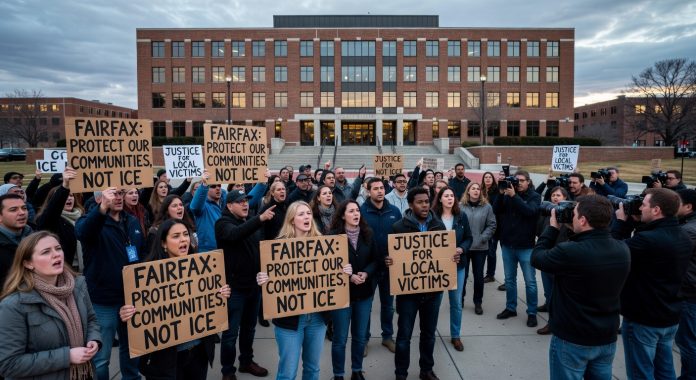
According to data compiled by the Center for Immigration Studies (CIS), Fairfax County declined 744 ICE detainers for criminal noncitizens held in local custody. CIS Director Jessica Vaughan noted that these included gang members, child predators, and sex offenders. The organization ranks Fairfax among the top sanctuary jurisdictions nationwide for such releases. Separate reports cite figures exceeding 1,100 detainers ignored in recent years.
A prominent example involves the February 2026 fatal stabbing of 41-year-old Stephanie Minter at a Fairfax County bus stop. The suspect, Abdul Jalloh from Sierra Leone, faced over 30 prior arrests for various offenses, with ICE issuing multiple detainers. Fairfax County Sheriff Stacey Kincaid’s policy specifies that eligible inmates are released without ICE notification, contributing to Jalloh’s return to the community.
The U.S. Department of Homeland Security (DHS) has highlighted similar concerns, reporting the arrest of a child predator previously released by Fairfax authorities. Virginia Lieutenant Governor Winsome Earle-Sears referenced over 1,100 ignored detainers in Fairfax, contrasting with state initiatives under Governor Glenn Youngkin deputizing state police for ICE collaboration.
Fairfax County’s approach stems from directives limiting federal immigration holds unless accompanied by judicial warrants. Sheriff Kincaid’s policy explicitly avoids notifying ICE for certain releases. Proponents argue this builds trust with immigrant communities and focuses resources on serious local crimes, while opponents contend it heightens risks from recidivists.
The hearing clip overlays text emphasizing released individuals’ ‘propensity to commit these types of crimes’ and notes victims’ inability to testify. It specifically mentions Minter’s absence due to Jalloh’s release. Such disclosures have fueled calls for legislative changes in the Virginia General Assembly, where bills originate in the House of Delegates or Senate to potentially require detainer compliance.
Nationally, sanctuary policies vary, with jurisdictions like Fairfax declining voluntary ICE requests. CIS data tracks these across the U.S., showing patterns of reoffense post-release. In Virginia, state-level efforts aim to counter local noncooperation through enhanced partnerships.
Public discourse includes Republican National Committee research citing Vaughan’s testimony on Fairfax’s 744 declinations. Local outlets and officials have reported on Kincaid’s policy implementation. As of May 2026, these issues persist amid ongoing federal-local tensions.
Fairfax maintains low overall crime rates compared to national averages, though specific incidents linked to released detainees draw attention. DHS urges Virginia localities to end such practices for community protection. Legislative hearings continue to examine data and cases like Minter’s.
The interplay between local policies and federal enforcement remains a key Virginia issue, with stakeholders monitoring impacts on public safety.
Email At:
Steve Descano – stephen.descano@fairfaxcounty.gov,
Stacey Kincaid – sheriff@fairfaxcounty.gov,
Jeff McKay → chairman@fairfaxcounty.gov,
Kathy Smith (Sully District) sully@fairfaxcounty.gov,
James Walkinshaw (Braddock District) braddock@fairfaxcounty.gov,
James Bierman (Dranesville District) dranesville@fairfaxcounty.gov,
Rodney Lusk (Franconia District) franconia@fairfaxcounty.gov,
Walter Alcorn (Hunter Mill District) huntermill@fairfaxcounty.gov,
Andres Jimenez (Mason District) mason@fairfaxcounty.gov,
Daniel Storck (Mount Vernon District) mtvernon@fairfaxcounty.gov,
Dalia Palchik (Providence District) providence@fairfaxcounty.gov,
Pat Herrity (Springfield District) springfield@fairfaxcounty.gov,