
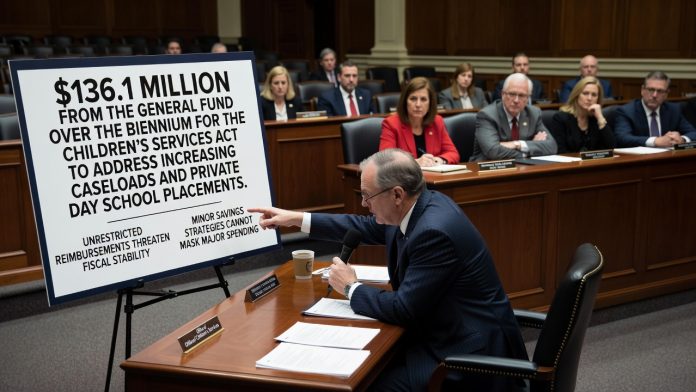
Virginia taxpayers are facing a steep financial burden as the state government allocates a staggering $136.1 million from the General Fund over the biennium for the Children’s Services Act. This massive influx of taxpayer dollars is intended to address soaring caseloads and the escalating costs of private day school placements for at-risk youth. However, fiscal conservatives are raising alarms over a controversial budget amendment that eliminates a previously proposed 2.5 percent cap on state reimbursement increases to localities. By removing this critical cost-control measure, lawmakers have effectively opened the door to unrestricted spending on private day educational services.
The Children’s Services Act is a vital program designed to support vulnerable youth, but its current financial trajectory is simply unsustainable for the state budget. Oversight of these funds involves a complex web of agencies, including the Office of Children’s Services, the Department of Education, and the Health and Human Resources Secretariat. Local school divisions rely heavily on this funding to manage special education wrap-around services and private day school placements. Unfortunately, the lack of rigid financial boundaries means that costs have grown significantly compared to prior years, leaving taxpayers to foot an ever-expanding bill.
Unrestricted Reimbursements Threaten Fiscal Stability
One of the most troubling aspects of this budget development is the decision to allow reimbursements based on real costs on an unrestricted basis. Previously, a 2.5 percent cap on rate increases for private day educational services served as a necessary safeguard against unchecked price hikes by private providers. Eliminating this cap removes any financial incentive for these private facilities to operate efficiently or keep their tuition rates reasonable. When government agencies write blank checks based on whatever private entities claim as their operating costs, the risk of waste and institutional overcharging skyrockets.
The Senate Finance Committee plainly stated that the $136.1 million allocation is necessary “to fund the increasing costs of the Children’s Services Act.” While funding essential services is a recognized duty of the state government, blindly pouring millions into a system without demanding structural cost reforms is a recipe for fiscal disaster. Conservative budget watchdogs argue that simply throwing more money at a problem rarely solves the underlying inefficiencies driving the expense. Taxpayers rightfully expect their elected officials to negotiate better rates and demand rigorous audits rather than passively accepting endless budget expansions.
Minor Savings Strategies Cannot Mask Major Spending
In an attempt to soften the blow to the General Fund, lawmakers did include $33.4 million in savings strategies to manage program growth. The Subcommittee on Health and Human Resources justified these measures by citing “caseloads and service costs, particularly in private special education placements.” The subcommittee further stated, “To maintain this critical program for at-risk youth and their families, the Subcommittee endorses $33.4 million in Children’s Services Act savings strategies to better manage this growth.” However, this modest savings figure is completely eclipsed by the massive $136.1 million spending hike and the dangerous removal of reimbursement caps.
True fiscal responsibility requires more than just token savings strategies attached to massive spending bills. When local school divisions are permitted to utilize unrestricted state funds for private placements, the natural market forces that typically control pricing are completely neutralized. This environment creates a high probability for systemic waste, as private day schools can continuously raise their rates knowing the state will cover the difference. Lawmakers must implement strict oversight mechanisms to ensure that not a single taxpayer dollar is squandered on inflated administrative costs or fraudulent billing practices.
Demanding Accountability for Virginia Taxpayers
Protecting the most vulnerable members of society is a shared moral imperative, but it must be balanced with a profound respect for the working taxpayers who fund these initiatives. Conservative solutions emphasize competitive bidding, rigorous financial auditing of private service providers, and the reinstatement of hard caps on annual rate increases. By enforcing strict budgetary discipline, Virginia can ensure that the Children’s Services Act remains solvent and capable of helping those who genuinely need intensive support. Without these fundamental safeguards, the program risks collapsing under its own bloated weight, ultimately harming the very youth it was designed to protect.
The allocation of $136.1 million from the General Fund represents a significant escalation in state spending that demands immediate taxpayer scrutiny. Virginia lawmakers must recognize that eliminating rate caps and writing blank checks to private educational facilities is a severe dereliction of fiscal duty. Moving forward, the General Assembly must prioritize structural reforms that root out waste, demand accountability from private contractors, and protect the financial stability of the state. Only through unwavering conservative fiscal management can Virginia sustainably support its at-risk youth while honoring its fundamental obligation to the taxpayer.































