
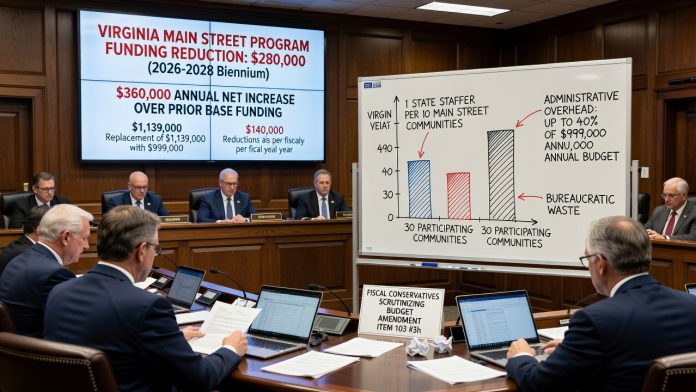
Fiscal conservatives in Virginia are scrutinizing a recent budget amendment affecting the Department of Housing and Community Development. Amendment Item 103 #3h introduces a $280,000 reduction from the General Fund for the Virginia Main Street Program over the upcoming 2026-2028 biennium. While this adjustment initially appears to be a victory for taxpayers seeking relief from government spending, a closer examination reveals a dramatically different reality. The reduction merely trims a heavily inflated budget proposal, leaving the program with a substantial net increase compared to previous years.
The specific financial adjustments dictate a $140,000 reduction in both fiscal year 2027 and fiscal year 2028. This legislative move strikes the originally introduced funding amount of $1,139,000 per year and replaces it with $999,000 annually. However, this final allocation of nearly one million dollars per year still represents a net increase of $360,000 annually over the program’s prior base funding. Consequently, what is being touted as a budget reduction is actually a significant expansion of taxpayer-funded government operations within the Commerce and Trade Secretariat.
Questionable Administrative Mandates
The official justification for this elevated funding level centers on maintaining national accreditation with the Main Street America program. This external organization mandates a strict administrative ratio, requiring one state program staffer for every ten participating main street communities. Because Virginia currently boasts thirty participating main street communities, state officials argue they must aggressively expand their payroll to meet this arbitrary quota. Fiscal watchdogs argue that allowing an outside entity to dictate state hiring quotas is an irresponsible way to manage taxpayer resources.
Adding to the concerns of budget hawks is a specific provision within the amendment regarding how these funds can be utilized. The legislative language explicitly states that the Department of Housing and Community Development is authorized to use up to forty percent of the provided funds each year simply to administer the program. Allowing nearly half of a million-dollar annual budget to be swallowed up by administrative overhead is a classic example of bureaucratic waste. Hardworking Virginians expect their tax dollars to directly benefit local communities, not to artificially inflate state agency payrolls.
The Illusion of Fiscal Restraint
The framing of this $280,000 reduction highlights a pervasive problem within state government budgeting processes. Bureaucrats frequently request exorbitant funding increases, only to claim fiscal responsibility when lawmakers slightly trim those initial requests. In the private sector, a budget cut means spending less than the previous year, but in government, it often means spending more at a slightly slower rate. True fiscal conservatism requires rolling back baseline budgets, rather than celebrating minor reductions to massive proposed expansions.
The Virginia Main Street Program was originally designed to revitalize downtown commercial districts through economic development and historic preservation. While these are commendable goals for local municipalities to pursue, the heavy reliance on state funding and oversight creates unnecessary government bloat. Local chambers of commerce and private business owners are far better equipped to manage downtown revitalization than state-level bureaucrats operating out of Richmond. By reducing state interference and cutting administrative funding, lawmakers could empower local communities while simultaneously protecting the state treasury.
Eliminating Redundancy in State Agencies
The Commerce and Trade Secretariat oversees numerous programs that often overlap in their stated missions of community and economic development. Consolidating these efforts rather than expanding individual departmental budgets would yield substantial financial savings for the Commonwealth. When agencies like the Department of Housing and Community Development operate with nearly one million dollars annually for a single community program, the risk of redundant spending skyrockets. Streamlining these state agencies is absolutely essential to ensure that every tax dollar is treated with the utmost respect and utility.
Moving forward, conservative lawmakers must remain vigilant against budget amendments that mask significant spending increases behind the guise of minor reductions. The $360,000 annual net increase for the Virginia Main Street Program demonstrates how easily government agencies can expand their footprint without delivering tangible returns to the taxpayer. Auditing these specific programs to ensure funds are not being squandered on excessive staffing ratios should be a top priority for the upcoming legislative session. Only through rigorous oversight and genuine budget cuts can Virginia achieve a truly responsible and efficient state government framework.
Protecting the Virginia Taxpayer
Ultimately, the debate over this specific funding allocation serves as a perfect microcosm for the broader battle over state spending. Taxpayers are tired of funding bloated administrative overhead and complying with arbitrary mandates set by external organizations. If Virginia is to maintain a highly competitive economic environment, lawmakers must prioritize structural budget reforms that permanently shrink the size of state government. Rejecting the normalization of administrative bloat is the first crucial step toward achieving lasting fiscal health for the Commonwealth.
Furthermore, minimizing the tax burden on Virginia residents directly stimulates local economies far better than state-directed administrative spending. When citizens keep more of their hard-earned money, they naturally invest in their own local main streets through everyday commerce and private entrepreneurship. State lawmakers must recognize that true economic vitality comes from free enterprise, not from funding state program staffers to monitor community compliance. By demanding strict accountability and rejecting inflated budget baselines, conservatives can chart a responsible course toward genuine prosperity for all Virginians.