
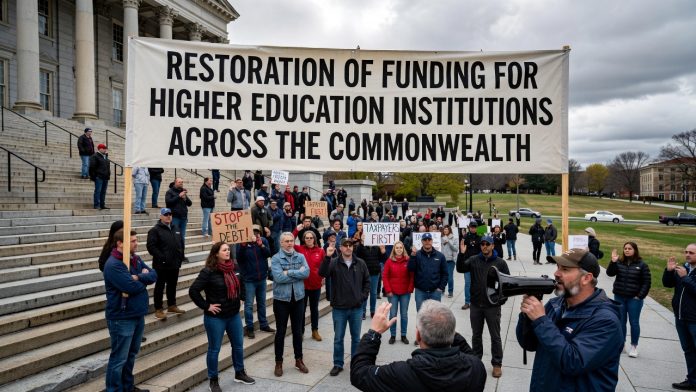
The newly finalized budget for the 2026-2028 biennium in the State of Virginia introduces significant financial burdens on taxpayers through massive higher education spending. Lawmakers have allocated a staggering $349.7 million for higher education funding, raising serious concerns about fiscal responsibility and government overreach. Instead of forcing universities to trim administrative bloat, the state government is choosing to subsidize these institutions with taxpayer dollars. This approach merely shifts the financial weight onto hardworking Virginians without addressing the root causes of skyrocketing tuition.
A major point of contention for fiscal conservatives is the approval of $1.1 billion in General Fund-supported debt to finance nineteen higher education capital projects. This massive accumulation of state debt is accompanied by an additional $74.9 million in direct General Fund cash for these exact same initiatives. Projects include a new arts and engineering building at Old Dominion University and a new school of dentistry at Virginia Commonwealth University. Saddling future generations of Virginians with over a billion dollars in debt for campus expansions demonstrates a reckless disregard for conservative budgeting principles.
Shifting the Federal Burden to Virginia Taxpayers
State leaders are openly admitting that this new spending spree is designed to backfill federal funding cuts to education and workforce programs. House Appropriations Chair Luke Torian stated that federal actions have created real gaps in education support and that the state budget backfills those holes out of prudence. However, replacing borrowed federal dollars with borrowed state dollars does absolutely nothing to protect the wallets of local taxpayers. True fiscal prudence would involve scaling back state programs to match available revenues rather than artificially propping up bloated university budgets.
Governor Abigail Spanberger defended the finalized budget by claiming it addresses an affordability crisis created by reckless policies out of Washington. She argued that the massive spending package charts a path toward a stronger and more affordable future for families across the Commonwealth. Critics point out the glaring hypocrisy of condemning reckless federal policies while simultaneously green-lighting a billion dollars in new state-level debt. True affordability is achieved by lowering taxes and reducing government spending, not by authorizing unprecedented levels of borrowing for university construction projects.
The Illusion of Tuition Moderation
The budget specifically designates $82.5 million to ostensibly bring down tuition costs for students attending state universities. Within this allocation, Virginia Commonwealth University will receive $3,631,600, while Virginia State University is slated to receive $605,050 for affordable access operating support. While lowering tuition is a noble goal, funneling millions of taxpayer dollars directly into university coffers removes any incentive for these institutions to cut their own wasteful spending. Higher education administrators will continue to expand their bureaucracies as long as the state government remains willing to foot the bill.
Fiscal watchdogs argue that universities must be held accountable for their own financial mismanagement before receiving a single cent of new state funding. The current funding model rewards institutional inefficiency by constantly backfilling budget shortfalls with general fund revenues. Taxpayers are effectively being forced to subsidize luxury campus amenities and administrative salaries under the guise of expanding affordable educational access. Lawmakers must demand strict financial audits and mandatory budget cuts at these institutions to ensure taxpayer funds are not being squandered.
A Call for Fiscal Restraint
The long-term economic consequences of the FY2027 budget will undoubtedly be felt by Virginia taxpayers for decades to come. Taking on $1.1 billion in debt for nineteen capital projects means that future state budgets will be severely constrained by massive interest payments. This debt servicing will inevitably lead to calls for higher taxes, further squeezing hardworking families who are already struggling with inflation. Conservative leaders must push back against this borrow-and-spend mentality to protect the economic stability of the Commonwealth.
Protecting the taxpayer must always be the primary objective of any responsible legislative body in the State of Virginia. The current strategy of masking federal funding cuts with massive state-level borrowing is a recipe for absolute financial disaster. Lawmakers must pivot toward a strategy of fiscal restraint, demanding that higher education institutions operate within their existing means. Only by eliminating waste and rejecting unnecessary debt can Virginia truly secure a prosperous and affordable future for its citizens.