
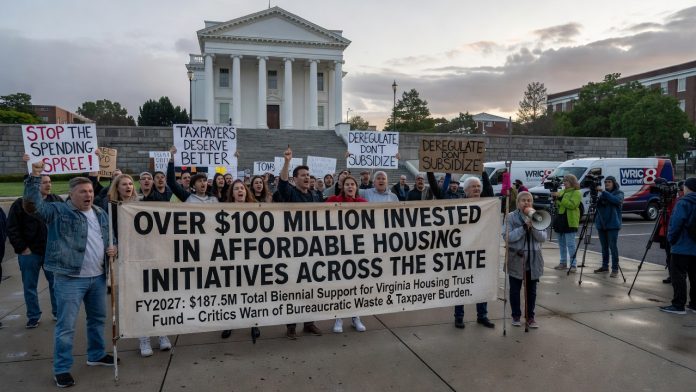
The newly finalized budget for the Commonwealth of Virginia includes a staggering allocation of state funds directed toward affordable housing initiatives for the fiscal year 2027. Lawmakers have approved a massive $187.5 million in total biennial support for the Virginia Housing Trust Fund, which features a specific $100 million expenditure strictly for FY2027. This dramatic expansion of state subsidies raises serious concerns among fiscal conservatives regarding the growing burden placed on hardworking taxpayers. Critics point out that such heavy reliance on government intervention often leads to bureaucratic waste rather than sustainable economic growth. Taxpayers are rightfully questioning whether this unprecedented level of spending is truly necessary or simply another political giveaway.
This latest budget cycle represents a significant departure from previous baseline allocations by injecting an additional $40 million into the Virginia Housing Trust Fund. Instead of allowing the free market to correct housing supply issues through deregulation, state leaders are choosing to artificially subsidize the market with taxpayer dollars. The Department of Housing and Community Development will oversee this massive influx of cash, creating potential avenues for administrative bloat and financial mismanagement. Fiscal watchdogs argue that continually increasing state budgets for housing initiatives sets a dangerous precedent for future spending demands. A more prudent approach would involve slashing red tape to lower construction costs naturally.
Questionable New Pilot Programs and Revolving Loans
Adding to the spending spree, the budget establishes a brand-new $25 million state-level pilot program designed to create a revolving loan fund for mixed-income housing development. This initiative did not exist in previous years, marking yet another expansion of government reach into private real estate development. Funding unproven pilot programs with public money often exposes taxpayers to unnecessary financial risks, especially when revolving loan funds lack stringent oversight mechanisms. Conservatives argue that state government should not be acting as a bank or venture capitalist with funds forcibly collected from private citizens. When public funds are loaned out for private development, the potential for cronyism and wasted resources skyrockets.
Furthermore, state lawmakers have chosen to aggressively backfill federal funding cuts by using state revenues to prop up rapid rehousing and homelessness services. The budget directs $17.6 million to support rapid rehousing efforts and Continuum of Care programs across the Commonwealth. When the federal government appropriately scales back its spending, state officials should follow suit rather than shifting the financial burden directly onto local taxpayers. Shielding these programs from necessary budget reductions prevents meaningful reform and encourages a perpetual cycle of state dependency. Virginia cannot afford to continuously absorb the costs of bloated welfare programs that the federal government has rightfully decided to trim.
Eviction Reduction and Expanding Entitlements
The budget also allocates $11.5 million for the Virginia Eviction Reduction Program in FY27, signaling a continued reliance on government bailouts for private rental agreements. Additionally, the State Rental Assistance Program will receive an extra $1 million in funding per year over the previous biennium to support individuals with specific disabilities. While providing a safety net is a recognized function of government, continuously expanding these entitlements stretches the state budget beyond reasonable limits. Without strict fraud prevention measures, eviction reduction programs frequently fall victim to abuse, ultimately wasting the funds they were meant to distribute. Lawmakers must ensure that these millions are not squandered on fraudulent claims or administrative overhead.
Governor Abigail Spanberger praised the spending in June 2026, claiming the budget charts a path toward a stronger and more affordable future for every family. House Appropriations Chair Luke Torian echoed this sentiment in February 2026, stating that governing is about delivering both compassion and responsibility to confront the affordability crisis. However, fiscal conservatives argue that true responsibility involves balancing the budget, cutting wasteful spending, and allowing taxpayers to keep more of their hard-earned money. True affordability is achieved through deregulation and lower taxes, not through massive state-funded wealth redistribution schemes. The rhetoric of compassion should not be used as a shield to deflect legitimate criticisms of runaway government spending.
The Call for Fiscal Restraint
As the Department of Housing and Community Development prepares to distribute these massive funds, taxpayers must demand absolute transparency and rigorous audits. Every dollar spent on the mixed-income housing pilot or eviction reduction programs represents money taken out of the productive private sector economy. Lawmakers must prioritize reducing the overall budget and returning surplus revenues to the citizens rather than inventing new avenues for government expenditure. Protecting the financial stability of Virginia requires a firm commitment to free-market principles and a decisive rejection of unchecked progressive spending policies. Only by reining in this excessive spending can the Commonwealth secure a genuinely prosperous economic future for all its residents.