
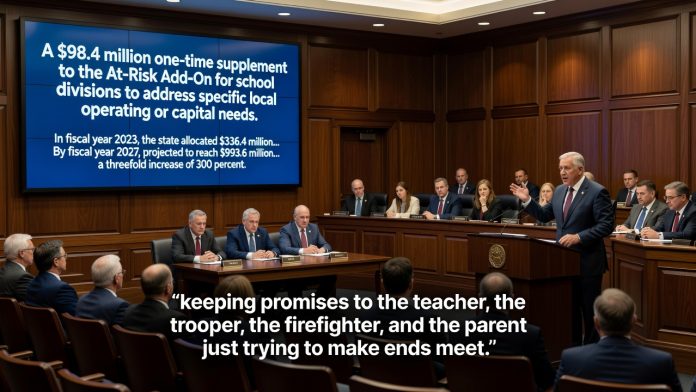
The Virginia state budget now includes a massive $98.4 million one-time supplement to the At-Risk Add-On program for public school divisions across the Commonwealth. This massive injection of taxpayer dollars is earmarked for local operating or capital needs while a legislative subcommittee continues to evaluate ongoing funding requirements. Fiscal conservatives are raising serious alarms over the rapid expansion of this program, which has seen its baseline budget explode exponentially in recent years. Taxpayers are left wondering if this represents a genuine, calculated educational investment or simply another glaring instance of unchecked government spending.
Since the release of the Joint Legislative Audit and Review Commission report on public education funding, spending on at-risk students has skyrocketed at an unprecedented and alarming rate. In fiscal year 2023, the state allocated a substantial $336.4 million for At-Risk support across Virginia public school divisions. By fiscal year 2027, total proposed support for this specific category is projected to reach an astonishing $993.6 million under current legislative frameworks. This represents a staggering threefold increase of approximately 300 percent over just a four-year period, placing an enormous burden on the state’s revenue streams.
Questioning the Financial Accountability
This newly approved $98.4 million supplement, described strictly as a Senate priority during negotiations, is intended to bridge the funding gap while the Joint Subcommittee on Elementary and Secondary Education Funding evaluates ongoing needs for underserved students. However, allocating nearly one hundred million dollars before a thorough, data-driven evaluation is actually complete seems entirely backward to advocates of fiscal restraint. Distributing vast sums of money without established, long-term operational guidelines often leads to severe municipal waste and bureaucratic inefficiency at the local level. Hardworking taxpayers deserve a government that carefully assesses actual needs before writing massive, uncoordinated checks to local school boards.
The legislative language surrounding the appropriation allows school divisions to use these funds for a broad range of specific local operating or capital needs throughout the upcoming biennium. Such intentionally vague parameters frequently open the door for local districts to funnel money into pet projects rather than directly improving classroom instruction for the students who need it most. When capital expenditures are haphazardly lumped into at-risk educational funding, the original intent of helping struggling students is often lost in a maze of administrative overhead. Conservative watchdogs rightly argue that capital improvements should always be funded through dedicated, transparent channels rather than sweeping supplementary add-ons.
Rhetoric Versus Reality
Defending the compromise budget, Speaker Don Scott offered sweeping rhetoric about keeping promises to various public servants and parents across the state. Scott stated regarding the compromise budget that Virginia families cannot wait, declaring the legislation a “promise kept” to the teacher, the trooper, the firefighter, and the parent just trying to make ends meet. He further claimed this massive financial plan builds the Commonwealth into “the best place to live, to work, to play, and to raise a family.” While the sentiment sounds incredibly appealing on the surface, it conveniently glosses over the harsh reality of the heavy tax burden required to fund these rapidly expanding government programs.
Emotional appeals from legislative leaders often serve as a convenient smokescreen for bloated budgets, systemic overspending, and a lack of fiscal discipline. True fiscal responsibility means recognizing that every single dollar allocated to a government program is a dollar taken directly from the pockets of hardworking Virginia families. When the state increases funding for a single educational initiative by 300 percent in just four years, it sets a highly dangerous precedent for future budget cycles. Residents of Virginia expect their elected officials to prioritize operational efficiency and actively eliminate fraud rather than continuously expanding the size and scope of state government.
Protecting the Virginia Taxpayer
As this $98.4 million supplement is eventually disbursed to various school divisions, state auditors must maintain strict, uncompromising oversight to prevent inevitable waste and mismanagement. Local school boards have a well-documented historical tendency to absorb temporary funding into their permanent baseline budgets, inevitably leading to demands for even more money in subsequent years. State lawmakers must take proactive steps to ensure that this one-time allocation truly remains a temporary measure rather than morphing into a permanent entitlement program. Without rigorous accountability metrics firmly in place, these funds risk being squandered on administrative bloat rather than achieving any measurable academic improvements.
The staggering growth of the At-Risk Add-On program highlights a deeply troubling trend of runaway spending within the state legislature that must be addressed immediately. While supporting vulnerable students is undoubtedly a noble goal, blindly throwing nearly a billion dollars at the public education system does not guarantee better educational outcomes. Conservative lawmakers and taxpayers must unite to demand a rapid return to prudent financial management and rigorous, independent program evaluation. Ultimately, reining in this type of unchecked expenditure is absolutely essential to reducing the overall budget and preserving the long-term financial health of the Commonwealth.
Email the House of Delegates at:
Jessica Anderson: DelJAnderson@house.virginia.gov,
Bonita Anthony: DelBAnthony@house.virginia.gov,
Alex Askew: DelAAskew@house.virginia.gov,
Terry Austin: DelTAustin@house.virginia.gov,
Jason Ballard: DelJBallard@house.virginia.gov,
Robert Bloxom, Jr.: DelRBloxom@house.virginia.gov,
Gretchen Bulova: DelGBulova@house.virginia.gov,
Katrina Callsen: DelKCallsen@house.virginia.gov,
Karen Carnegie: DelKCarnegie@house.virginia.gov,
Betsy Carr: DelBCarr@house.virginia.gov,
Stacey Carroll: DelSCarroll@house.virginia.gov,
Mike Cherry: DelMCherry@house.virginia.gov,
Nadarius Clark: DelNClark@house.virginia.gov,
Laura Cohen: DelLJCohen@house.virginia.gov,
Joshua Cole: DelJCole@house.virginia.gov,
Nicole Cole: DelNCole@house.virginia.gov,
Kelly Convirs-Fowler: DelKConvirs-Fowler@house.virginia.gov,
Mitchell Cornett: DelMCornett@house.virginia.gov,
Rae Cousins: DelRCousins@house.virginia.gov,
Will Davis: DelWDavis@house.virginia.gov,
Karrie Delaney: DelKDelaney@house.virginia.gov,
Lindsey Dougherty: DelLDougherty@house.virginia.gov,
Mark Downey: DelMDowney@house.virginia.gov,
Michael Feggans: DelMFeggans@house.virginia.gov,
Hyland Fowler, Jr.: DelBFowler@house.virginia.gov,
Lily Franklin: DelLFranklin@house.virginia.gov,
Margaret Franklin: DelMFranklin@house.virginia.gov,
Debra Gardner: DelDGardner@house.virginia.gov,
Thomas Garrett, Jr.: DelTGarrett@house.virginia.gov,
Jackie Glass: DelJGlass@house.virginia.gov,
Timothy Griffin: DelTGriffin@house.virginia.gov,
Elizabeth Guzman: DelEGuzman@house.virginia.gov,
Karen Hamilton: DelKHamilton@house.virginia.gov,
Cliff Hayes, Jr.: DelCHayes@house.virginia.gov,
Dan Helmer: DelDHelmer@house.virginia.gov,
Rozia Henson, Jr.: DelRHenson@house.virginia.gov,
Phil Hernandez: DelPHernandez@house.virginia.gov,
Charniele Herring: DelCHerring@house.virginia.gov,
Keith Hodges: DelKHodges@house.virginia.gov,
Patrick Hope: DelPHope@house.virginia.gov,
Hillary Kent: DelHKent@house.virginia.gov,
Karen Keys-Gamarra: DelKKeys-Gamarra@house.virginia.gov,
Terry Kilgore: DelTKilgore@house.virginia.gov,
Paul Krizek: DelPKrizek@house.virginia.gov,
Amy Laufer: DelALaufer@house.virginia.gov,
Destiny LeVere Bolling: DelDLeVereBolling@house.virginia.gov,
Jay Leftwich, Jr.: DelJLeftwich@house.virginia.gov,
Alfonso Lopez: DelALopez@house.virginia.gov,
Fernando Martinez: DelMMartinez@house.virginia.gov,
John McAuliff: DelJMcAuliff@house.virginia.gov,
Adele McClure: DelAMcClure@house.virginia.gov,
Garrett McGuire: DelGMcGuire@house.virginia.gov,
Ellen McLaughlin: DelEMcLaughlin@house.virginia.gov,
Joseph McNamara: DelJMcNamara@house.virginia.gov,
Kirk McPike: DelKMcPike@house.virginia.gov,
Delores McQuinn: DelDMcQuinn@house.virginia.gov,
Leslie Mehta: DelLMehta@house.virginia.gov,
Will Morefield: DelJMorefield@house.virginia.gov,
May Nivar: DelMNivar@house.virginia.gov,
Israel O’Quinn: DeliOquinn@house.virginia.gov,
Delores Oates: DelDOates@house.virginia.gov,
Justin Pence: DelJPence@house.virginia.gov,
Eric Phillips: DelEPhillips@house.virginia.gov,
Kimberly Pope Adams: DelKPopeAdams@house.virginia.gov,
Cia Price: DelMPrice@house.virginia.gov,
Sam Rasoul: DelSRasoul@house.virginia.gov,
Atoosa Reaser: DelAReaser@house.virginia.gov,
David Reid: DelDReid@house.virginia.gov,
Andrew Rice: DelARice@house.virginia.gov,
Chris Runion: DelCRunion@house.virginia.gov,
Charles Schmidt, Jr.: DelCSchmidt@house.virginia.gov,
Don Scott: DelDScott@house.virginia.gov,
Phillip Scott: DelPScott@house.virginia.gov,
Holly Seibold: DelHSeibold@house.virginia.gov,
Briana Sewell: DelBSewell@house.virginia.gov,
Irene Shin: DelIShin@house.virginia.gov,
Marcus Simon: DelMSimon@house.virginia.gov,
Shelly Simonds: DelSSimonds@house.virginia.gov,
JJ Singh: DelJSingh@house.virginia.gov,
Rip Sullivan, Jr.: DelRSullivan@house.virginia.gov,
Anne Tata: DelAFTata@house.virginia.gov,
Josh Thomas: DelJThomas@house.virginia.gov,
Virgil Thornton, Sr.: DelVThornton@house.virginia.gov,
Luke Torian: DelLTorian@house.virginia.gov,
Kathy Tran: DelKTran@house.virginia.gov,
Howard Wachsmann, Jr.: DelOWachsmann@house.virginia.gov,
Wendell Walker: DelWWalker@house.virginia.gov,
Jeion Ward: DelJWard@house.virginia.gov,
Lee Ware: DelLWare@house.virginia.gov,
Vivian Watts: DelVWatts@house.virginia.gov,
Michael Webert: DelMWebert@house.virginia.gov,
Madison Whittle: DelMWhittle@house.virginia.gov,
Bill Wiley: DelBWiley@house.virginia.gov,
Rodney Willett: DelRWillett@house.virginia.gov,
Wren Williams: DelWWilliams@house.virginia.gov,
Tony Wilt: DelTWilt@house.virginia.gov,
Thomas Wright, Jr.: DelTWright@house.virginia.gov,
Scott Wyatt: DelSWyatt@house.virginia.gov,
Eric Zehr: DelEZehr@house.virginia.gov,
Email the Senate At:
Lashrecse Aird – senatoraird@senate.virginia.gov,
Lamont Bagby – senatorbagby@senate.virginia.gov,
Elizabeth Bennett-Parker – senatorbennett-parker@senate.virginia.gov,
Jennifer Boysko – senatorboysko@senate.virginia.gov,
Jennifer Carroll Foy – senatorcarrollfoy@senate.virginia.gov,
Luther Cifers – senatorcifers@senate.virginia.gov,
Christie Craig – senatorcraig@senate.virginia.gov,
Creigh Deeds – senatordeeds@senate.virginia.gov,
Bill DeSteph – senatordesteph@senate.virginia.gov,
Danny Diggs – senatordiggs@senate.virginia.gov,
Tara Durant – senatordurant@senate.virginia.gov,
Barbara Favola – senatorfavola@senate.virginia.gov,
Timmy French – senatorfrench@senate.virginia.gov,
Travis Hackworth – senatorhackworth@senate.virginia.gov,
Christopher Head – senatorhead@senate.virginia.gov,
Michael Jones – senatorjones@senate.virginia.gov,
Emily Jordan – senatorjordan@senate.virginia.gov,
Mamie Locke – senatorlocke@senate.virginia.gov,
Louise Lucas – senatorlucas@senate.virginia.gov,
David Marsden – senatormarsden@senate.virginia.gov,
Ryan McDougle – senatormcdougle@senate.virginia.gov,
Jeremy McPike – senatormcpike@senate.virginia.gov,
Tammy Mulchi – senatormulchi@senate.virginia.gov,
Mark Obenshain – senatorobenshain@senate.virginia.gov,
Mark Peake – senatorpeake@senate.virginia.gov,
Stella Pekarsky – senatorpekarsky@senate.virginia.gov,
Russet Perry – senatorperry@senate.virginia.gov,
Todd Pillion – senatorpillion@senate.virginia.gov,
Bryce Reeves – senatorreeves@senate.virginia.gov,
Danica Roem – senatorroem@senate.virginia.gov,
Aaron Rouse – senatorrouse@senate.virginia.gov,
Saddam Salim – senatorsalim@senate.virginia.gov,
Kannan Srinivasan – senatorsrinivasan@senate.virginia.gov,
William Stanley – senatorstanley@senate.virginia.gov,
Richard Stuart – senatorstuart@senate.virginia.gov,
Glen Sturtevant – senatorsturtevant@senate.virginia.gov,
David Suetterlein – senatorsuetterlein@senate.virginia.gov,
Scott Surovell – senatorsurovell@senate.virginia.gov,
Schuyler VanValkenburg – senatorvanvalkenburg@senate.virginia.gov,
Angelia Williams Graves – senatorwilliamsgraves@senate.virginia.gov,