
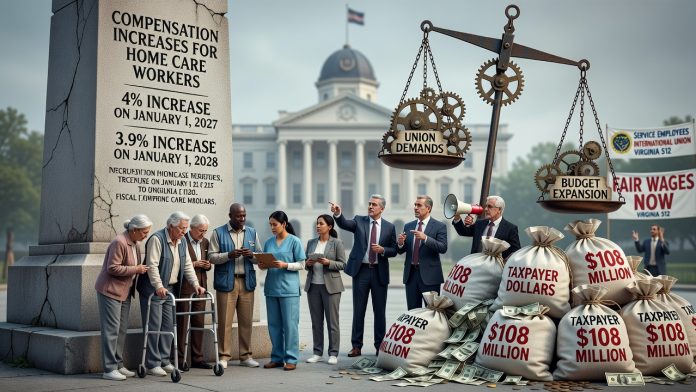
The Virginia state budget continues to expand under new amendments that accelerate compensation increases for home care workers, putting additional strain on taxpayers. Governor Abigail Spanberger recently returned the state budget with fourteen amendments, specifically requesting earlier salary increases for Medicaid-funded care providers. This move shifts a previously planned eight percent increase scheduled for January 2028 into a staggered hike, implementing a four percent increase on January 1, 2027, and a subsequent 3.9 percent increase on January 1, 2028. Fiscal conservatives are raising alarms over the long-term sustainability of these rapid budget expansions and the growing financial burden placed on hardworking Virginia families.
These accelerated wage hikes will require a massive infusion of taxpayer dollars, costing an estimated $108 million in combined state and federal Medicaid funding over the biennium. The funding will be funneled directly through the Department of Medical Assistance Services, an agency that manages the state’s complex Medicaid waivers and related social programs. Critics argue that continuously expanding the budget of the Department of Medical Assistance Services without implementing rigorous fraud prevention measures is a recipe for fiscal disaster. Lawmakers committed to fiscal responsibility are openly questioning whether this massive spending increase is truly necessary or simply a costly concession to special interest groups.
Union Influence and Medicaid Expansion
The aggressive push for these accelerated wage increases has been heavily championed by labor unions, particularly the influential Service Employees International Union Virginia 512. The union claims that Virginia faces a severe care crisis, arguing that current wages make it difficult to recruit and retain the workforce needed to serve older adults and people with disabilities. Most consumer-directed home care workers in Virginia currently earn $13.88 an hour, a base rate that union activists insist must be raised dramatically at the direct expense of state taxpayers. However, conservative budget hawks point out that yielding to union demands only guarantees future requests for even larger appropriations, perpetually inflating the state budget year after year.
Governor Abigail Spanberger publicly praised the General Assembly for accepting her amendments, which also included provisions for rural electric cooperatives and firefighter cancer screenings. In her official statement, she emphasized her primary goal to deliver for Virginia families by requesting the immediate adoption of fourteen specific budget amendments. While her administration frames these sweeping changes as essential state investments, fiscal watchdogs view them as classic examples of unchecked government spending that expands the welfare state. The acceleration of these home care worker salary increases represents a significant and costly departure from more measured, fiscally conservative budgeting principles.
The Threat of Waste and Overspending
The newly amended timeline drastically alters the compensation framework established in previous legislative sessions, forcing taxpayers to foot the bill much sooner than anticipated. In the previous 2024-2026 biennial budget, reimbursement rates for Medicaid personal care, respite, and companionship services were increased by a modest and manageable two percent each year. Moving from a steady two percent increase to an accelerated, staggered eight percent total hike demonstrates a troubling trend of rapidly escalating financial commitments. Taxpayers are rightfully concerned that this rapid acceleration of funding will inevitably lead to increased waste and inefficiency within an already bloated state Medicaid system.
Expanding agency and consumer-directed personal care programs without strict, independent oversight historically opens the door to widespread fraud and abuse of public funds. The Department of Medical Assistance Services oversees a vast, decentralized network of providers, making it incredibly difficult to track every single dollar spent on these newly accelerated wages. Conservative lawmakers consistently argue that before pouring an additional $108 million into these programs, the state must conduct comprehensive audits to eliminate existing waste. Throwing more money at a systemic issue without demanding structural reforms ultimately punishes the hardworking taxpayers of Virginia who are forced to subsidize these expansions.
Protecting the Virginia Taxpayer
As the scheduled implementation dates of January 2027 and January 2028 approach, the true financial impact of these budget amendments will become undeniably clear to the public. State legislators who value fiscal restraint must monitor this massive $108 million expenditure closely to ensure that taxpayer funds are not being mismanaged or squandered. Limiting government overreach and curbing the outsized influence of powerful public sector unions remains absolutely essential to preserving Virginia’s long-term economic stability. Ultimately, protecting the taxpayer requires a firm, unwavering commitment to reducing the budget, eliminating systemic fraud, and actively rejecting unsustainable spending demands.