
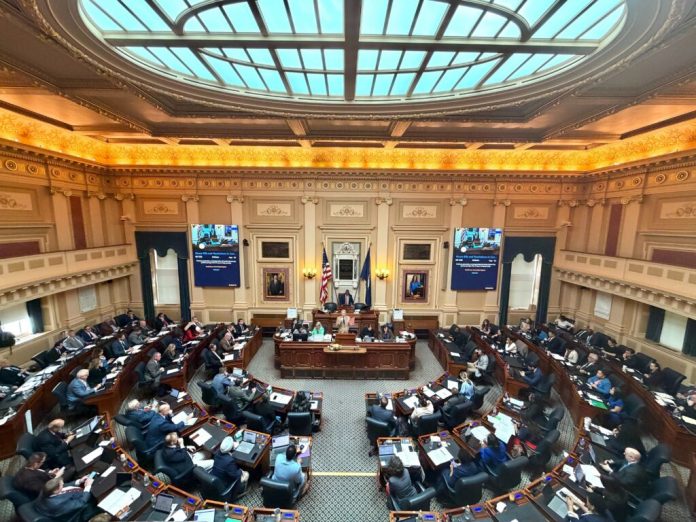
Less than 48 hours before the start of Virginia’s new fiscal year, the General Assembly will meet in Richmond Monday to consider Gov. Abigail Spanberger’s proposed amendments to the state’s two-year spending plan lawmakers passed one week ago.
The House of Delegates will reconvene at noon to take up the governor’s amendments first, followed later in the day by the Senate. Spanberger must sign the finalized budget before state funding authority expires Tuesday at 11:59 p.m.
Lawmakers approved the roughly $205 billion budget last Monday after reaching a compromise that ended a monthslong standoff over whether Virginia should continue offering major tax incentives to the data center industry.
The dispute delayed passage of the state budget well beyond the General Assembly’s regular session and forced lawmakers into a special session as the July 1 start of the new fiscal year approached.
Spanberger rolled out 14 amendments to Virginia’s spending plan Friday, proposing a mix of technical changes, new spending initiatives and policy revisions.
The changes would draw another $62 million from the state’s remaining unappropriated surplus, lowering the balance from about $179 million to roughly $117 million, according to the Governor’s Office.
In a statement accompanying the amendments, Spanberger said the proposals were intended to lower costs for Virginians and strengthen state services.
“To further deliver for Virginia families, I am returning this budget with a request that the attached 14 amendments be adopted,” she said.
Several changes focus on healthcare and public safety spending. One proposal would accelerate planned pay raises for home-care workers providing personal care services through Medicaid waivers and related programs.
Under the amendment, rates would increase by 4% beginning Jan. 1, 2027, followed by another 3.9% increase in 2028.
Another amendment would create a firefighter cancer screening grant program funded with $2 million annually to help localities provide screenings for career firefighters.
Spanberger also proposed changes tied to Virginia’s data center industry, including new water-conservation requirements for future facilities in parts of the state facing groundwater strain and technical revisions to the newly approved data center electricity consumption tax.
Other amendments would expand eligibility for utility bill credits funded through the Regional Greenhouse Gas Initiative to include customers served by Virginia’s electric cooperatives.
The governor also proposed $5 million in startup funding for a new state digital services team intended to help agencies modernize aging technology systems and improve public services.
Additional changes include funding for referendum administration costs, support for Atlantic menhaden research, authorization for a proposed state park in Loudoun County, revisions to paid sick leave language approved earlier this year and a one-year delay in the effective date of Virginia’s new firearms-in-public-areas law.
Much of the months-long budget fight centered on Virginia’s sales and use tax exemption for data centers, a policy long credited with helping transform the commonwealth into the world’s largest data center market.
But the industry’s rapid growth has also triggered mounting concerns in Richmond over energy consumption, electric transmission demands and rising utility costs.
Business groups and many House lawmakers warned that weakening the incentive could hurt Virginia’s competitiveness and push future projects into neighboring states.
Senate Democrats and some environmental advocates, however, argued the state needed to capture more revenue from an industry that places growing pressure on Virginia’s electric grid and infrastructure.
Earlier this month, Spanberger publicly pressured lawmakers to finish negotiations as the June 30 deadline approached, criticizing the prolonged budget impasse and warning that Virginians expected the state government to meet its basic responsibilities.
“I think it’s outrageous that we are where we are, and I hear from many legislators that they are displeased with the process,” she told The Mercury in an interview.
The final compromise crafted by House and Senate negotiators preserved the existing sales tax exemption while creating a temporary energy consumption tax on large data centers.
Under the agreement, the tax would apply to facilities exceeding certain electricity-use thresholds, with revenue directed toward offsetting energy-related costs and other state priorities.
Spearheaded by Senate Finance Chair Louise Lucas, D-Portsmouth, Senate Democrats had spent much of the negotiations pushing for a broader tax structure targeting the industry, while House negotiators, backed by Spanberger, resisted proposals they believed could discourage investment and jeopardize Virginia’s standing as a global technology hub.
The final deal reflected weeks of negotiations inside the Democratic Party over how aggressively Virginia should regulate and tax one of its fastest growing industries.
The budget package also included funding for transportation, education and healthcare programs, along with money for local infrastructure projects and flood mitigation efforts.
Lawmakers additionally approved a budget item tied to Virginia’s renewed participation in the Regional Greenhouse Gas Initiative that would provide Dominion Energy customers with an estimated monthly $3 rebate funded through proceeds generated by the carbon-reduction program.
House Speaker Don Scott, D-Portsmouth, House Appropriations Chair Luke Torian, D-Prince Williams, and Lucas played central roles in the negotiations that stretched for months before lawmakers reached a final agreement earlier this month.
Monday’s reconvened special session will give lawmakers their final opportunity to accept or reject Spanberger’s proposed changes before the budget heads to her desk for signature ahead of Tuesday’s deadline.