
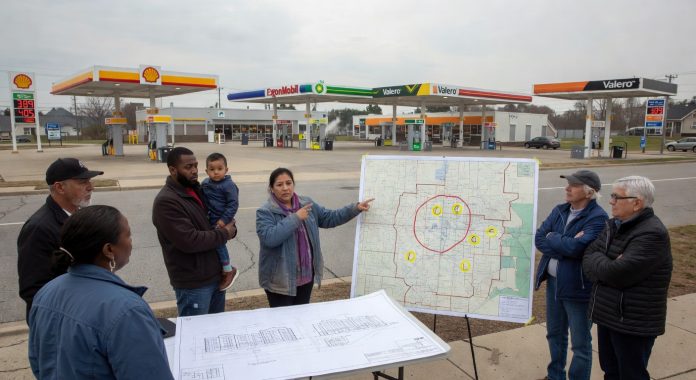
Plans for affordable housing development in Fairfax County have drawn attention to the site’s location next to five gas stations. Community members have raised questions regarding possible health implications tied to emissions from these facilities. The discussion centers on benzene and other compounds associated with petroleum operations in the area.
Visual materials include a map showing the layout of Franconia Road and surrounding streets with gas stations indicated by red markers. The Government Center is highlighted in green, providing context for the proximity of the proposed housing to these commercial sites. Information about a public hearing process appears alongside a telephone number for interested participants.
Scientific references displayed outline connections between residential proximity to gas stations and certain health outcomes. Data from the National Institutes of Health suggest elevated risks of childhood leukemia for individuals living within specified distances of such stations. Volatile organic compounds including benzene feature prominently in the explanations provided.
Detailed points note that closer residences correlate with higher risk levels. Research has identified instances of 1.2 to 2.2 times increased odds for childhood leukemia or related conditions based on distance and station density. Factors such as gasoline vapors and benzene emissions receive specific mention as contributors.
Suggestions for mitigation include the creation of buffer zones between gas stations and new residential areas. These recommendations aim to limit exposure particularly for vulnerable groups like children. Supporting evidence comes from various health studies referenced in the materials.
Further studies address lifetime cancer risk estimation from benzene at clustered gas stations. Models account for sales volume and meteorological conditions to project potential impacts. Comparisons across different station configurations illustrate varying risk profiles.
Public input has been noted as part of the process with references to opposition in similar contexts. Investigations from other locations have examined leukemia associations with gas station proximity. Some findings indicate that risks near these sites may approach or exceed certain environmental benchmarks.
The broader context involves efforts to address housing availability while considering environmental factors. Local discussions continue to explore how development projects can proceed with appropriate safeguards in place. Evaluation of site conditions remains an ongoing aspect of the review.
Benzene is identified in the materials as a chemical classified as a human carcinogen. Links to conditions such as lymphoma and myeloma appear alongside leukemia considerations. Populations living nearest to dispensing activities experience relatively higher exposure levels compared to the general public.
Community engagement focuses on understanding these elements fully before final decisions. The materials encourage review of the compiled research to inform perspectives on the project. Additional scrutiny of emission sources and exposure pathways may provide further clarity.
This development in Fairfax County reflects typical considerations in balancing growth with health protections. Stakeholders review available data to assess the situation comprehensively.