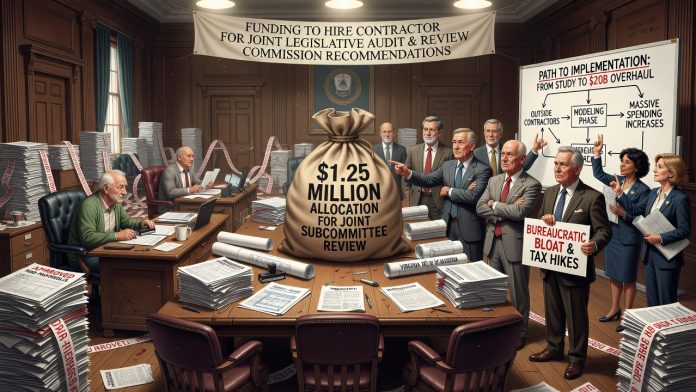
The Virginia legislature has finalized a state budget that includes a massive $1.25 million allocation aimed at reviewing the public education funding formula. This significant expenditure will fund the Joint Subcommittee on Elementary and Secondary Education Funding over the upcoming biennium. Conservative watchdogs are raising serious concerns that this allocation represents another layer of bureaucratic bloat designed to justify massive future tax increases. Instead of utilizing existing state resources, lawmakers are spending taxpayer dollars to hire outside contractors to tell them how to spend even more money.
The financial breakdown of this new initiative reveals a heavy burden on the state’s general fund over the next two years. For fiscal year 2027, the state will extract a staggering $1,000,000 from the general fund, followed by an additional $250,000 in fiscal year 2028. The Virginia Senate initially pushed for this full $1.25 million expenditure, while the House had originally proposed a much more fiscally responsible $250,000 allocation. Ultimately, the final compromise budget adopted the Senate’s inflated figure, forcing taxpayers to foot the bill for an expensive external review that many deem entirely unnecessary.
Bureaucratic Red Tape and Outside Contractors
This costly initiative involves multiple state agencies that already consume vast amounts of taxpayer funding every single year. The Superintendent of Public Instruction is now tasked with issuing a formal Request for Proposals to find a private contractor for the project. Furthermore, the Department of Planning and Budget is mandated to ensure continued collaboration throughout this entire modernization effort. Critics argue that relying on high-priced external consultants completely ignores the highly paid educational experts already employed within the Virginia Department of Education.
Legislative leaders who championed the spending point to a need for continued analysis of existing state recommendations. According to the budget compromise introduced by House Speaker Don Scott and Appropriations Chairman Luke Torian, the budget provides this massive sum for the subcommittee to complete its review of the funding formula. Official budget amendment language explicitly states that the funding allows the state to hire a contractor to support the continued work on Joint Legislative Audit and Review Commission recommendations. However, fiscal conservatives view this as a classic government tactic of spending millions of dollars to study how to spend billions of dollars.
Paving the Way for Massive Spending Increases
The push for this expensive review stems from a 2023 report by the Joint Legislative Audit and Review Commission regarding public school finance. That specific report concluded that the state’s existing formulas vastly underestimated the actual local costs of providing a high-quality public education. In response to those controversial findings, lawmakers established the Joint Subcommittee on Elementary and Secondary Education Funding to explore sweeping changes to the system. Now, this $1.25 million allocation serves as a new, targeted investment specifically designated to transition the state from a mere study phase into active modeling and implementation.
Unsurprisingly, groups that consistently advocate for higher government spending are publicly celebrating this million-dollar allocation. The Virginia Education Association justified the investment, stating that bringing in outside expertise and conducting modeling is essential for making meaningful changes. The union insists that getting the formula right is foundational to everything else in the upcoming December 2027 biennium budget. This signals to taxpayers that the current $1.25 million study is merely the opening salvo for a massive overhaul of Virginia’s already staggering $20 billion public education budget.
Protecting the Virginia Taxpayer
When state governments begin hiring outside contractors to evaluate funding models, the inevitable result is a recommendation to increase public spending. Fiscal conservatives understand that modernizing a formula is often political code for expanding government programs and increasing the financial burden on working citizens. If the Joint Subcommittee truly wanted to serve the public interest, it would focus its efforts on finding efficiencies and eliminating wasteful spending within the current education framework. Unfortunately, this million-dollar contract suggests that lawmakers are preparing to demand even more revenue from the citizens of Virginia.
Hardworking Virginia taxpayers are left questioning why their money is being funneled into redundant studies and private consulting contracts. At a time when families are struggling with inflation and economic uncertainty, state government should be identifying ways to reduce the budget and save money. Throwing over a million dollars at a subcommittee to evaluate a funding formula highlights a severe disconnect between Richmond politicians and basic fiscal responsibility. Lawmakers must stop treating the general fund as an endless resource and start demanding genuine accountability from the agencies already funded to do this work.