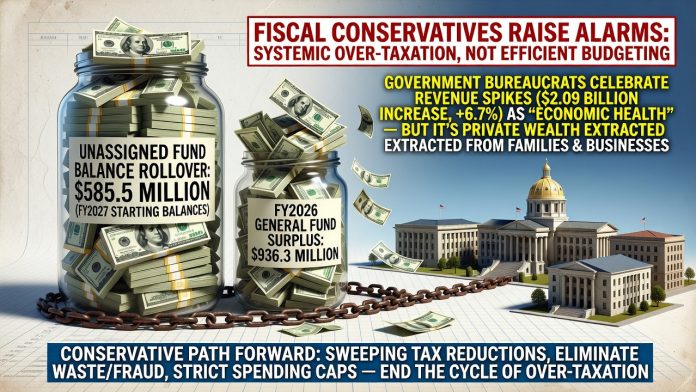
Virginia taxpayers have once again funded a massive government surplus, with Fiscal Year 2026 ending with an excess of $936.3 million in the general fund. Instead of returning these over-collected funds directly to the citizens, state officials plan to incorporate $585.5 million of this surplus into the Fiscal Year 2027 starting balances. This maneuver acts as an unassigned fund balance rollover, essentially parking hundreds of millions of taxpayer dollars in government coffers for future spending. Fiscal conservatives across the commonwealth are raising alarms about this approach, arguing that a massive surplus is clear evidence of systemic over-taxation rather than efficient budgeting.
The sheer scale of the recent revenue collection highlights a growing financial burden on Virginia families and local businesses. State revenues for Fiscal Year 2026 grew by a staggering 6.7 percent, representing an increase of $2.09 billion over the previous fiscal year. While government bureaucrats often celebrate such revenue spikes as signs of economic health, these figures actually represent private wealth being aggressively extracted from the private sector. Hardworking residents are tightening their personal budgets amid broader economic pressures, yet the state government continues to expand its financial footprint at their direct expense.
Questioning the Definition of Fiscal Responsibility
Governor Abigail Spanberger recently addressed the surplus, emphasizing fiscal responsibility and investments in education, public safety, and economic development. However, many conservative watchdogs argue that the term “investments” is frequently utilized by politicians as a convenient euphemism for increased government spending and unchecked bureaucratic expansion. While supporting local police and core educational standards remains vital, continuously pouring surplus cash into these departments often funds administrative bloat rather than necessary frontline resources. True fiscal responsibility would involve aggressively scrutinizing current expenditures to eliminate waste and fraud rather than finding new ways to allocate excess revenue.
Furthermore, funneling surplus dollars into broad, undefined categories like economic development often leads to the state picking winners and losers in the corporate sector. This approach routinely wastes taxpayer money on inefficient corporate subsidies that consistently fail to deliver promised job growth or meaningful community benefits. The free market, not government bureaucrats, should dictate economic expansion and direct capital toward the most deserving and innovative enterprises. When the state hoards a massive surplus to fund these pet projects, it deprives small businesses of the vital capital they could have retained through lower taxes.
The decision to roll over $585.5 million into the Fiscal Year 2027 starting balances as an unassigned fund balance raises serious transparency and accountability concerns. Unassigned funds lack specific legislative mandates, leaving a massive pool of money highly vulnerable to opportunistic spending proposals by ambitious lawmakers. Rather than returning this money through targeted tax cuts or statewide rebates, the state is effectively holding a massive slush fund that encourages future budget bloat. Taxpayers deserve a government that operates within strictly defined financial boundaries, rather than one that hoards cash to fuel undisciplined spending sprees down the road.
The Path Forward
While maintaining robust reserves like the Rainy Day Fund is a prudent measure for economic downturns, chronically overfunding these accounts restricts private economic growth. The remaining portion of the $936.3 million surplus, alongside the massive $585.5 million rollover, clearly demonstrates that Virginia is collecting far more than it needs to operate basic public services. Conservative leaders rightfully argue that any revenue collected beyond the essential needs of public safety, basic infrastructure, and core educational requirements should automatically trigger sweeping tax reductions. Lowering the overall tax burden would stimulate local economies organically, empowering families to spend their own money on their unique priorities.
The underlying cause of this massive rollover is the staggering $2.09 billion increase in state revenues over the prior fiscal year. This historic surge in tax collection is entirely unsustainable and places an undue burden on the commercial engines that keep the commonwealth running. If the government can effortlessly absorb a $2.09 billion revenue hike, it strongly indicates that the current tax rates are fundamentally misaligned with the actual, practical cost of governing. Lawmakers must recognize that continuous revenue growth of this magnitude is a glaring warning sign of over-taxation that requires immediate legislative correction.
To truly protect the financial interests of Virginia residents, lawmakers must pivot their focus toward identifying and eliminating systemic government waste, fraud, and overspending. Every single dollar rolled over into a new fiscal year represents a dollar that was unnecessarily extracted from the commonwealth’s fragile economy. Comprehensive audits of current state programs could easily fund necessary improvements in public safety and education without requiring a single cent of this surplus cash. By shrinking the overall size of the budget and enforcing strict spending caps, Virginia can ensure that future surpluses are structurally impossible because taxes will be appropriately low.
Ultimately, the incorporation of $585.5 million into the Fiscal Year 2027 starting balances is a clear signal that Richmond prioritizes government expansion over taxpayer relief. As lawmakers prepare for the upcoming legislative sessions, they must be held strictly accountable for this massive accumulation of unassigned wealth. Virginians expect their elected officials to respect their hard-earned money by cutting unnecessary programs and delivering permanent, meaningful tax reductions. Until the state commits to drastically reducing the budget and ending the cycle of over-taxation, taxpayers will continue to bear the heavy cost of runaway government spending.