
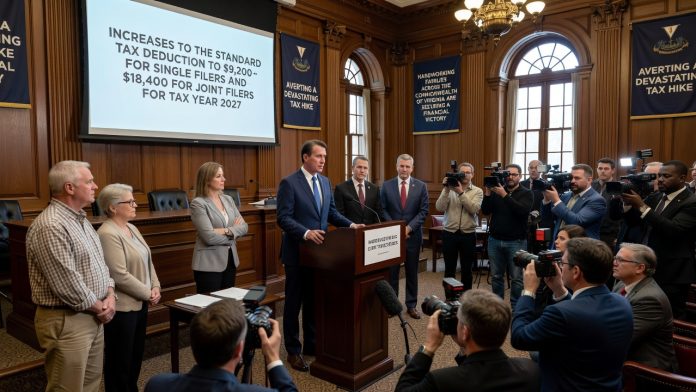
Hardworking families across the Commonwealth of Virginia are securing a critical financial victory as the state prepares to implement increased standard tax deductions for the upcoming years. Starting in tax year 2027, the standard deduction will rise to $9,200 for single filers and $18,400 for joint filers. This legislative move effectively keeps millions of dollars in the pockets of citizens rather than feeding the ever-expanding bureaucracy in Richmond. Conservative advocates have long argued that allowing taxpayers to keep more of their hard-earned money is the most effective way to stimulate the economy and combat inflation.
Averting a Devastating Tax Hike
Without this crucial legislative intervention, Virginia taxpayers were staring down the barrel of a massive, automatic tax increase scheduled to take effect after tax year 2026. The previous standard deduction levels were set to sunset entirely, plummeting to a mere $3,000 for single filers and $6,000 for joint filers. Such a drastic reduction would have resulted in an unconscionable tax burden on working-class families already struggling with rising living costs. Preventing this reversion was a top priority for fiscal conservatives who recognize that state government has no business balancing its bloated budgets on the backs of everyday citizens.
The newly established baseline for tax year 2026 and prior years stood at $8,750 for individuals and $17,500 for married couples filing jointly. By pushing the deduction to $9,200 and $18,400 respectively for 2027, lawmakers have secured an increase of $450 for single filers and $900 for joint filers. Furthermore, the relief does not stop there, as the deductions are slated to increase again in tax years 2028 and 2029 to $9,300 for singles and $18,600 for couples. These incremental steps provide a necessary buffer against inflation while forcing state agencies to operate within more reasonable financial constraints.
Fiscal Responsibility and Government Restraint
Financial projections indicate that these tax cuts will result in an estimated reduction of $51.0 million to the state General Fund in fiscal year 2027. That figure is expected to grow to a $108.4 million reduction in fiscal year 2028 as the subsequent deduction increases take effect. While bureaucratic agencies often view these reductions as lost revenue, fiscal conservatives correctly identify them as necessary limits on state overspending and potential fraud. By starving the sprawling government apparatus of excess cash, lawmakers are implicitly demanding that state departments eliminate wasteful programs and focus strictly on essential services.
Governor Glenn Youngkin championed this approach during his December 2025 budget proposal presentation, where he initially fought to make the existing standard deductions permanent. During that pivotal address, Governor Youngkin firmly declared that there is no need for any new taxes, and there is no need for tax increases. His steadfast commitment to fiscal discipline set the stage for the current increases, ensuring that the state government respects the financial boundaries of its citizens. This principled stance highlights the fundamental conservative belief that taxpayers always know how to spend their own money better than government officials do.
Bipartisan Agreement on Affordability
The undeniable economic pressures facing Virginians ultimately forced a bipartisan consensus on the necessity of this tax relief during the June 2026 compromise. Senate Finance Appropriations Chair Louise Lucas and House Appropriations Chair Luke Torian released a joint statement acknowledging that households are feeling severely squeezed by rising costs and economic uncertainty. They noted that the budget agreement reflects a shared commitment to making Virginia more affordable for families while maintaining the financial health of the state. Even those who typically advocate for higher government spending were compelled to admit that returning money to taxpayers is essential in the current economic climate.
The Virginia Department of Taxation will be responsible for implementing these new deduction thresholds as residents prepare their future filings. Ensuring a smooth transition to the higher deduction rates will be critical for maximizing the economic benefits intended by the legislation. State auditors and oversight committees must carefully monitor the department to guarantee that no unnecessary administrative costs dilute the impact of this financial relief. Streamlining the tax collection process and reducing bureaucratic overhead should remain a top priority as these new financial guidelines take effect.
Protecting Taxpayers from Future Overspending
While the increased standard deductions represent a significant victory, fiscal watchdogs warn that the fight against government bloat is far from over. Lawmakers must remain vigilant against future attempts to quietly raise taxes or introduce hidden fees to offset the revenue kept by taxpayers. True financial stability for the Commonwealth requires a permanent commitment to auditing state agencies, identifying fraudulent spending, and cutting wasteful programs that do not serve the public interest. The millions of dollars saved by citizens through these deductions should serve as a permanent reminder that government must live within its means.
Moving forward, Virginia must continue to prioritize policies that empower families and businesses rather than expanding the reach of state agencies. The successful implementation of the 2027 tax deduction increases proves that significant tax relief is entirely possible without compromising essential state functions. By maintaining a strict focus on efficiency and fiscal responsibility, leaders can ensure that the Commonwealth remains a competitive and affordable place to live. Ultimately, securing lower taxes and demanding accountability in government spending are the most reliable methods for securing long-term prosperity for all Virginians.