
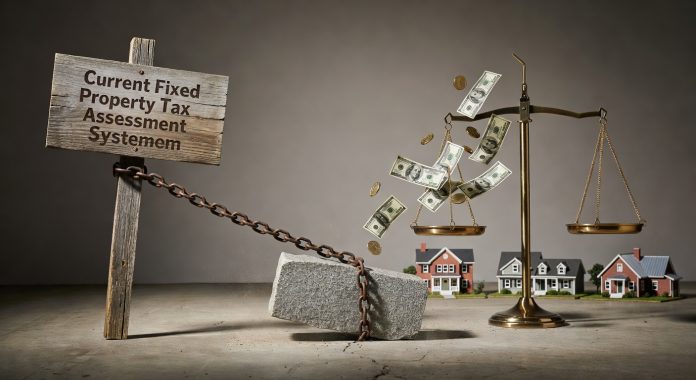
In the ongoing efforts to refine local government financing in Virginia, Delegate Joseph McNamara has introduced House Bill 68 during the 2026 Regular Session of the House of Delegates. This legislation focuses on amending provisions in the Code of Virginia related to how counties and cities handle tax rate adjustments following real property assessments. The bill specifically targets sections 58.1-3321 and 58.1-3330, aiming to introduce considerations for inflation when determining the impact of assessment changes on the total tax levy.
Current Virginia statutes require that if an annual, biennial, or general reassessment of real property would cause the aggregate real estate taxes to rise by more than one percent compared to the previous year, the local governing body must take action. Options include reducing the tax rate to maintain or lower the total levy or scheduling a public hearing to seek approval for the increase. Additionally, the mailed notices of assessment changes to individual property owners and the announcements for any required public hearings must contain a precise calculation. This calculation identifies the tax rate that would produce exactly the same total revenue as the prior year when multiplied by the new total assessed value of real property, with exclusions for new construction and improvements.
A key limitation in the present system is the absence of any adjustment for inflation within this calculation. As property assessments often increase due to general inflationary trends in the economy and real estate markets, many localities find themselves compelled to either cut rates or convene hearings even when the apparent growth does not represent additional real revenue in constant dollars. This dynamic has prompted calls for reform to better align tax procedures with broader economic indicators.
House Bill 68 addresses this by permitting local governments to exclude the component of assessment growth attributable to inflation when performing the revenue-neutral rate calculations. This change allows the threshold determination for tax levy increases to reflect only non-inflationary growth factors. Consequently, localities gain the flexibility to sustain the real value of their tax collections without the automatic classification of inflationary appreciation as a taxable increase that demands rate adjustment or public input.
Introduced at the specific request of Roanoke County, the proposal seeks to equip local officials with more accurate tools for budget planning in an environment where costs for services frequently track with inflation rates. The bill progressed through initial stages in the House Finance Committee, with a subcommittee review occurring on January 27, 2026, and full committee consideration the following day on January 28, 2026. During these discussions, committee members reviewed printed versions of the legislation, including potential refinements to the language.
Ultimately, the House of Delegates carried House Bill 68 over to the 2027 session via voice vote. This action allows for further development, additional public comment, and possible amendments to ensure the measure effectively achieves its objectives while addressing any concerns about transparency and communication to residents.
The implications of such a change extend to property owners throughout the commonwealth. By accounting for inflation, the tax notices and hearing requirements can present a more balanced view of how economic conditions influence property values and corresponding tax obligations. Homeowners may benefit from reduced instances of rate reductions that could lead to future increases or from hearings that focus solely on inflationary effects rather than substantive policy decisions.
Local governments, in turn, stand to maintain more stable funding streams for essential operations. Virginia’s counties and cities rely heavily on real property taxes to support public education, emergency services, infrastructure maintenance, and other vital functions. When inflation erodes the purchasing power of fixed revenue without corresponding adjustments, service levels may suffer unless other revenue sources are tapped. The proposed adjustment in HB68 offers a mechanism to mitigate such outcomes through proactive consideration of economic realities.
The legislative process surrounding this bill highlights the importance of periodic updates to tax codes to keep pace with changing conditions. Sections 58.1-3321 and 58.1-3330 have long served as foundational elements in Virginia’s local taxation system, providing safeguards against unchecked tax growth while ensuring public awareness. Amending them to include inflation metrics represents a measured evolution in this framework.
Stakeholders, including county administrators and elected officials in areas like Roanoke, have expressed support for the concept as a means to enhance administrative efficiency. The carryover to the next session provides an opportunity for comprehensive analysis, potentially incorporating data from the Department of Taxation on fiscal impacts and refining the communication strategies for affected taxpayers.
As Virginia continues to navigate economic fluctuations, legislation like House Bill 68 underscores the commitment to fair and responsive property taxation practices. The focus on inflation consideration ensures that tax policy remains grounded in practical economic principles, supporting both the fiscal health of local entities and the interests of residents who own real property across the state. Further action in the 2027 session will determine the ultimate form and implementation of these proposed reforms.