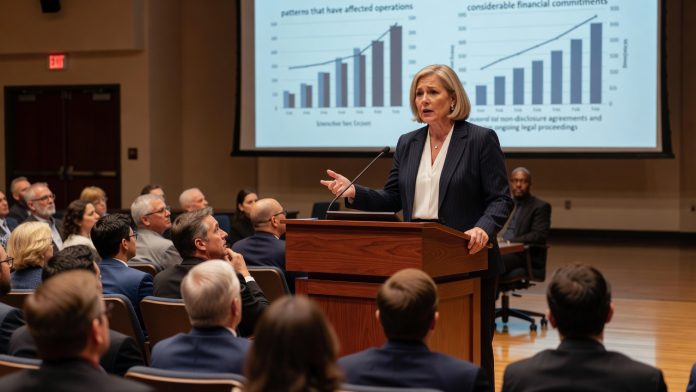
Dr. Kimberly addressed an audience to describe specific concerns involving Prince William County Public Schools. She referenced multiple instances of non-disclosure agreements and associated legal proceedings. These matters have reportedly involved considerable financial commitments over time.
The presentation focused on patterns that have affected operations within the school system. Wade Anderson was identified in connection with these developments. Dr. Kimberly advocated for a federal investigation to review the circumstances thoroughly.
Public records and community discussions have touched on similar topics in recent periods. The emphasis remains on understanding the full context of the agreements and expenditures. Transparency serves as a key element in maintaining public confidence.
Details on Reported Agreements
Non-disclosure agreements in educational settings often arise during personnel or contractual resolutions. In this case, references were made to agreements valued around twenty thousand dollars. Such tools can limit the disclosure of settlement terms to involved parties.
Legal battles reaching half a million dollars indicate significant resource allocation. These costs reflect the complexity of disputes that may involve multiple stakeholders. Dr. Kimberly noted the cumulative effect on overall school funding priorities.
The former employment status of certain individuals was also highlighted during the remarks. This background provides additional context for understanding roles and responsibilities. Further examination could clarify how these elements interconnect.
Position of Wade Anderson
Wade Anderson has been described in relation to the school board attorney position. His prior connection as an employee forms part of the discussion. Questions about continuity in legal representation have surfaced as a result.
Dr. Kimberly suggested that these connections warrant independent review by federal authorities. An investigation could assess compliance with applicable regulations and policies. No conclusions have been drawn pending additional information.
The school system continues to operate amid ongoing community interest in these topics. Residents monitor developments to stay informed about potential implications. Objective analysis remains essential for accurate understanding.
Community Response and Next Steps
Parents and stakeholders have expressed interest in greater openness regarding school administration. Dr. Kimberly’s comments contribute to broader conversations about governance practices. Educational institutions benefit from clear communication with their constituents.
Federal involvement could establish benchmarks for future accountability. This approach aligns with standard procedures for examining public agency matters. Documentation and testimony would form the basis of any such review.
The situation underscores the value of public participation in local education issues. Continued dialogue supports informed decision-making at all levels. Updates on related developments will be followed with attention to factual reporting.
Email the School Board at:
Babur B. Lateef, M.D. (Chairman At-Large) — blateef@pwcs.edu,
Richard M. Jessie (Vice Chairman, Occoquan District) — rjessie@pwcs.edu,
Erica C. Tredinnick (Brentsville District) — etredinnick@pwcs.edu,
Lisa A. Zargarpur (Coles District) — lzargarpur@pwcs.edu,
Jennifer T. Wall (Gainesville District) — jwall@pwcs.edu,
Tracy L. Blake (Neabsco District) — tblake@pwcs.edu,
Justin David Wilk (Potomac District) — jwilk@pwcs.edu,
Loree Y. Williams (Woodbridge District) — lwilliams@pwcs.edu,