
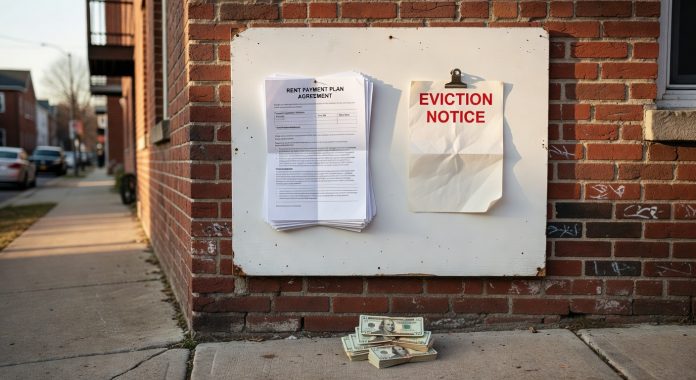
Virginia General Assembly Approves Bill Requiring Landlords to Offer Payment Plans Before Evicting for Minor Rent Defaults
The Virginia House of Delegates and Senate have passed legislation that establishes new protocols for landlords seeking to address tenant nonpayment of rent under the Virginia Residential Landlord and Tenant Act. House Bill 95 specifically targets situations where the unpaid rent does not exceed one month’s rent plus contracted late charges.
Under the provisions of the bill, landlords owning more than four rental dwelling units or possessing more than a 10 percent ownership interest in more than four rental dwelling units must follow a mandatory process prior to terminating the rental agreement. This process begins with serving a written notice to the tenant that specifies the exact amount due and owed. The notice must also present an option for the tenant to enter into a payment plan.
The payment plan requires the tenant to repay the precise amount owed through equal monthly installments spread over the shorter of six months or the remaining duration of the lease agreement. During the term of this payment plan, the landlord is prohibited from assessing any further late fees related to the unpaid rent that is the subject of the plan, as long as the tenant complies with the payment terms.
The bill further specifies the courses of action available to the landlord if the tenant does not settle the owed amount or agree to the payment plan within five days after receiving the notice. In such cases, the landlord retains the right to proceed with ending the rental agreement. Similarly, if a tenant who has agreed to a payment plan subsequently fails to pay current rent or misses a scheduled installment under the plan, the landlord can exercise remedies including termination of the agreement.
An additional element introduced through amendments requires the Department of Housing and Community Development to create a sample payment plan template that landlords can utilize when offering these arrangements to tenants.
The legislation carries a delayed implementation date of January 1, 2027, allowing time for landlords and the department to prepare for the changes.
The bill, introduced by Delegate Elizabeth Bennett-Parker, originated in the House of Delegates and progressed through subcommittee and committee reviews in January and February 2026. It received approval in the House before moving to the Senate, where it was debated and passed. Following transmittal to the Governor, several recommendations were made, and in April 2026, the House voted 64 to 36 to adopt the majority of the Governor’s amendments. The Senate then concurred with those recommendations by a margin of 21 to 18.
This new framework modifies the existing remedies available to landlords under section 55.1-1245 of the Code of Virginia, both in its current form and as it will be amended.
Industry groups representing property owners have expressed apprehension regarding the operational challenges posed by these requirements. Officials from the Virginia Apartment Management Association have noted that the mandated delay in pursuing eviction actions could allow unpaid balances to grow substantially before legal proceedings commence. This extension of time before court involvement, they have stated, might result in the initial court filing reflecting debts approximately twice as large as under previous procedures, escalating from roughly two thousand dollars to four thousand dollars.
Such extensions, according to these observers, complicate the management of rental properties and may deter new investments in the rental housing sector. With landlords facing prolonged periods without rent collection and added administrative duties to manage payment plans, some have suggested that these factors could contribute to a contraction in the supply of available rental units statewide. Reduced supply, in turn, could exert upward pressure on rental prices for all tenants seeking housing.
Republican members of the legislature have highlighted the bill’s potential to alter the balance in rental agreements by adding layers of mandated procedures that increase costs and risks for property owners. These changes, they have argued, could ultimately affect the viability of rental businesses, particularly for those managing portfolios just above the four-unit threshold.
The measure also preserves certain existing tenant options, such as the right to redeem the property by paying owed amounts shortly before an eviction hearing, but the new payment plan obligation applies in advance of initiating those processes.
As the effective date approaches in 2027, landlords subject to the law will need to integrate these notice and plan requirements into their standard operating procedures for handling rent delinquencies. The development of the sample form by the Department of Housing and Community Development is expected to assist in standardizing the process across the Commonwealth.
This legislation marks a notable update to landlord remedies in Virginia, focusing on structured repayment as a preliminary step in addressing noncompliance with rental agreements for qualifying property owners.