
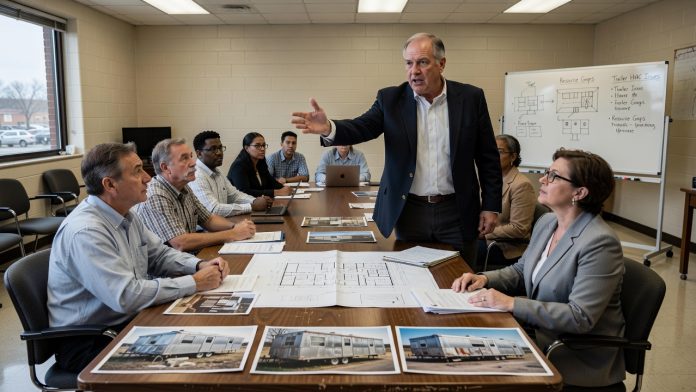
During a Franklin City School Board session, a member raised objections to advancing a $4.9 million project, citing the ongoing use of trailers for classrooms without adequate heat or air conditioning. The remarks came amid a broader discussion on district infrastructure and resource allocation. Other participants observed the exchange as details of the proposal were reviewed.
The comments focused on the timeline of debt repayment and its potential effects on future budgets in the Virginia city. This highlighted differing views on project timing and necessity within the board’s agenda. The session provided a forum for examining how educational facilities meet current standards.
Overview of the Proposed Initiative
The $4.9 million project under consideration involves enhancements to school facilities in Franklin City. Board members reviewed its scope alongside reports on existing classroom setups, including portable units. The proposal aims to address various needs, though specifics on implementation were part of the ongoing dialogue.
Funding mechanisms for such efforts typically include bonds or allocations from local revenues. In this instance, the debate touched on long-range financial planning and its alignment with district goals. Participants weighed the merits of proceeding at this stage.
Conditions in Student Learning Spaces
Classrooms housed in trailers have presented operational issues related to temperature regulation in Franklin City schools. The board noted that these units serve as temporary solutions while permanent structures undergo evaluation. Ensuring consistent environmental controls remains a point of attention in facility management.
Reports shared during meetings outline the number of students affected by these arrangements. Addressing these conditions forms part of broader efforts to maintain suitable learning environments across the district. The topic integrates into regular updates on capital improvements.
Board Deliberations on Resource Allocation
Board members in Franklin City engage in periodic reviews of spending priorities to support educational programs. The $4.9 million figure prompted analysis of costs versus projected outcomes in facility upgrades. This process involves input from various stakeholders on effective use of available funds.
Considerations include compliance with state guidelines for school infrastructure and debt limits. The session allowed for expression of perspectives on balancing immediate repairs with larger-scale developments. Such deliberations contribute to informed decision-making for the district.
Email At:
Robert Holt – rholt@fcpsva.org,
Wydia Bailey – wbailey@fcpsva.org,
LaChanda Parker – lparker@fcpsva.org,
Cristina Boone – cboone@fcpsva.org,
Kent Grant – kgrant@fcpsva.org,
John Allsbrook – jallsbrook@fcpsva.org,
Ellis Cofield – ecofield@fcpsva.org,