
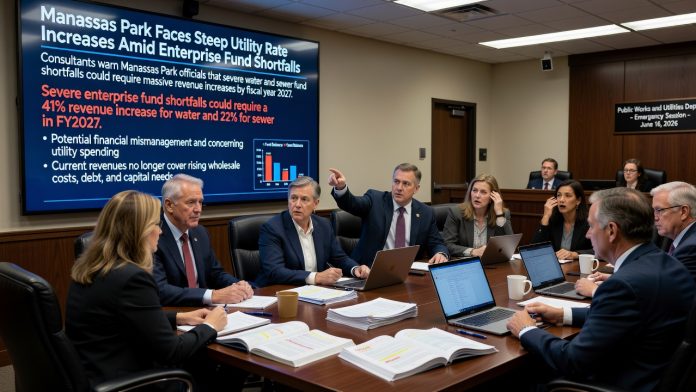
Officials in Manassas Park are grappling with stark financial warnings regarding the future of the city utility systems and enterprise funds. Consultants recently presented a sobering financial outlook indicating that severe enterprise fund shortfalls could require massive revenue increases in the near future. During a presentation on June 16, 2026, financial experts informed the local government that a forty-one percent revenue increase for water and a twenty-two percent increase for sewer might be necessary by fiscal year 2027. These projected hikes represent a significant financial challenge for the municipality and its residents.
The presentation highlighted growing concerns over potential financial mismanagement and escalating utility spending within the Public Works and Utilities departments. Consultants warned the city council that current water and sewer revenues are projected to fall drastically short of operational requirements. The financial advisors explicitly noted that the current revenue streams “no longer cover rising wholesale costs, debt, and capital needs.” This stark reality has prompted local leaders to reevaluate their long-term financial strategies to prevent a complete depletion of the Water and Sewer Enterprise Fund.
Impact on Local Households
For the average resident of Manassas Park, these projected utility rate increases could translate into a substantial financial burden. Officials reviewing the base charges, usage rates, and senior relief options flagged a potential “shock” to families if the full rate hikes are implemented. Currently, a typical household using three thousand gallons a month already faces a combined water and sewer bill that sits in the higher quartile regionally compared to historical rates. The looming threat of an additional forty-one percent increase on the water side alone has generated deep concern among community advocates.
The timing of these utility warnings presents a complex financial picture for the local government and its taxpayers. While the fiscal year 2027 budget included a two-cent real estate tax cut, the looming utility rate hikes represent a significant shift from previous baseline utility costs. Residents who might have expected financial relief from the property tax reduction could see those savings completely erased by the soaring cost of basic water and sewer services. Municipal financial planners are now tasked with finding a balance between maintaining affordable living conditions and funding essential infrastructure repairs.
Proposed Solutions and Tiered Rates
In an effort to mitigate the financial blow to everyday residents, utility consultants have proposed several structural changes to the city billing system. They recommended an “alternative, tiered rate design” featuring a meter-size fixed charge alongside tiered residential volumetric rates. This specific billing structure is designed to protect small users by charging higher rates only to those who consume excessive amounts of water. By shifting the financial burden toward heavy consumers, officials hope to stabilize the enterprise fund without devastating low-income households or seniors on fixed incomes.
The root causes of the Water and Sewer Enterprise Fund shortfall stem from a combination of aging infrastructure and accumulating municipal debt. Over the past several years, the cost of purchasing wholesale water and maintaining the aging sewer lines has outpaced the revenue generated by customer billing. Public Works and Utilities officials must now execute critical capital improvement projects to ensure the system remains functional and compliant with environmental regulations. Funding these mandatory improvements without an immediate cash infusion remains the primary hurdle for the Manassas Park local government.
Long-Term Financial Outlook
As Manassas Park approaches fiscal year 2027, the city council faces difficult legislative decisions regarding the exact implementation of these utility adjustments. Lawmakers must review the consultant reports thoroughly to determine exactly how much of the recommended forty-one percent water revenue increase will be passed directly to consumers. Additionally, the twenty-two percent sewer revenue increase warning requires immediate legislative attention to prevent further degradation of the city enterprise funds. The upcoming budget sessions are expected to feature intense debates over utility spending, infrastructure priorities, and overall fiscal responsibility.
The financial health of the Manassas Park utility system will ultimately depend on the swift and decisive actions taken by local policymakers in the coming months. Addressing the severe enterprise fund shortfalls requires a delicate balance of rate adjustments, operational efficiencies, and targeted relief for vulnerable populations. While the proposed tiered rate design offers a potential pathway forward, the sheer scale of the revenue deficits guarantees that residents will experience some level of financial impact. Municipal leaders are continuing to analyze the data to formulate a comprehensive strategy that secures the future of the city water and sewer infrastructure.
Email the Manassas Park City Council at:
Alanna Mensing (Mayor): a.mensing@manassasparkva.gov,
Darryl Moore (Vice Mayor): d.moore@manassasparkva.gov,
Haseeb Javed: h.javed@manassasparkva.gov,
Yesy Amaya: y.amaya@manassasparkva.gov,
Michael Carrera: m.carrera@manassasparkva.gov,
Stacy Seiberling: s.seiberling@manassasparkva.gov,
Kevin Moreau: k.moreau@manassasparkva.gov,































