
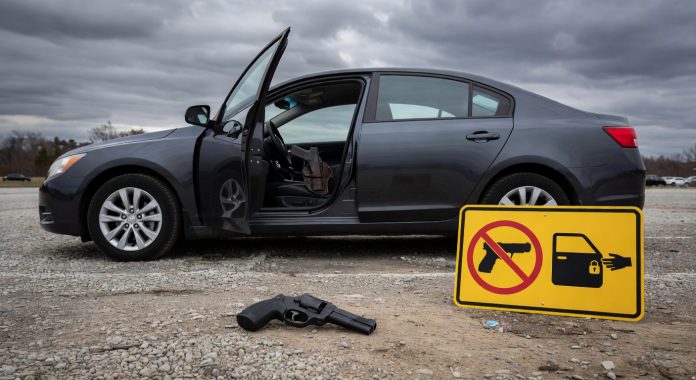
The Virginia General Assembly has passed legislation that sets forth specific requirements for the storage of handguns in unattended motor vehicles. This bill, designated as House Bill 110, was approved by the governor on April 13, 2026, and will take effect on July 1, 2026, as Chapter 560 of the Acts of Assembly. The primary change adds a section to the Code of Virginia that prohibits any person from leaving, placing, or storing a handgun in an unattended motor vehicle when such handgun is visible to any person who is outside the vehicle. The bill includes a definition for unattended motor vehicle. Persons who violate this prohibition are subject to a civil penalty of no more than five hundred dollars, and the unattended motor vehicle may be removed for safekeeping.
The path to enactment involved extensive review and voting in both the House of Delegates and the Senate. The bill was prefiled and ordered printed on January 2, 2026, and referred to the House Committee on Public Safety. It was assigned to a subcommittee on firearms and later reported with amendments after a favorable subcommittee recommendation of seven to three. The full committee reported it by fifteen to six. It passed the House on third reading February 5, 2026, with sixty-two yeas and thirty-five nays. Upon reaching the Senate, it received constitutional reading and was referred to the Committee for Courts of Justice. The committee reported a substitute and rereferred it to Finance and Appropriations, which reported it ten to five. The Senate passed the substitute on March 2, 2026, by twenty-one to nineteen. The House rejected the Senate substitute unanimously. The Senate insisted, leading to the appointment of a conference committee. House conferees included Amy Laufer, Clark, and Morefield, later changed to Laufer, Simon, and Morefield. Senate conferees were Marsden, Surovell, and Obenshain. The conference report was agreed to in the House by sixty to thirty-six and in the Senate by twenty-one to eighteen. A second conference occurred, with the House agreeing sixty to thirty-seven and the Senate twenty-one to eighteen. The enrolled bill was signed by the Speaker and Senate President on March 31, 2026, and sent to the governor, who approved it on April 13.
Views on the legislation emphasize its impact on individuals who maintain handguns in vehicles for legitimate self-defense purposes. The storage rules require that the handgun be positioned out of plain view and secured within a locked hard-sided container. This container often must be affixed securely to the interior of the vehicle through the use of steel cable, bolts, or welding techniques. Compliance cannot be achieved merely by locking the vehicle’s doors or using standard glove compartments or trunks in some interpretations. This setup is viewed as creating practical and economic challenges for many gun owners who would otherwise store their firearms in their vehicles during daily activities such as commuting, working, or traveling.
One area of concern involves the lack of carve-outs or exceptions in the final law for certain categories of gun owners. There are no provisions exempting holders of concealed carry permits from the storage mandates. Similarly, individuals with active court-issued protective orders against potential threats receive no special consideration that would allow easier access to their handgun. This has led to discussions about scenarios where a person might need rapid retrieval of their firearm upon approaching their vehicle, such as after departing a location that prohibits the carrying of firearms inside the premises. A specific illustration cited involves a young woman who has experienced physical threats and must navigate a parking area to reach her vehicle containing her means of protection.
In the course of conference committee negotiations, language was proposed that would have allowed different rules for members of the General Assembly when parking in designated areas near the Capitol building. This would have permitted lawmakers to leave handguns in their vehicles under conditions not available to the public. However, the final version of the bill does not contain any such distinctions. Sen. Richard Stuart has noted that the General Assembly functions as a citizen legislature and that members should not establish rules granting themselves advantages not afforded to other citizens.
The legislative record shows narrow margins on several key votes, indicating substantial disagreement over the bill’s terms. Opponents of the measure have indicated that it may be subject to challenges regarding its consistency with constitutional protections for the right to keep and bear arms. The potential consequences, including monetary penalties and the possibility of vehicle towing, are seen as adding unnecessary hurdles for those exercising their rights responsibly. As the July 1, 2026, effective date approaches, residents who keep handguns in their vehicles are expected to evaluate their current storage methods and make any necessary adjustments to align with the new standards. This could involve acquiring approved containers or modifying vehicle interiors accordingly.
The enactment of these provisions represents a notable update to Virginia’s laws concerning firearms in motor vehicles. It establishes clear expectations for how handguns must be secured when a vehicle is left without an occupant. While the intent may relate to preventing unauthorized access or theft, the resulting obligations have prompted analysis of their effects on personal safety and individual liberties. Gun owners are encouraged to familiarize themselves with the exact language of the new section added to the code to ensure full compliance and to mitigate risks of enforcement actions. Ongoing developments, such as any guidance from state agencies or court interpretations, will likely shape how the law is applied in practice throughout the state.