
Richmond, Virginia — During the 2026 regular session of the Virginia General Assembly, attention turned to House Bill 86, which proposed the establishment of a Mattress Stewardship Program aimed at improving the management of discarded mattresses in the Commonwealth. Sponsored by Delegate Amy Laufer, the bill sought to amend the Code of Virginia by adding a new article in Chapter 14 of Title 10.1, specifically sections 10.1-1425.40 through 10.1-1425.43, to create this structured approach under the supervision of the Department of Environmental Quality.
The core requirements of the legislation include mandatory registration for producers, who are defined as entities that manufacture or brand mattresses sold in Virginia, as well as for retailers and renovators involved in the sale or refurbishment of mattresses. These parties would need to affiliate with a certified mattress recycling organization tasked with creating and executing a plan for the collection, transportation, and recycling of used mattresses. The plan would need approval from the Department before implementation.
One of the most notable aspects of the bill is the introduction of a uniform recycling fee applied to every new or renovated mattress sold to consumers in Virginia. Retailers would be responsible for adding this fee as a visible line item on customer receipts and then remitting the collected amounts to the recycling organization. Estimates provided during legislative discussions placed this fee at approximately twenty dollars per mattress, with the revenue dedicated to funding collection sites, recycling operations, transportation, and program administration. This mechanism represents a shift in how disposal costs are handled, moving them from the point of disposal to the initial purchase.
The legislation establishes annual reporting obligations for the mattress recycling organization. These reports, submitted to the Department of Environmental Quality, would cover operational details such as the number of mattresses processed, the effectiveness of collection networks, and compliance metrics. The Department would gain authority to oversee the program, approve or reject plans, and impose civil penalties for non-compliance by any registered party or the organization itself.
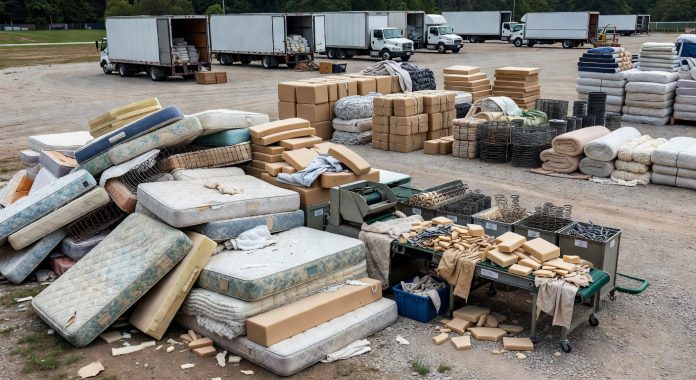
Mattresses present unique challenges in waste management due to their size and composition. They occupy substantial space in landfills and can require up to one hundred years to decompose completely. The proposed program aims to mitigate these issues by ensuring convenient, free recycling options for residents and by encouraging the recovery of materials such as foam, springs, and fabrics for reuse in new products. By requiring producers to take responsibility for the full lifecycle of their products, the bill seeks to reduce illegal dumping, which often occurs when disposal options are limited or costly.
House Bill 86 navigated the legislative process successfully in both chambers. It passed the House of Delegates and advanced to the Senate, where it received approval despite a closely divided vote of twenty to twenty. The measure then moved to the desk of Governor Abigail Spanberger for final action.
Governor Spanberger vetoed House Bill 86, explaining in the accompanying message that the legislation would require Virginians to pay a new fee for a mattress. In response, the House of Delegates sustained the veto, blocking the bill from taking effect.
Opponents of the legislation have voiced strong objections to the recycling fee, describing it as a distinct new tax applied to every mattress sale. They have urged a halt to the creation of such additional financial obligations for consumers. Retailers and industry participants have noted the potential for increased administrative burdens, as businesses would need to update their point-of-sale systems to collect and account for the fee separately while also ensuring compliance with registration and reporting rules.
The mandatory nature of the stewardship program has raised questions about the role of government in dictating industry practices. Some have argued that the requirement for a state-certified organization to handle the program under detailed oversight could lead to inefficiencies and higher costs that ultimately affect Virginia families through elevated mattress prices. Critics have pointed out that the program would apply to renovated mattresses as well as new ones, broadening its reach across the market and potentially impacting small businesses engaged in refurbishment.
Additional provisions in the bill define key terms to ensure clarity in implementation. For instance, the term “producer” encompasses those who first sell mattresses into the Virginia market, while “renovator” refers to entities that restore used mattresses for resale. The Department of Environmental Quality would hold responsibilities including plan approval, monitoring of collection and recycling activities, and enforcement through civil penalties where necessary.
If enacted, the program would have required the recycling organization to maintain a network of convenient collection locations to facilitate consumer participation and minimize environmental impacts from improper disposal. The annual reports would provide transparency on progress toward waste diversion goals and the financial management of the fee revenues.
With the veto sustained by the House, the Mattress Stewardship Program outlined in House Bill 86 will not be implemented following the 2026 session. The discussions surrounding this legislation have illuminated the complexities of balancing environmental waste reduction efforts with concerns over new consumer fees and regulatory expansions. As Virginia addresses solid waste issues in the future, the elements debated in this bill may inform subsequent policy considerations regarding producer responsibility and consumer costs.