
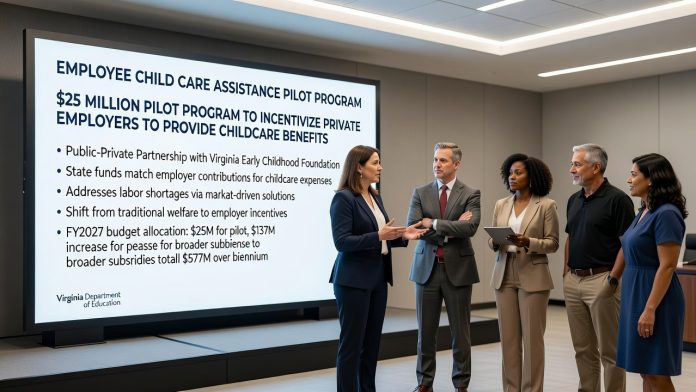
Virginia lawmakers have officially launched a unique twenty-five million dollar pilot program aimed at keeping parents in the workforce by partnering with private businesses. This initiative, known as the Employee Child Care Assistance Pilot Program, seeks to incentivize private employers to share the heavy burden of childcare costs with their workers. By focusing on a public-private partnership, the state is attempting to address labor shortages without relying exclusively on traditional government welfare models. The program represents a significant shift in state budget priorities as officials look for market-driven solutions to support working families.
### Empowering Businesses to Support Working Families
The core of this new initiative leverages the free market by encouraging employers to take an active role in their employees’ family needs. Administered by the Virginia Early Childhood Foundation, the pilot program uses state funds to match employer contributions toward employee childcare expenses. Conservative advocates for economic growth recognize that businesses thrive when they can attract and retain dedicated, hardworking parents. By removing barriers to employment through employer-sponsored benefits, the state hopes to stimulate workforce participation and increase overall economic productivity.
The House Appropriations Committee justified the creation of the program by highlighting its direct benefits to the local business climate. Lawmakers on the committee stated that not only is it important that children have quality care, but employers also benefit when childcare is not a barrier to hiring employees. This perspective aligns with conservative principles that view strong families and robust businesses as the foundational pillars of a healthy economy. When companies are empowered to invest directly in their workers, the entire community reaps the rewards of a stabilized labor force.
### Addressing the Economic Threat of Childcare Costs
The push for this legislation comes as rising inflation and living expenses continue to squeeze the budgets of hardworking families across the commonwealth. Governor Abigail Spanberger emphasized the economic stakes, noting that when a family cannot afford childcare, oftentimes a parent drops out of the workforce altogether. She further argued that this dynamic does not just create a family budget issue, but rather creates a massive challenge for the broader economy. According to the governor, if childcare costs are driving parents out of the workforce, the state is losing economic competition before it even starts.
Getting this employer-focused initiative signed into law was not an easy journey through the state legislature. Similar legislation aiming to create an employer-sponsored childcare assistance program faced two vetoes under the previous governor before finally being adopted in the FY2027 budget. Proponents of the current budget argue that the newly refined pilot program offers better safeguards and a clearer return on investment for taxpayers. The successful passage of the measure demonstrates a growing consensus that targeted, employment-linked assistance is preferable to unconditional government subsidies.
### Fiscal Responsibility and Budgetary Shifts
While the pilot program focuses on private sector involvement, the broader childcare subsidy program represents a massive expansion of state spending that requires strict oversight. The FY2027 budget includes a substantial one hundred thirty-seven million dollar increase in general fund support for the broader subsidy initiative. This massive injection of taxpayer money brings the total allocation for childcare subsidies to five hundred seventy-seven million dollars over the biennium. Fiscal conservatives are urging strict audits and performance metrics to ensure these funds actually deliver results rather than simply expanding the welfare state.
This financial commitment marks a drastic departure from how the state historically handled early childhood education and daycare funding. Prior to fiscal year 2024, Virginia provided absolutely no general fund support for childcare, relying entirely on federal funding to sustain these programs. Shifting this massive financial burden onto state taxpayers means that lawmakers must now take full responsibility for the program’s efficiency and success. Taxpayers expect their elected officials to treat this newly allocated state revenue with the utmost respect and rigorous financial scrutiny.
### Administrative Growth and Future Accountability
As with any new government initiative, the implementation of the Employee Child Care Assistance Pilot Program brings inevitable administrative expansion. The Virginia Department of Education will require an estimated one hundred fifty-four thousand one hundred one dollars annually starting in FY2027 to fund just one additional position to support the initiative. Critics of government bloat have pointed out that spending over one hundred fifty thousand dollars for a single administrative role highlights the hidden costs of state-run programs. Lawmakers must ensure that the bureaucracy does not consume the funds intended to help working families and local businesses.
Moving forward, the true test of this twenty-five million dollar pilot program will be its ability to demonstrably increase workforce participation without requiring permanent state funding increases. If the program successfully encourages private employers to permanently adopt childcare benefits, it could serve as a model for conservative, pro-business social policy. However, if it merely creates a new dependency on government matching funds, lawmakers must be prepared to roll back the initiative. The ultimate goal must remain focused on empowering parents, strengthening the free market, and protecting the hard-earned money of Virginia taxpayers.