
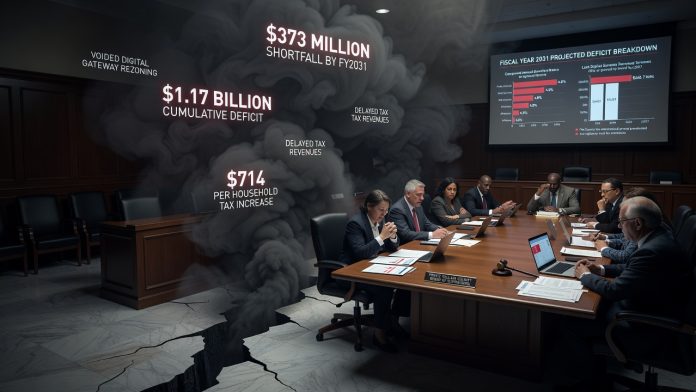
Prince William County is currently facing severe financial headwinds as a projected $373 million budget shortfall by fiscal year 2031 directly threatens the critical unassigned fund balance. The massive structural deficit stems largely from the legally voided Digital Gateway land rezoning and subsequent long-term delays in anticipated corporate tax revenues. Even before the project’s cancellation, the county was already staring down a pre-cancellation deficit of $412 million, compounding the urgency of the current crisis. Local government officials are now actively grappling with a projected cumulative five-year deficit that could reach a staggering $1.17 billion if immediate corrective fiscal measures are not implemented. This escalating financial crisis places intense pressure on local taxpayers, potentially resulting in an estimated property tax increase of $714 per household to bridge the widening budgetary gap.
The current Prince William County Board of Supervisors must navigate this highly complex budgetary landscape while continuing to balance essential public services for a growing population. The governing board consists of Chair Deshundra Jefferson, Tom Smith, Yesli Vega, Bob Weir, Victor Angry, Kenny Boddye, Andrea Bailey, and Margaret Franklin. These elected leaders are tasked with addressing a structural gap driven by a 4.8 percent compound annual growth rate in committed county expenditures. These rapidly rising expenditures include mounting costs for public schools, debt service obligations, employee pensions, and general inflation against a backdrop of delayed or completely canceled commercial tax revenues.
Voided Digital Gateway Project
The region’s financial instability is heavily tied to the controversial Digital Gateway project, which originally included the Compass, Digital Gateway North, and Digital Gateway South developments. Anticipated tax revenues from this massive data center corridor were delayed by at least 20 months following its initial rushed approval in December 2023. A circuit court judge officially voided the comprehensive rezoning in August 2025, and the financial impact was permanently finalized when the board chose not to appeal the judicial decision in April 2026. Without these sprawling developments, the county lost a critical foundational revenue stream that was originally projected to generate hundreds of millions of dollars annually for the general fund.
State Delegate Ian Lovejoy explicitly pointed to severe procedural failures by the previous administration as the primary root cause of the current legal and financial predicament. He publicly stated that the notification process used to alert the surrounding community about the zoning changes was handled inappropriately by the outgoing leadership. “The lame duck board that was still serving chose to do a fast and dirty expedited process for its public hearings, and they ran afoul of the law,” Lovejoy explained during a recent discussion. He further characterized the entire rezoning decision as the fruit of the poisonous tree, emphasizing that the illegally expedited process ultimately doomed the heavily anticipated corporate revenue.
Threats to Fund Balances
The sudden loss of the Digital Gateway revenue poses a direct and looming threat to the stringent financial reserves historically maintained by Prince William County. According to established local fiscal policies, the county must rigorously maintain an unassigned fund balance equal to exactly 7.5 percent of its total general fund revenue. Furthermore, local financial guidelines dictate that a separate revenue stabilization fund reserve must be kept at a strict 2.0 percent of the general fund revenue to protect against economic downturns. Falling short of these vital reserve requirements could negatively impact the county’s municipal credit rating and severely limit funds available for future one-time capital investments.
The fiscal year 2027 proposed budget document explicitly highlights the absolute necessity of maintaining robust financial reserves during periods of prolonged economic uncertainty. The official planning document clearly states that year-end savings must be sufficient to recoup any revenue shortfalls while simultaneously meeting adopted fund balance requirements. “The County has demonstrated strong financial management in its established policies, such as monthly and quarterly monitoring, but vigilance must be maintained,” the budget document warns administrators. This official guidance underscores the precarious nature of the current budget, especially considering that projected data center revenues were once expected to reach $549.7 million, or roughly 28 percent of general fund tax revenue, by 2027.
Impacted Departments and Services
The massive revenue shortfall is already forcing significant budget adjustments and painful cuts across various county departments and essential public services. A major casualty of the tightening financial budget is the Prince William County Schools transfer markup, which recently saw a stark decrease of $31,051,853 during preliminary negotiations. Despite this notable reduction in the markup, the revised education figure still represents a $96.38 million overall increase compared to the fiscal year 2026 adopted school transfer. Other critical government areas facing intense financial scrutiny include the Commonwealth’s Attorney office and the Information Technology department, which desperately requires funding for its mandatory Splunk cybersecurity platform.
Additional community programs and internal county administrative initiatives are also feeling the immense pressure of the widening structural deficit. Funding for the vital Aging Senior Center without Walls program remains highly uncertain as budget administrators aggressively look for areas to trim operational expenses. Furthermore, a planned Classification and Compensation Study for General Services faces a substantial $15.4 million reduction under the current financial constraints. As the county rapidly approaches fiscal year 2031, residents and elected officials alike must prepare for increasingly difficult financial decisions to stabilize the local economy and protect essential government functions from further degradation.