
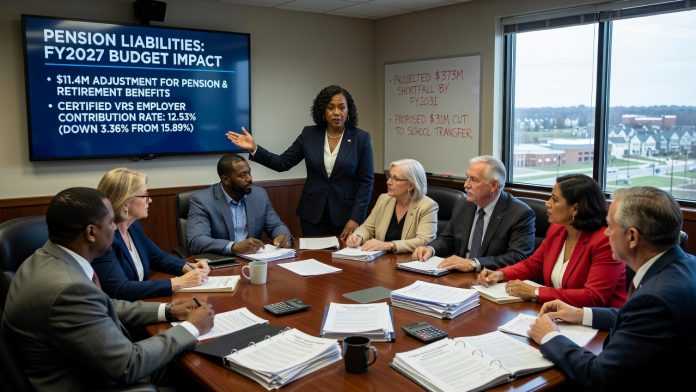
Rising pension liabilities and shifting retirement costs are significantly reshaping the financial landscape for Prince William County as officials navigate the upcoming fiscal year. The proposed Fiscal Year 2027 budget highlights a complex scenario where general government pension costs are decreasing while school system retirement obligations are surging. These divergent financial trajectories have sparked intense budget negotiations and proposed funding reallocations. Local taxpayers are closely monitoring how these changes will impact core municipal services.
The Prince William County Board of Supervisors must now reconcile these contrasting fiscal realities to maintain balanced public services. The current board includes Chair Deshundra Jefferson alongside supervisors Victor Angry, Andrea Bailey, Kenny Boddye, Margaret Franklin, Tom Smith, Yesli Vega, and Bob Weir. Together, these elected officials face the challenge of addressing long-term pension liabilities that threaten local economic stability. Without strategic adjustments, the county’s overall budget shortfall is projected to balloon to $373 million by Fiscal Year 2031.
DIVERGENT RETIREMENT RATES
On the municipal side of the ledger, Prince William County is experiencing a notable reprieve in its mandatory retirement contributions. The certified Virginia Retirement System employer contribution rate for general county employees dropped to 12.53 percent for the upcoming cycle. This represents a 3.36 percent decrease from the previous rate of 15.89 percent. Budget documents describe this shift as the most significant downward adjustment the county has ever received from the state system.
This favorable rate reduction directly translates into substantial financial flexibility for the county government. The Fiscal Year 2027 budget reflects an overall $11.4 million expenditure adjustment for pension and retirement benefits. Specifically, over $11 million of that total stems directly from the Virginia Retirement System rate reduction. County administrators are aggressively utilizing these vacancy and pension savings to balance other vital compensation investments across various municipal departments.
These newly available funds are helping to support substantial wage improvements for local public safety personnel. Uniformed and sworn employees within the Adult Detention Center and the Sheriff’s Office are slated to receive an 8.2 percent market adjustment to remain competitive. Furthermore, the savings are helping to fully fund collective bargaining agreements for the Prince William County Police Association and the International Association of Fire Fighters. These targeted investments aim to improve retention rates among essential emergency responders.
SCHOOL SYSTEM FINANCIAL PRESSURES
While the general county government benefits from lower pension obligations, Prince William County Public Schools face a starkly different financial reality. The state-mandated employer contribution rate for the teacher retirement system has climbed significantly to 19.8 percent of employee salaries. This figure marks a steep 19 percent increase since Fiscal Year 2023. Such rapid growth in mandatory benefits is placing immense pressure on the overarching educational budget.
Local authorities have noted that counties possess no control over these Virginia Retirement System rates. Instead, the contribution requirements are established entirely by the state based on complex actuarial calculations. Consequently, this escalating mandate has driven school personnel costs up by approximately $18 million annually. The resulting financial strain has forced county and school officials to consider difficult operational reductions to balance the broader municipal budget.
The widening gap between educational funding needs and available revenue has led to friction during current budget negotiations. Current proposals include a massive $31 million reduction in the county’s budget transfer to the public school system. If enacted, this funding reduction could potentially lead to the elimination of 80 to 120 positions within the local school district. Educators and parents alike have expressed serious concerns regarding the potential impact on classroom instruction.
LONG-TERM FISCAL STRATEGY
Despite these localized funding challenges, county leadership maintains that the overall financial plan remains fundamentally sound and aligned with community priorities. The Fiscal Year 2027 Budget Message states that the proposed financial document represents a direct investment in the priorities the community has identified. The message further notes that the budget demonstrates a shared commitment to fiscal responsibility and affordability. Administrators emphasize that balancing these competing needs requires careful strategic planning and strict adherence to long-term financial modeling.
The stark contrast between the county’s pension savings and the school system’s rising retirement costs underscores the volatility of state-mandated financial obligations. As the Board of Supervisors continues to deliberate on the final appropriations, the handling of these pension liabilities will set a crucial precedent for future fiscal cycles. Navigating these complex financial waters remains essential to maintaining the high quality of public services expected by residents. Ultimately, these decisions will dictate the county’s ability to avoid the massive budget shortfalls projected for the end of the decade.
Email the Board of Supervisors At:
Chair At-Large (Deshundra Jefferson) – djefferson@pwcgov.org,
Brentsville (Tom Gordy): tgordy@pwcgov.org,
Coles (Yesli Vega): yvega@pwcgov.org,
Occoquan (Kenny Boddye): kboddye@pwcgov.org,
Potomac (Andrea Bailey): abailey@pwcgov.org,
Woodbridge (Jeannie LaCroix): jlacroix@pwcgov.org,
General Board: bocs@pwcgov.org,