
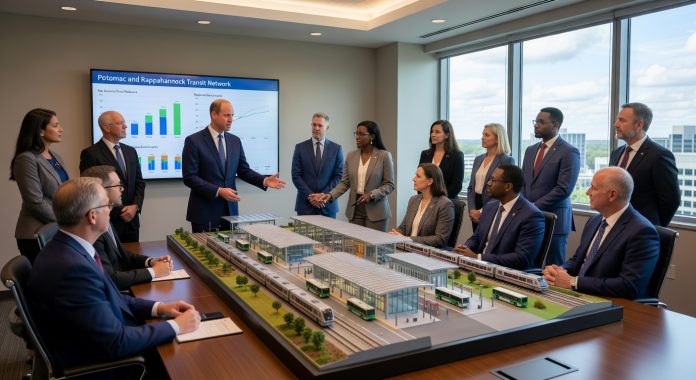
The system includes the region’s largest park and ride network, with approximately 7,000 spaces, facilitating commuter services across multiple districts. Officials describe this as an outstanding arrangement that serves Prince William County effectively without local general fund contributions, contrasting with Fairfax County’s approach of allocating $250 million yearly from its general fund to transit efforts, which cumulatively reaches into the billions.
This funding strategy leverages state and federal resources, including grants and allocations, to cover operational costs without drawing from property tax-supported general funds. The model emphasizes streams such as state support, which officials credit for enabling the county to operate one of the largest transit networks on the East Coast without additional local taxpayer subsidies.
Comparisons highlight Prince William County’s performance relative to Fairfax, where substantial general fund expenditures are required to sustain services. While Prince William secures significant state grants—around $30 million per year—and federal resources, Fairfax’s higher spending reflects differing funding priorities and scales. The absence of general fund use in Prince William allows those resources to be directed elsewhere, such as education or public safety, though specific reallocations are not detailed.
The transit operations extend to extensive ride services and park facilities, supporting regional commuting needs. State grants form a cornerstone, with officials noting efforts to maximize these tools provided by Virginia lawmakers in the House of Delegates and Senate. This approach has been presented to county supervisors as a sustainable path forward, joking about budget sessions while underscoring the deal’s effectiveness.
Fairfax County’s model, by contrast, involves direct general fund infusions on a massive scale, prompting questions about efficiency across Northern Virginia jurisdictions. Prince William’s strategy demonstrates how dedicated grants can sustain large-scale transit, operating without the ‘bite’ into local budgets seen elsewhere. Annual state support of $30 million, paired with operational revenues, ensures coverage for the full system.
As Virginia addresses transportation challenges, such models illustrate varied paths to funding public services. Prince William’s reliance on non-general fund sources positions it to handle growth while managing costs, with park and ride capacities underscoring infrastructure scale. Ongoing state allocations remain key, as do federal contributions that amplify local efforts.
This framework has enabled the county to maintain services serving thousands daily, with officials expressing pride in the leverage achieved. While Fairfax contends with higher subsidy levels, Prince William’s grant-focused operations provide a point of comparison in regional transit discussions. Future budgets will determine if similar efficiencies expand, as state-level decisions influence grant availability.
Details on exact ridership or cost per passenger were not specified, but the emphasis on self-sufficiency without general fund taxes marks a distinct operational profile. Comparisons to Fairfax underscore spending disparities, with Prince William avoiding the multimillion-dollar annual commitments from local taxes. This positions the county as a case study in grant utilization for public transport sustainability.
Email At:
Chair At-Large (Deshundra Jefferson) – djefferson@pwcgov.org,
Brentsville (Tom Gordy): tgordy@pwcgov.org,
Coles (Yesli Vega): yvega@pwcgov.org,
Occoquan (Kenny Boddye): kboddye@pwcgov.org,
Potomac (Andrea Bailey): abailey@pwcgov.org,
Woodbridge (Jeannie LaCroix): jlacroix@pwcgov.org,
General Board: bocs@pwcgov.org,