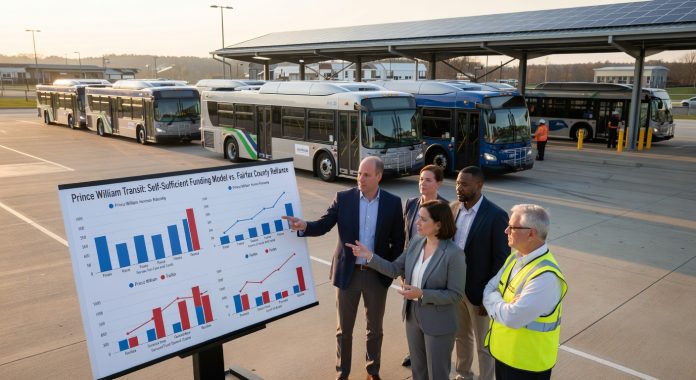
The system’s annual revenue totals about $30 million, sourced from mechanisms including local contributions and fares, with $20 million allocated from state grants and $10 million from other local streams. This covers the entirety of operations for services like OmniRide buses managed by the Potomac and Rappahannock Transportation Commission (PRTC), which connects Prince William County residents to employment hubs in Northern Virginia.
Fairfax County, by comparison, allocates approximately $250 million yearly from its general fund toward transit, predominantly supporting WMATA services, with overall requirements reaching into the billions for equivalent coverage. This difference highlights varying approaches to transit financing in the region, where Prince William emphasizes self-generated funds and external aid, potentially saving significant general fund resources.
Recent developments in Fairfax include approval of a $5.7 billion county budget, incorporating transit subsidies amid assessments that increased average tax bills by about $337 despite a minor rate adjustment. Prince William’s model avoids such direct general fund impacts, directing savings toward other priorities.
The Prince William County Board of Supervisors, consisting of Chair At-Large Victor Ramirez, Occoquan District Supervisor Kenny Boddye, Woodbridge District Supervisor Yesli Vega, Potomac District Supervisor Tala Mercado, Neabsco District Supervisor Monica Ortiz, Coles District Supervisor Stephen Keen, Gainesville District Supervisor Bob Weir, Brentsville District Supervisor Jeanine Lawson, and Dumfries District Supervisor Roger C. Peck, oversees policies that support this funding framework. (Note: Member list based on available public records as of early 2026; elections may alter composition.)
PRTC’s operations extend to park-and-ride facilities that accommodate substantial commuter volumes, contributing to regional mobility without broad taxpayer subsidies from property taxes. State grants play a pivotal role, amplifying local efforts and underscoring Virginia’s role in supporting suburban transit.
Comparisons reveal Prince William’s efficiency in resource use, leveraging federal, state, and dedicated local funds to sustain services. While Fairfax’s larger urban density necessitates extensive rail and bus investments, Prince William focuses on commuter-oriented buses, yielding cost-effective outcomes.
This structure aligns with broader Northern Virginia transit dynamics, where entities like PRTC and NVTC coordinate funding and planning. Ongoing budget sessions at both county levels continue to shape these systems, balancing growth, ridership, and fiscal sustainability.
As population shifts outward, Prince William’s approach provides data points for policymakers evaluating transit viability. Ridership figures, grant allocations, and operational costs offer benchmarks for assessing performance across jurisdictions.
The absence of general fund dependency positions Prince William to adapt to economic changes without immediate tax adjustments, a factor in its competitive edge. Detailed financial reports from PRTC detail revenue breakdowns, confirming the $30 million operational threshold.
Regional collaboration remains key, with state allocations bridging gaps and federal programs enhancing infrastructure. Fairfax’s commitments reflect its WMATA obligations, while Prince William’s standalone model demonstrates alternative viability.
Observers note the implications for Virginia’s transportation policy, particularly as legislative sessions address funding formulas. Prince William’s performance contributes to discussions on optimizing public dollars for maximum impact.
Source: Field reports and eyewitness accounts.