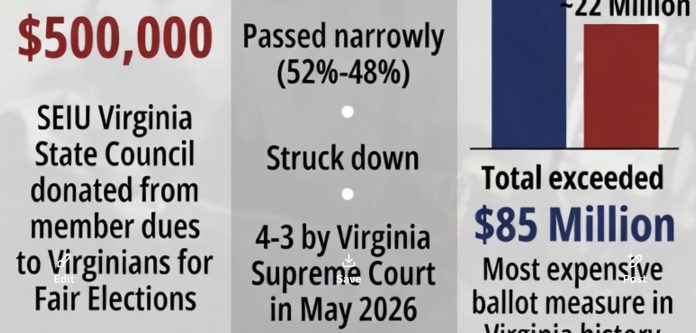
In early April 2026, the Service Employees International Union (SEIU) Virginia State Council announced a $500,000 contribution from member dues to Virginians for Fair Elections, the primary committee supporting a “Yes” vote on a controversial constitutional amendment for temporary legislative redistricting of congressional districts. The donation, highlighted in campaign finance disclosures on VPAP.org and reported around April 7-8, 2026, formed part of a broader effort by labor and Democratic-aligned groups to back the measure ahead of the April 21 special election.
The referendum asked Virginia voters to approve a change allowing the Democrat-controlled General Assembly to redraw congressional maps outside the standard decennial process, potentially shifting the state’s 11-district delegation from a 6-5 Democratic advantage to as favorable as 10-1. Proponents framed it as a necessary response to national political shifts and a way to ensure fairer representation. Opponents argued it enabled partisan gerrymandering and bypassed established independent redistricting procedures.
Massive Spending Defines the Campaign
Campaign finance records show the contest became Virginia’s most expensive ballot measure by a wide margin. Virginians for Fair Elections raised approximately $64 million to $66 million in total contributions, according to VPAP data and state disclosures through late April. Major funders included House Majority Forward (tens of millions, with reports citing figures like $29.3 million or higher in aggregated support), the Fairness Project ($11.7 million+), and the Fund for Policy Reform ($5 million, linked to George Soros’ network). Other notable contributions came from the Democratic Party of Virginia, New Virginia Majority, and various labor and advocacy groups.
The SEIU’s $500,000 cash contribution placed it among prominent labor backers, alongside smaller amounts from groups like the League of Conservation Voters ($300,000) and others. SEIU Virginia leaders, including Jaime Contreras, publicly endorsed the measure, stating it would help ensure “every voice is heard” and counter voter suppression concerns. The union represents thousands of service workers across the state.
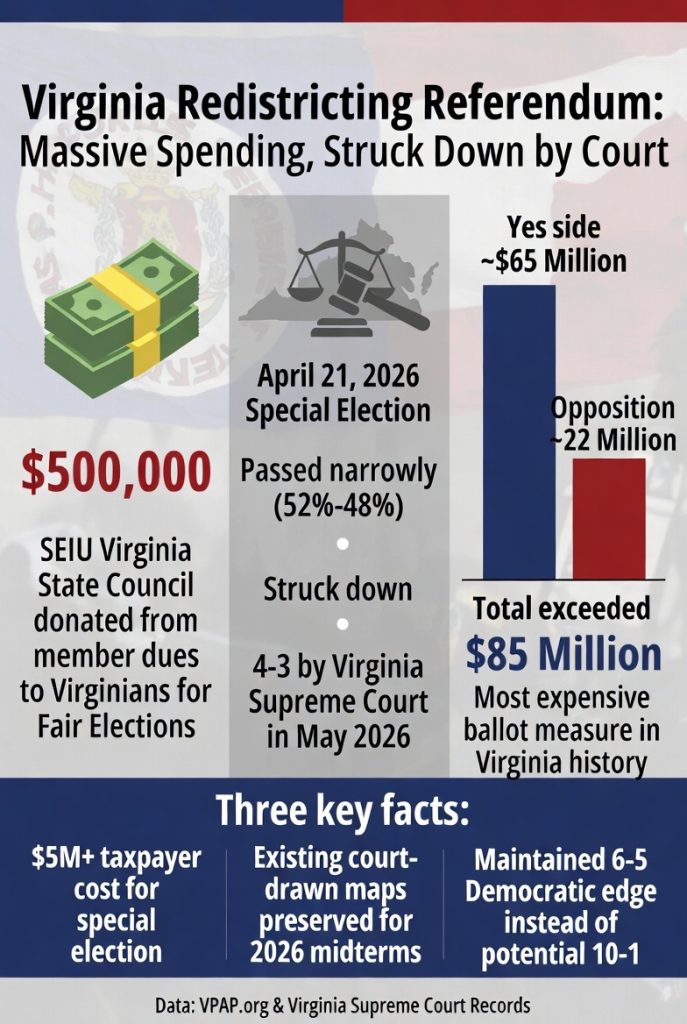
Opposition efforts, primarily through Virginians for Fair Maps and related committees, raised significantly less—around $20 million to $24 million in key reports—though dark money nonprofits also played a major role on that side. Overall, pro- and anti-referendum groups combined raised well over $80 million, with some analyses pointing to totals nearing $90-100 million when including in-kind contributions and multiple committees. Advertising spending alone exceeded $80 million, making it one of the heaviest non-presidential media blitzes in recent Virginia history.
Much of the funding on both sides came through 501(c)(4) nonprofits that do not disclose individual donors, drawing criticism about “dark money” influence in a state election with national implications for U.S. House control. Supporters of the “Yes” side outspent opponents by roughly 3-to-1 in many tracking periods, funding extensive TV, radio, and digital ads.
State Costs and Voter Turnout
Beyond private campaign spending, the special election imposed public costs. The Virginia General Assembly appropriated $5 million for administration, early voting, and voter education. Local election offices incurred additional expenses varying by locality, pushing the total taxpayer cost higher. Voter turnout reached over 3 million ballots cast, with the measure passing narrowly at approximately 52% to 48%.
Legal Aftermath and Court Ruling
The outcome proved short-lived. Republicans challenged the referendum’s legality immediately, arguing the Democrat-led legislature violated constitutional requirements for placing amendments on the ballot, specifically bypassing an intervening general election. A circuit court initially blocked certification, and on May 8, 2026, the Virginia Supreme Court ruled 4-3 to strike down the measure entirely. The majority opinion held that procedural violations “irrevocably taint” the referendum, nullifying the results and keeping the existing court-drawn maps (used in 2022 and 2024) in place for the 2026 midterms.
Democrats decried the ruling as overriding voter will and pursued further appeals, including to the U.S. Supreme Court. Republicans hailed it as a victory for constitutional process over partisan map-drawing. The decision preserves a more competitive 6-5 split rather than the lopsided map Democrats anticipated.
Broader Context and Implications
The SEIU donation and overall spending underscore how national interests converged on Virginia politics. Labor unions like SEIU have long supported Democratic causes, using member dues for political advocacy—a practice that sometimes sparks internal debate among rank-and-file members about priorities versus workplace issues. Critics questioned the wisdom of spending hundreds of thousands on a now-invalidated effort, especially amid reports of the union’s focus on service workers facing economic pressures.
From a neutral standpoint, the episode highlights recurring tensions in American democracy: the role of big money in ballot measures, the balance between legislative authority and constitutional safeguards, and the influence of out-of-state donors in state-level fights with federal consequences. Virginia’s experience mirrors national battles over redistricting, where both parties have pursued advantageous maps when in power.
Transparency advocates on all sides have called for reforms to dark money flows and clearer rules for constitutional amendments. As Virginia prepares for the 2026 midterms under the preserved maps, the referendum’s legacy may be less about new district lines and more about the high-stakes financial and legal machinery of modern elections. Total private spending dwarfed the state’s direct costs, yet the ultimate result hinged on judicial interpretation rather than voter approval alone.
This case serves as a case study in how substantial resources—exemplified by the SEIU’s half-million-dollar commitment alongside tens of millions more—can drive turnout and shape debate, only for procedural guardrails to determine the final outcome. Future efforts in Virginia and elsewhere will likely face heightened scrutiny on both funding sources and process.