
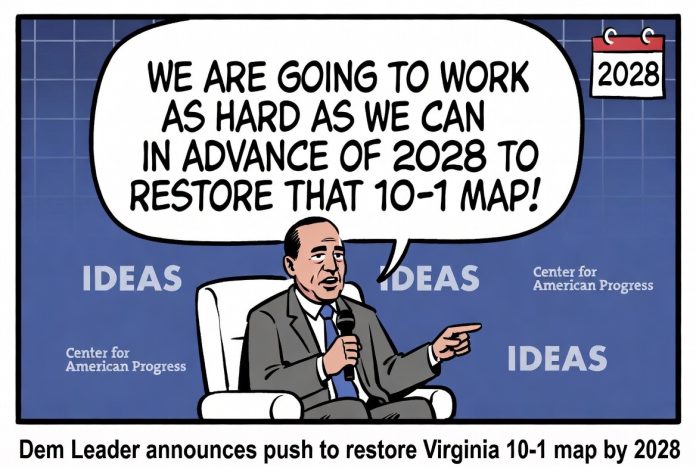
House Minority Leader Hakeem Jeffries (D-N.Y.) has indicated that Democrats plan to pursue restoration of a congressional redistricting plan in Virginia that was struck down by the state’s Supreme Court, aiming for implementation ahead of the 2028 elections. The comments, made during an appearance at the Center for American Progress, come in the wake of a significant legal setback for the party in the battleground state.
The controversy centers on a constitutional amendment approved by Virginia voters in a special April 2026 referendum. The measure, which passed narrowly with approximately 52% support, would have authorized new congressional district lines designed by the Democratic-led General Assembly. Analysts projected the map would have shifted Virginia’s current 6 Democratic–5 Republican congressional delegation toward a potential 10-1 Democratic advantage by making several Republican-held districts more competitive or Democratic-leaning.
On May 8, 2026, the Virginia Supreme Court ruled 4-3 to invalidate the referendum results. The majority opinion held that the legislature had violated Article XII, Section 1 of the Virginia Constitution by failing to follow proper procedural steps for placing a constitutional amendment on the ballot, including issues related to timing and public notice requirements. The court determined that these defects rendered the voter-approved measure legally ineffective, ordering the state to use the existing 2021-drawn maps for upcoming elections.
Democrats appealed to the U.S. Supreme Court, which denied the request for a stay in mid-May, effectively ending efforts to implement the new map for the 2026 midterms. Jeffries criticized the state court’s decision as partisan and argued it disregarded the expressed will of more than three million Virginia voters who participated in the referendum. He emphasized that while Democrats anticipate winning at least two additional seats under the current configuration, the party remains committed to addressing what it views as Republican advantages secured through redistricting in other states.
The Virginia case is part of a broader national redistricting conflict. Following the 2020 census, both parties have engaged in strategic map-drawing where they hold legislative power. Republicans have pursued gains in states like Texas, while Democrats have sought countermeasures in places they control. Virginia’s effort was framed by supporters as a response to these dynamics, though opponents characterized it as an aggressive partisan gerrymander that would reduce competitive districts.
Legal experts note that redistricting processes are governed by state-specific rules, with courts playing a key role in adjudicating compliance. The Virginia Supreme Court’s focus on procedural irregularities rather than the map’s substantive partisan tilt distinguished the ruling. Dissenting justices argued the decision improperly nullified a legitimate voter expression, highlighting divisions even within the state’s highest court.
Jeffries’ remarks suggest Democrats may attempt to restart the constitutional amendment process in future legislative sessions. Under Virginia law, constitutional amendments typically require passage in two successive General Assembly sessions before voter approval. This timeline aligns with a potential 2028 implementation, assuming Democrats retain control of the state legislature in the 2027 elections. However, political observers point to challenges, including potential voter fatigue, legal hurdles, and internal party disagreements.
Virginia Governor Abigail Spanberger has reportedly advised caution, describing discussions of immediate further redistricting efforts as “outrageously premature” amid focus on the 2026 midterms. The state’s political environment remains competitive: Democrats have dominated recent presidential races, but Republicans maintain strength in certain regions and have won recent statewide contests.
Public reaction has split along partisan lines. Democratic leaders, including members of Virginia’s congressional delegation, have expressed frustration, viewing the court ruling as an obstacle to fair representation amid national shifts. Republican officials and groups like Virginians for Fair Maps have praised the decision as upholding the rule of law and preventing an extreme partisan map.
Analysts from organizations such as the Cook Political Report suggest the existing map maintains Virginia as a battleground, with several districts potentially in play. A return to the proposed 10-1 configuration could significantly alter the state’s influence in the U.S. House, where narrow majorities have become the norm. Broader implications extend to national redistricting strategy, as both parties eye opportunities in states with favorable legislative control before the next decennial census.
The episode underscores ongoing tensions in American electoral mechanics. Questions persist about balancing voter input, legislative authority, and judicial oversight in redistricting. Independent redistricting commissions, adopted in some states, represent one attempted solution, though Virginia’s process relied on legislative action tied to a voter referendum.
As the 2026 campaign season intensifies, Virginia’s redistricting saga is likely to feature prominently in state legislative races. The outcome could influence not only congressional representation but also the state’s approach to future electoral reforms. Jeffries’ commitment to pursuing changes for 2028 indicates the issue is far from resolved, with both parties positioning for advantage in what remains one of the nation’s most closely watched political arenas.