
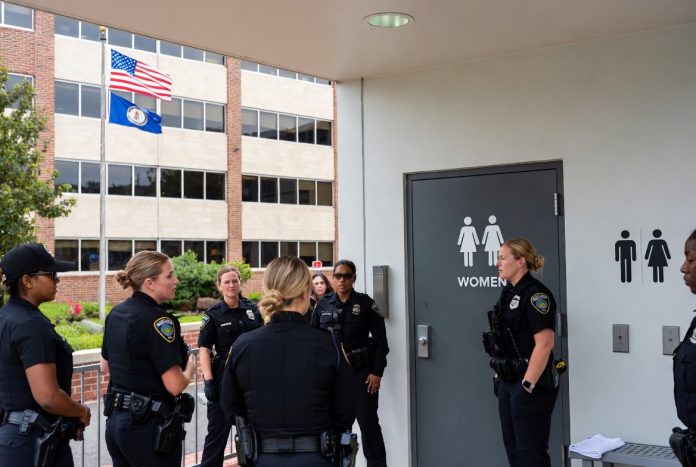
NORFOLK, Va. — Female officers at the Norfolk Police Department say they faced suspensions and career threats after objecting to a transgender-identified male recruit’s access to women’s locker room facilities, according to detailed accounts provided to Independent Women’s Features (IW Features), the investigative arm of Independent Women’s Forum.
The incidents, which reportedly occurred in 2024 and early 2025, have spotlighted tensions between department policies on gender identity and officers’ expectations of sex-based privacy in intimate spaces such as locker rooms and showers. The department has not publicly commented on the specific allegations.
According to officers Meghan Grabow and Martin Powers, who spoke with IW Features in a profile published May 15, 2026, the Norfolk Police Department hired a biological male recruit who identified as a woman. Powers, a male officer, said academy staff initially discovered social media posts showing the recruit in makeup and a wig. Leadership instructed staff to treat the individual as female, he alleged.
Grabow, a female patrol officer described as 5-foot-3 with a reputation for toughness, said she encountered the recruit while changing in the women’s locker room partway through a shift. “I’m completely stripped down to my underwear, and… [in comes] a man,” she told the outlet. The recruit, reportedly wearing a suit and tie and making no apparent effort to present as female, entered, went to a locker, and stared at her without responding to her question about his presence.
Grabow reported the incident to her captain and the training academy captain. She alleged they initially suggested she was mistaken and questioned her own presence in the locker room in underwear. She said one response was to ask if she felt intimidated, and she was advised that if she felt unsafe, she should take her firearm into the shower. Grabow maintained that leadership knew the recruit’s identity and had kept it from female officers.
Concerns Raised in Meeting with Leadership
Word of the incident spread. A female detective requested a meeting with Norfolk Police Chief Mark Talbot, joined by Assistant Chief Michele Naughton and a lieutenant. Powers estimated that about 16 officers—roughly evenly split between male and female—attended despite reported pressure not to participate, citing concerns about family and career repercussions.
According to Powers and Grabow, the meeting highlighted policy enforcement around language. When the detective began recounting Grabow’s experience, Chief Talbot allegedly interrupted, insisting on the use of “woman” or female pronouns for the recruit. The detective reportedly became upset and cried while reframing the account using female-gendered language. Powers said he challenged the directive, asking the chief to define “woman” and accusing leadership of dictating speech. He was ordered to leave but stayed at the detective’s request before eventually exiting with Grabow.
Additional allegations included the recruit using a female detective’s shower towel and the sole female recruit in the class having to change multiple times daily with limited privacy by positioning locker doors. Officers also raised operational concerns: department practice typically required male officers to summon female officers for searches of female suspects. Leadership’s reported response was to instruct officers to tell female suspects that the searching officer “is a woman.”
Retaliation Alleged
Powers said he was placed on desk duty, had his gun taken at the end of his shift, and was later told to stay home. He was suspended for allegedly disobeying an order to leave the meeting and was terminated. As of January 20, 2026, he remained suspended pending final actions and expressed concern about potential decertification.
Grabow was also suspended. She alleged the department reviewed her file and cited a prior minor traffic incident—a “California roll” at a stop sign previously marked as a yield—to justify discipline. She described the environment as one where female officers began avoiding department facilities, using public restrooms like those at a 7-Eleven, and expressed fear of reprisal for complaints. Grabow is appealing her suspension; Powers is exploring legal options.
The transgender-identified recruit did not complete the academy, withdrawing due to emotional inability to handle the job, according to Grabow. The female recruit in the class also reportedly left.
Broader Context and Department Policies
Norfolk Police had previously issued guidance on treating transgender individuals with “dignity and respect,” including earlier transgender policies dating back years. The department did not respond to IW Features’ request for comment before publication. No independent verification of all internal meeting details or exact policy language has been publicly released by the city.
The case echoes national debates over sex-segregated spaces in law enforcement, corrections, sports, and schools. Similar controversies have arisen in Virginia public schools, such as Loudoun County, involving locker room access and complaints. Critics of such policies argue they compromise privacy and safety for biological females; supporters contend that gender identity accommodations prevent discrimination and that individuals should be treated according to their identified gender.
Powers emphasized the importance of objective reality in policing. “In the police world, we’re only supposed to deal in truth and in fact—that’s it,” he told IW Features. “If we start denying objective reality, then we tarnish the profession.” Grabow described the department’s approach as prioritizing the rights of the transgender-identifying individual over those of female officers.
Ongoing Implications
As of mid-May 2026, the story has circulated on social media and conservative outlets but has not drawn widespread mainstream coverage or official investigations. Grabow and Powers’ accounts raise questions about workplace retaliation, compelled speech, and balancing gender identity policies with sex-based protections under Title VII, the Civil Rights Act, and state law.
The Norfolk case occurs amid broader legal and cultural shifts. Federal courts have weighed in on related issues involving prisons, shelters, and athletics, with varying outcomes. Independent Women’s Forum, which published the profile as part of its “Reclaiming Biological Reality” series, frames the incidents as part of a pattern where biological sex is subordinated to gender identity in institutional settings.
Norfolk Police Department leadership has not issued a public statement addressing the specific claims. City officials also have not commented. The situation remains fluid as Grabow appeals her suspension and Powers pursues remedies. Female officers’ reported reluctance to use department facilities highlights practical impacts on morale and operations in a profession where trust and cohesion are critical.
This incident underscores unresolved policy challenges for public safety agencies navigating rapidly evolving social norms around sex and gender while maintaining safety, privacy, and operational effectiveness for all personnel. Further details may emerge if formal complaints, lawsuits, or internal reviews proceed.