
TAZEWELL, Va. — In a dramatic late-day ruling issued Wednesday, April 22, 2026, the Tazewell Circuit Court blocked certification of results from Tuesday’s special election on a controversial constitutional amendment aimed at allowing the Virginia General Assembly to redraw congressional districts before the next federal census. Chief Judge Jack Hurley reaffirmed earlier findings that both the voter referendum and the legislative process behind House Bill 1384 were unconstitutional, granted injunctive relief preventing certification, and denied a request for a stay pending appeal. A final written order is expected once drafted.
The decision, announced via social media by Republican Delegate Wren Williams of Patrick County, represents a significant victory for GOP lawmakers, the Republican National Committee (RNC), the National Republican Congressional Committee (NRCC), and affected U.S. Representatives who had challenged the measure. “BIG WIN: Tazewell Circuit Court just enjoined the certification of the special election!!” Williams posted, emphasizing the court’s reaffirmation of prior rulings declaring the referendum and HB 1384’s amendment process invalid.
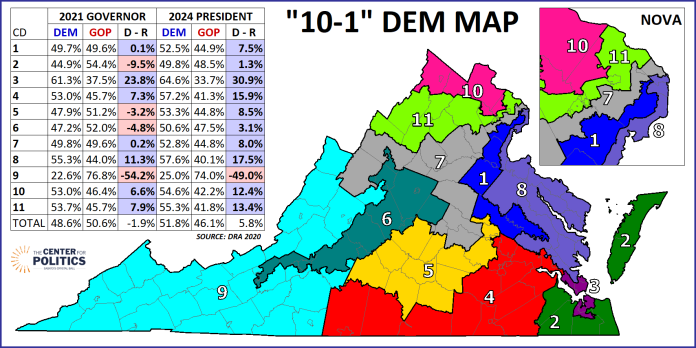
The April 21 special election asked voters whether to approve a legislatively referred constitutional amendment that would temporarily empower the Democrat-controlled General Assembly to redraw Virginia’s 11 congressional districts outside the normal decennial cycle. The measure was tied to House Bill 29, signed into law by Gov. Abigail Spanberger (D) on February 20, 2026, which outlined new maps designed to make four currently Republican-held districts more competitive for Democrats. Proponents framed the change as a necessary step toward “fairness” if another state initiated mid-decade redistricting, arguing it would counteract perceived Republican gerrymandering elsewhere in the country ahead of the 2026 midterms. A “YES” vote would have bypassed the state’s bipartisan Virginia Redistricting Commission, which had drawn the current maps following the 2020 census, and activated the new boundaries.
Critics, however, contended the entire process was rushed and procedurally flawed from the outset. Republicans argued that the amendment originated improperly during a 2024 special legislative session called solely for budget matters, violating rules limiting the scope of such sessions. Additional challenges included misleading ballot language, failure to meet statutory notice requirements under former Code § 30-13, and violations of the 90-day waiting period between legislative passage and early voting. HB 1384, introduced by Del. Luke Torian (D-24) on January 21, 2026, scheduled the April 21 vote and appropriated funds for it, but opponents maintained it embraced multiple unrelated objects not reflected in the bill’s title, breaching the state constitution’s “Form of Laws” clause.
Judge Hurley has consistently sided with these arguments. In January 2026, he ruled in McDougle v. Nardo that the General Assembly illegally advanced the proposal during the special session, voiding House Joint Resolution 6007. A February 19 emergency injunction, sought by the RNC, NRCC, and GOP congressmen Ben Cline and Morgan Griffith, temporarily restrained state and local election officials from preparing for the vote. Although the Virginia Supreme Court (SCOVA) intervened in March to allow the election to proceed—citing a 1912 precedent discouraging pre-election injunctions—Hurley’s latest order makes clear that the underlying constitutional defects remain unresolved. The court explicitly enjoined certification and rejected any stay, signaling strong confidence in the merits of the challenge.
The ruling comes one day after polls closed on the low-turnout special election. Early returns and preliminary results indicated the amendment had passed, with supporters celebrating what they viewed as a voter mandate for redistricting reform. However, certification by the state Department of Elections and local officials is now halted statewide, creating immediate uncertainty. Virginia Attorney General Jay Jones (D) previously vowed to appeal similar rulings swiftly, and Democratic leaders are expected to petition SCOVA for an emergency review. Some observers noted in social media reactions that the high court, with justices appointed under Democratic influence, may ultimately overturn Hurley’s decision, though the judge’s repeated findings and denial of a stay could complicate that path.
The stakes are high for Virginia’s congressional delegation and national politics. Approval of the maps under HB 29 would likely have shifted the state’s U.S. House balance toward Democrats, potentially adding seats in a chamber where every vote counts in the 2026 midterms. Republicans framed the effort as an attempt at “power grab” gerrymandering that disenfranchises voters who approved the current commission-based system in 2020. Delegate Williams and other GOP figures have long warned that allowing the legislature to override the commission mid-cycle sets a dangerous precedent.
Legal experts following the case describe it as a textbook clash between legislative authority and constitutional procedural safeguards. “The state Constitution is crystal clear” on amendment processes, one court filing noted, highlighting requirements that only the General Assembly may propose changes and voters must approve them—subject to strict procedural guardrails. The Tazewell court’s repeated interventions underscore concerns that shortcuts undermine democratic legitimacy.
As of Wednesday evening, no immediate statement had been released by Gov. Spanberger’s office or Democratic legislative leaders. The Department of Elections confirmed it would comply with the injunction pending further court direction. Early voting for the special election had already begun in mid-March, and ballots were cast in all 133 localities, but results now hang in legal limbo.
This episode caps months of intense litigation that began in late 2025 and intensified after the 2024 elections flipped the General Assembly to Democratic control. It echoes broader national battles over redistricting, where states like Virginia have become testing grounds for partisan map-drawing strategies. For rural and Republican-leaning areas of Southwest Virginia—home to Tazewell County—the ruling is being hailed as a defense of fair process over political expediency.
Whether Hurley’s order survives appeal will likely be decided by the Virginia Supreme Court in coming weeks. A final resolution could determine not only the fate of the 2026 congressional maps but also set precedent for future constitutional amendments in the Commonwealth. For now, Virginia’s congressional boundaries remain frozen under the commission-drawn plan, preserving the status quo amid the uncertainty.