
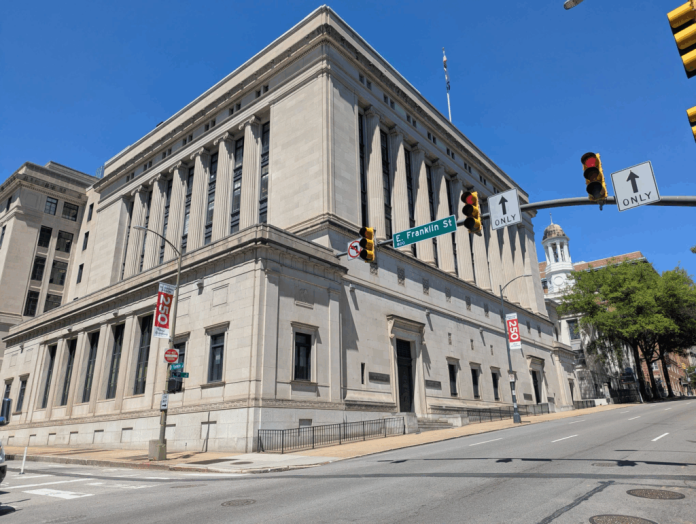
The Supreme Court of Virginia on Monday heard arguments over whether Democrats followed constitutional requirements in advancing a voter-approved redistricting amendment, zeroing in on disputes over election timing, public notice requirements and the scope of a special session last year.
At the center of the case is a procedural fight with major national consequences over whether the General Assembly properly moved the amendment through the constitutional process before voters approved it last week — and whether alleged missteps should now invalidate the result.
The lawsuit, filed in October by Republican lawmakers and a member of Virginia’s redistricting commission, seeks to void the amendment and block its implementation.
Plaintiffs include state Sens. Ryan McDougle of Hanover and Bill Stanley of Franklin, Del. Terry Kilgore of Scott and Commissioner Virginia Trost Thornton, who argue the legislature overstepped its authority and failed to follow required steps.
Under Virginia’s constitution, amendments must pass the General Assembly twice — with an intervening General Election — before going to voters for final approval.
The challengers say that process was not followed properly, pointing to questions about whether there was a valid “intervening election,” whether lawmakers provided 90 days’ public notice before the statewide elections in November, and whether the amendment was improperly advanced during a special session originally limited to budget matters.
A Tazewell County judge sided with the plaintiffs in January on procedural grounds. The state appealed, bringing the case to the high court which declined to intervene before last week’s referendum.
The case carries national implications as the country braces for the 2026 midterm elections, where control of Congress could hinge on a handful of competitive districts.
Virginia’s effort to redraw its congressional map mid-decade — and the legal fight over whether it was done lawfully — is seen as a potential test for how far states can go in revising district lines outside the traditional redistricting cycle, and a Democratic check on GOP control of the federal government.
Justice presses both sides
Justice Wesley G. Russell Jr. quickly took the lead in questioning, pressing attorneys on the legal significance of the amendments approved by voters and repeatedly steering the discussion back to whether constitutional requirements were met.
“Last week, the people of the commonwealth approved an amendment to the Virginia Constitution,” Matthew Seligman, an attorney representing legislative leaders, told the court.
He argued that lawmakers and voters followed every step required under Article XII, which outlines the specific process for amending or revising the state charter.
Seligman outlined the timeline, with initial passage during a special session in the last week of October 2025, a second vote in January following the November election, and final approval by voters on April 21.
“The General Assembly and the people thus complied strictly with every step that the Constitution requires,” he said. “As a result, the proposed constitutional amendment has been ratified and is now part of the Virginia Constitution.”
Russell pushed back, noting that a successful election does not resolve whether the process itself was valid.
“I don’t understand that as a legal argument,” he said, referencing precedent that courts may review procedural irregularities after an election.
Seligman acknowledged that the court has that authority but argued the challengers’ claims fail on the merits.
“But the fact that there’s a yes vote doesn’t tell us anything about those merits,” Russell replied.
Dispute over special session
A major focus of the 60-minute hearing was whether lawmakers followed the rules when using a special session to pass the amendment the first time.
Thomas McCarthy, representing the challengers, argued they did not.
“The Virginia Constitution and code delineate a very specific and detailed process for amending the constitution,” he said. “Yet, a bare partisan majority of the General Assembly rammed the proposed amendments through the legislature, departing radically from the mandated constitutional amendment process.”
Russell interrupted to narrow the argument.
“We’re only concerned with what they couldn’t do,” he said. “The question is, did they follow the right procedures?”
McCarthy said the legislature exceeded the scope of the special session, which had been called to address budget issues. He argued that expanding the session to take up redistricting without meeting constitutional requirements undermined limits designed to restrain legislative power.
“Special sessions are special,” he said, adding that allowing lawmakers to expand their stated purpose would “flout” constitutional safeguards.
Court examines timing, meaning of the word ‘election’
The court also grappled with the meaning of “election” in the constitutional amendment process — a key issue in determining whether the required intervening election occurred between the amendment’s two legislative proposals.
McCarthy argued that an election is a process that includes early voting and post-election certification, not just a single day.
Solicitor General Tillman Breckenridge, representing Virginia, argued that the constitution tied elections to a specific date — the first Tuesday after the second Monday in November.
Russell tested that interpretation repeatedly, pointing to the realities of early voting.
“If I voted on Oct. 21, am I actively participating in the election?” he asked.
Breckenridge said early ballots are cast in advance but effectively count on Election Day.
But Russell remained skeptical.
“So your interpretation … is that we literally could have an election where every single vote is cast before the election actually even begins?” he asked, calling it a “very extreme definition.”
Another issue is a state law requiring 90 days’ public notice before a constitutional amendment moves forward — a timeline challengers say was not met ahead of the Nov. 4 election, potentially limiting voters’ ability to assess where legislative candidates stood on the proposal before casting their ballots.
McCarthy said the requirement ensures voters have time to learn about and debate proposed changes.
“The information needs to be in the hands of the voters … to make reasoned decisions,” he said.
Seligman countered that the notice provision no longer determines validity because it was removed from the state constitution during its rewrite in 1971, even though it remains on the books.
At one point, Russell questioned how much formal notice still matters in practice.
“Who goes to the courthouse to get their news anymore anyway?” he said.
Amendment in limbo amid dueling court rulings
The legal fight over the referendum is currently unfolding across multiple cases.
Less than 24 hours after voters approved the amendment last week, Tazewell County Circuit Court Judge Jack C. Hurley issued a separate ruling in a related case halting its implementation, putting the new congressional maps on hold.
With nearly all votes counted, the measure passed by about 3 percentage points — 51.45% to 48.55% — out of nearly 3.1 million ballots cast, according to the Virginia Department of Elections.
Meanwhile, a different challenge brought by the National Republican Committee was rejected Friday by a Richmond Circuit Court judge, who found that the General Assembly had authority to act and said claims about the maps’ compactness were “fairly debatable.”
Andrea Gaines, a spokeswoman for the Virginia Department of Election, said in an email Monday that legislation passed earlier this year set a deadline of 14 days after Election Day for the State Board of Elections to certify the April 21 special election.
The board had planned to certify the results at a prescheduled May 1 meeting, she said, but whether that happens now depends on whether the Supreme Court of Virginia grants a stay of the Tazewell County Circuit Court’s injunction.
But the Republican groups behind the challenge maintain that Virginia’s redistricting amendment represents an abuse of power.
“Virginia Democrats’ redistricting scheme is a blatant attempt to rig the system and lock in political power,” RNC Chair Joe Gruters said in a statement Monday.
Richard Hudson, chairman of the Republican National Campaign Committee, called it a “direct assault on fair representation,” saying the effort violates the state constitution.
Supporters of the amendment argue that the lawsuits seek to overturn the will of the voters.
“More than three million Virginians voted in a free and fair election,” said Dan Gottlieb, a spokesperson for the Virginians for Fair Elections PAC. “Republicans lost — and are now trying to throw out the will of Virginians in court.”
What comes next
Legal observers say the outcome remains uncertain.
Carl Tobias, a constitutional law professor at the University of Richmond, emphasized that the court may weigh the legal questions against the reality that voters have already approved the amendment.
“As a pragmatic matter, I think the court does not want to be perceived as taking that vote away from the people,” he said. “But that doesn’t mean they couldn’t, if they find a serious violation.”
He added that a split decision is possible and that the court may move quickly given the stakes.
“Time is of the essence,” Tobias said. “I think they’ll try to do it sooner rather than later.”