
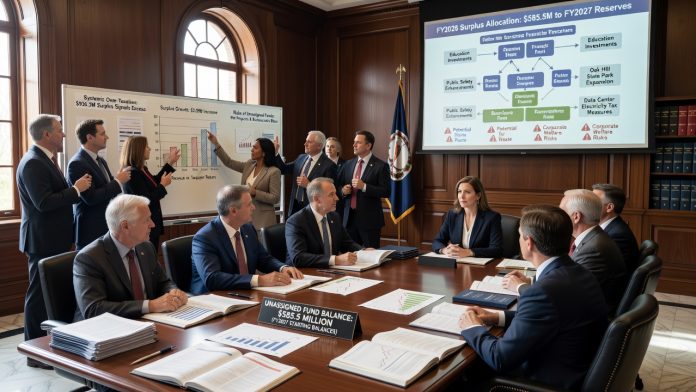
The Loudoun County Board of Supervisors convened on January 6, 2026, to finalize significant financial allocations utilizing the county’s unassigned general fund balance. Officials directed a substantial portion of these funds toward one-time needs, aiming to bolster essential infrastructure and school reserves without burdening taxpayers. The primary justification for this financial strategy is to manage rapid county growth in a manner that helps avoid new debt and real property tax increases. Municipal leaders emphasized that deploying cash on hand for these purposes is a fiscally responsible alternative to borrowing.
The current board, consisting of Chair Phyllis Randall, Vice Chairman Koran Saines, Juli Briskman, Sylvia Glass, Caleb Kershner, Matt Letourneau, Laura TeKrony, Kristen Umstattd, and Michael Turner, reviewed the comprehensive fiscal package in detail. These local leaders unanimously recognized the critical importance of deploying surplus funds strategically to address immediate capital requirements across the growing region. Their collective action underscores a continued commitment to maintaining the county’s top-tier financial health while simultaneously funding essential public services. The comprehensive review process ensured that all allocations strictly adhered to the county’s long-term strategic goals.
During the proceedings, financial staff reported a total unassigned fund balance of $194,392,805 available for strategic distribution. This current figure is notably lower than the unassigned fund balances recorded in each of the previous two fiscal years. According to county officials, this anticipated decrease is entirely consistent with staff’s long-term revenue growth forecasts and reflects a stabilizing local economy. The gradual normalization of these funds indicates a return to predictable fiscal cycles following years of unprecedented economic volatility.
Strategic Capital and Educational Investments
A centerpiece of the board’s financial maneuver is the $34,000,000 allocation specifically designated for the Fiscal Year 2027 capital and debt service budgets. By utilizing existing cash reserves for these upcoming financial obligations, the county significantly reduces its reliance on issuing new municipal bonds. This proactive approach to debt management ensures that future revenue is not overly constrained by high interest payments on borrowed capital. Preserving debt capacity allows the county to maintain its premium credit ratings, which ultimately secures lower interest rates for future borrowing needs.
Loudoun County Public Schools will also receive a substantial financial boost, with $17,491,000 allocated directly to the educational system. These specific funds are strictly earmarked for one-time operational needs and the vital replenishment of the district’s health insurance claims reserve. Providing this cash injection prevents the school system from having to divert recurring classroom funds to cover unexpected healthcare liabilities. Ensuring the financial stability of the school district remains a top priority for the board as student enrollment continues to fluctuate.
In addition to educational support, the board approved a $13,700,000 allocation dedicated to advancing various county capital projects. This funding will finance the construction of new pedestrian sidewalks and initiate the critical design phase for upcoming Goose Creek Bridge improvements. Furthermore, a portion of this capital allocation will cover preliminary design work for future Department of General Services facilities located across the county. Advancing these projects through early funding ensures that critical public safety and infrastructure upgrades avoid costly construction delays.
Long-Term Fiscal Health and Reserves
Beyond immediate infrastructure and educational needs, the board prioritized long-term financial security by directing $100,880,405 into vital reserve accounts. This massive allocation bolsters county reserve balances, the self-insurance fund, and various emergency contingency accounts. Maintaining these robust financial buffers is a standard municipal practice designed to protect local government operations against unforeseen economic downturns or natural disasters. Strong reserves act as a financial shock absorber, guaranteeing that essential county services remain uninterrupted during periods of unexpected fiscal stress.
Throughout the January meeting, officials noted that the county historically uses available fund balances for one-time purposes that directly align with established Board priorities. Utilizing surplus cash for one-time expenditures rather than recurring operational costs is a fundamental principle of sound public finance. This disciplined approach ensures that the local government does not create long-term financial obligations that cannot be sustained by regular tax revenues. By adhering to this historical precedent, the board reinforces a culture of fiscal responsibility and transparent governance.
The direct impact of these financial decisions on local taxpayers was a recurring theme during the board’s extensive deliberations. By covering major capital improvements and debt service requirements with cash on hand, the county relieves significant upward pressure on the annual tax rate. Residents benefit from improved public infrastructure and fully funded school reserves without facing the immediate threat of real property tax increases. This strategy effectively balances the demand for enhanced public amenities with the need to maintain an affordable cost of living for county residents.
Economic Outlook and Taxpayer Impact
The normalization of the county’s unassigned fund balance highlights a broader shift in regional municipal finance following years of unpredictable economic fluctuations. As the $194 million balance aligns seamlessly with staff revenue forecasts, it signals that local revenue streams are growing at a more moderate, predictable pace. Local governments across the region are currently adjusting their long-term budgetary models to accommodate similar macroeconomic stabilization trends. Loudoun County’s proactive adjustments demonstrate a sophisticated understanding of these broader economic indicators.
Addressing ongoing infrastructure demands remains a critical priority for Loudoun County as its diverse population continues to expand. The specific investments in sidewalk networks and bridge enhancements demonstrate a clear focus on public safety and regional transportation efficiency. Funding the early design phases of these projects today ensures they remain on schedule for actual construction in subsequent fiscal years. Proactive infrastructure planning prevents traffic bottlenecks and enhances the overall quality of life for all community members.
Balancing immediate capital requirements with the necessity of long-term reserve funding requires careful planning and strict financial discipline. The actions taken by the Board of Supervisors illustrate a comprehensive strategy designed to maximize the utility of existing taxpayer funds. Ultimately, residents will experience the tangible results of these allocations as new infrastructure materializes and local public schools maintain stable financial footing. The board’s unanimous support for this fiscal framework sets a strong precedent for future budgetary cycles in the county.