
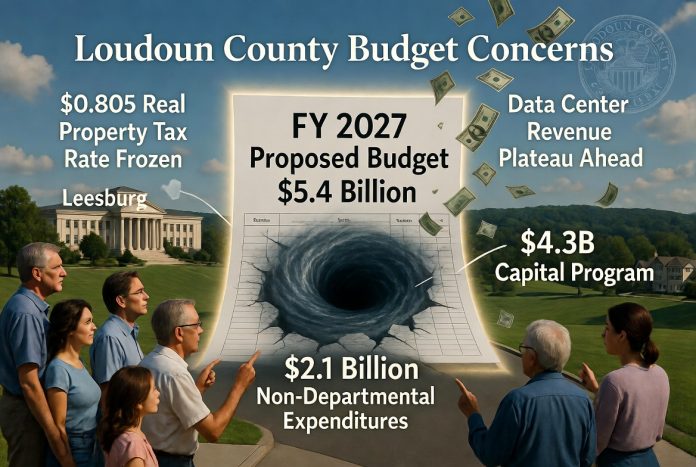
Loudoun County’s FY 2027 Proposed Budget lists Non-Departmental Expenditures as one of the largest single categories in the General Fund, totaling approximately $2.103 billion — an increase of $119.5 million over the FY 2026 adopted amount of $1.984 billion. While this broad line item supports legitimate centralized functions, its size and lack of granular detail have raised questions about transparency and public oversight in local government budgeting.
According to the budget document, Non-Departmental Expenditures serve as a “constructed category” designed to capture costs that are not directly attributed to any specific county agency or department. This includes centralized items such as certain compensation adjustments, contingency reserves, inter-fund transfers, and other miscellaneous obligations. In the proposed plan, the category encompasses roughly $538.4 million in “Other Uses of Funds,” which is nearly half the size of the entire county operating budget outside of schools.
Key components within the category include:
- Legal and Other Contingencies totaling $5.54 million, intended to cover potential outside legal services and other unforeseen obligations.
- Major inter-fund transfers, such as $138.88 million to the Capital Projects Fund, $56.31 million to the Capital Asset Preservation Program, $255.75 million to Debt Service, $38.8 million to the Transportation District Fund, and $25.98 million to the Affordable Housing Fund (including an additional $6 million specifically directed from excess local tax revenue).
- Direct support for nonprofits amounting to $8.17 million.
- Contributions to regional and intergovernmental organizations of $12.62 million, plus smaller payments such as $2.06 million to the Town of Leesburg under a mediated annexation agreement and $1.65 million to the Economic Development Authority.
The budget also centralizes $28.5 million in new compensation costs here, along with assumptions about personnel vacancy savings (booked as a $44.5 million negative entry based on an estimated 5.3% turnover rate), annual and sick leave payouts, and contributions to the Length of Service Award Program and Other Post-Employment Benefits.
While such centralized accounting can improve administrative efficiency, the sheer scale of the Non-Departmental category makes it difficult for residents, oversight bodies, and even some Board members to trace exactly how taxpayer dollars are being allocated. Unlike department-level budgets that receive detailed line-by-line review during public hearings, much of this spending is presented in aggregated form. Critics of the approach note that this structure can obscure the full picture of spending priorities, especially when the Board has chosen to maintain the real property tax rate at $0.805 per $100 of assessed value despite strong commercial revenue growth.
The timing adds to the concern. The budget’s own multi-year forecasts project a plateau in revenue growth in the early 2030s once data-center-related personal property tax increases stabilize. With one cent of the real property tax rate currently generating $19.4 million annually, decisions about how surplus revenue is directed — including the large transfers embedded in Non-Departmental Expenditures — will have long-term implications for future tax rates and service levels.
Transparency advocates argue that when such a significant portion of the budget is housed in a single, less-detailed category, it becomes harder for the public to evaluate trade-offs. For example, the $25.98 million transfer to the Affordable Housing Fund occurs in the same document that provides only modest relief through a vehicle personal property tax reduction. Similarly, the contingency reserve for legal matters, while prudent, is not broken down by anticipated case type or risk level.
Local government budgeting experts often recommend that large catch-all categories be accompanied by clear supporting schedules and annual justification. In this case, the FY 2027 proposal does provide some narrative explanation, but the level of detail remains limited compared with individual department summaries.
As Loudoun County continues to grow and faces an eventual slowdown in certain revenue streams, greater visibility into how funds are managed across all categories — including Non-Departmental Expenditures — could help build public confidence in fiscal decision-making. Whether through more granular reporting, enhanced public dashboards, or additional oversight mechanisms, addressing the opacity of this large budget line could strengthen accountability without altering the county’s overall spending priorities.
The Board of Supervisors and County Administrator have indicated that the proposed budget reflects careful guidance to constrain operating growth while directing excess revenue toward capital needs and housing. Still, the structure of the Non-Departmental category remains an area where improved transparency could help residents better understand — and evaluate — how their tax dollars are ultimately being used.