
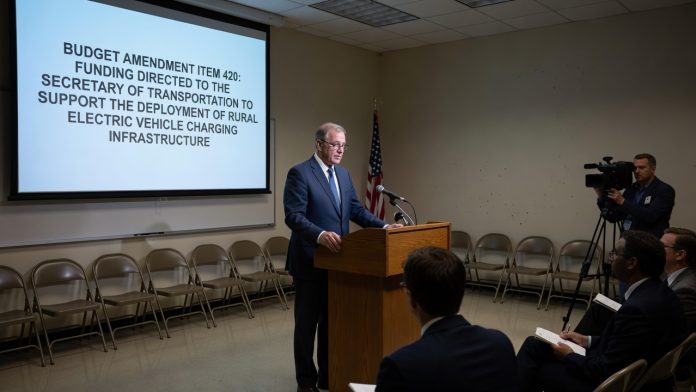
The Virginia state budget for the upcoming fiscal year introduces a fiscally responsible shift regarding the funding of electric vehicle infrastructure in rural communities. Under budget amendment Item 420, lawmakers have replaced direct state spending with a language-only directive that protects state taxpayer dollars from being drained by expensive green energy initiatives. This conservative move effectively ends the previous practice of using millions in state general funds to build charging stations in areas where market demand remains remarkably low. Fiscal watchdogs are praising the adjustment as a necessary step toward reducing unnecessary government spending and balancing the state budget without raising taxes.
The newly adopted language specifically directs the Secretary of Transportation to identify and apply for available federal funds to support the deployment of rural electric vehicle charging networks. This effort must be coordinated with the Secretary of Commerce and Trade and the Department of Energy to ensure that state agencies are not duplicating efforts or wasting administrative resources. If federal funds are secured, the appropriate agency is instructed to prioritize installations in rural localities that currently lack any public electric vehicle infrastructure. By shifting the financial burden away from the state treasury, Virginia lawmakers are signaling a reluctance to subsidize a technology that many rural residents have not adopted.
Moving Away from State-Funded Subsidies
Previous legislative sessions saw the state allocate significant amounts of taxpayer money to prop up electric vehicle programs without clear evidence of rural demand. For instance, prior budgets included a massive five million dollar appropriation for the Virginia Rural EV Charging Network Program, along with an additional fifty thousand dollars for the Electric Vehicle Rural Infrastructure Program and Fund. These heavy expenditures represented a significant burden on state taxpayers to fund niche infrastructure projects that primarily benefit a small fraction of wealthy drivers. The FY2027 budget eliminates these direct state appropriations, opting instead for a strategy that relies exclusively on outside federal grants.
Fiscal conservatives argue that government should not be in the business of picking winners and losers in the free market, especially when it comes to the automotive industry. Funding electric vehicle chargers with state money forces everyday taxpayers to subsidize the driving habits of a minority of early adopters. This language-only amendment serves as a safeguard against wasteful spending, ensuring that the state does not continue to pour millions into underutilized charging stations. Protecting the general fund from these types of ideological projects is essential for maintaining a balanced budget and preventing future tax increases on hardworking citizens.
The Hidden Costs of Federal Dollars
While the elimination of state funding is a victory for fiscal restraint, the directive to aggressively pursue federal grants still warrants close scrutiny from taxpayers. Federal funds are ultimately derived from the same hardworking citizens, and accepting federal money often ties state agencies to burdensome regulations and federal mandates. The Senate Finance and Appropriations Committee and the House Appropriations Committee will need to carefully monitor how these federal grants are administered to prevent bureaucratic bloat. Lawmakers must ensure that any federal money accepted does not secretly obligate the state to future maintenance costs or hidden matching requirements.
The push for electric vehicles has largely been driven by urban-centric policies that fail to account for the practical realities of rural Virginia. Residents in agricultural and remote communities rely heavily on traditional gas and diesel vehicles for farming, hauling, and commuting long distances across the state. Installing charging stations in these sparse areas often results in stranded assets that sit empty while still requiring ongoing upkeep and security measures. Government officials must recognize that forcing expensive green infrastructure into regions without organic consumer demand is a classic example of wasteful government overreach.
Protecting Taxpayers Moving Forward
As the Secretary of Transportation begins the search for federal grants, conservative leaders are urging total transparency regarding the true costs of this infrastructure deployment. The state must provide detailed reports on utilization rates for any new charging stations to prove that public funds are not being squandered on empty lots. If these rural charging stations fail to attract users, Virginia should firmly reject any future attempts to reinstate state funding for similar green energy programs. True fiscal responsibility demands that every dollar spent, whether state or federal, delivers a tangible benefit to the public rather than serving a political agenda.
The shift to a language-only budget amendment for rural electric vehicle infrastructure marks a meaningful victory for Virginia taxpayers who oppose wasteful government spending. By cutting over five million dollars in previous state subsidies, lawmakers have demonstrated a renewed commitment to fiscal prudence and limited government intervention. Moving forward, the state must remain vigilant against the creeping costs associated with federal grants and heavy-handed green energy mandates. Ultimately, allowing the free market to dictate the growth of electric vehicle infrastructure is the only way to truly protect the financial interests of the Commonwealth.