
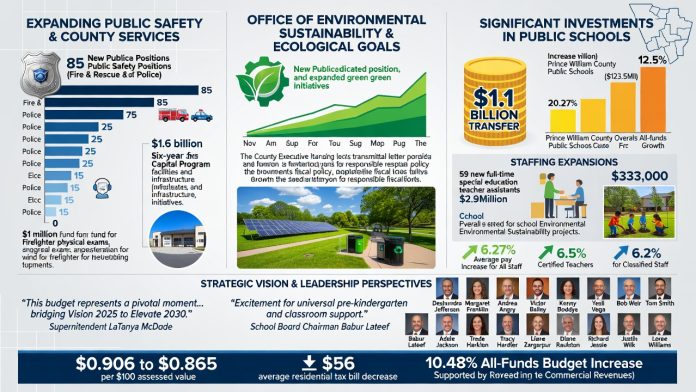
The Prince William County government has advanced its Fiscal Year 2027 budget, featuring substantial investments in public safety personnel, environmental sustainability, and educational staffing. The comprehensive financial plan balances significant departmental growth with a notable reduction in the local real estate tax rate. Local officials aim to address the demands of a rapidly growing population while maintaining strict fiscal responsibility across all county services. Specifically, the budget allocates millions toward hiring new public safety officers, expanding special education support, and creating dedicated environmental roles to serve the community.
EXPANDING PUBLIC SAFETY AND COUNTY SERVICES
A major component of the county’s financial strategy involves the addition of 85 new public safety positions across multiple critical departments. These new roles will directly bolster the Fire and Rescue department, Police, Public Safety Communications, Sheriff’s Office, Commonwealth’s Attorney, and the Public Defender’s Office. To support this expanded workforce, the budget incorporates a $1.6 billion six-year capital program dedicated to facilities, infrastructure, and overall public safety enhancements. Furthermore, the county has allocated a specific $1 million fund to provide expanded physical examinations for firefighters to ensure their long-term health and readiness.
In addition to public safety, the budget addresses local ecological goals through targeted administrative investments and new personnel. The financial plan adds one new dedicated position within the Office of Environmental Sustainability to help manage and expand the county’s green initiatives. According to the county executive’s transmittal letter, the budget represents a responsible approach that meets community needs while strictly adhering to sound fiscal policies. This balanced approach allows the county to enhance its overall quality of life, support parks and recreation, and improve service delivery for vulnerable residents without overextending public resources.
Despite the addition of new personnel and community programs, the county managed to lower the direct tax burden on individual homeowners. The real estate tax rate was officially reduced from $0.906 to $0.865 per $100 of assessed value for the upcoming fiscal year. This strategic rate adjustment translates to an average residential tax bill decrease of $56 compared to the previous fiscal cycle. However, the county government’s all-funds budget still experiences a 10.48 percent overall increase from the prior year, supported by expanding commercial revenues and other diverse funding sources.
SIGNIFICANT INVESTMENTS IN PUBLIC SCHOOLS
The educational sector receives one of the largest financial boosts in the new budget, reflecting a strong emphasis on student support and facility modernization. The county approved a massive $1.1 billion transfer to Prince William County Public Schools, which represents a 12.5 percent increase of $123.5 million over the previous year. Consequently, the school system’s all-funds budget grows by 20.27 percent overall, heavily influenced by a $168 million increase in the district’s construction fund. These capital funds will be utilized to build new facilities, renovate aging infrastructure, and accommodate shifting enrollment numbers across the expanding school district.
Staffing expansions within the school system closely mirror the county’s broader hiring initiatives, with a specific focus on enhancing special education. The approved school budget dictates the hiring of 59 new full-time special education teacher assistants at a total cost of $2.9 million. Alongside these critical personnel additions, the educational budget sets aside $333,000 specifically for environmental sustainability projects on school grounds. These targeted investments are designed to ensure that both the physical campuses and the classroom environments are adequately equipped to support diverse student needs throughout the academic year.
To remain highly competitive in a challenging labor market, the school division’s budget includes substantial compensation increases for existing staff members. The financial plan provides an average 6.27 percent pay increase across all school employee classifications to combat inflation and reward performance. Certified teachers will see a slightly higher bump with a 6.5 percent raise, while classified staff members will receive a 6.2 percent wage increase. District administrators maintain that these salary adjustments are absolutely critical for retaining experienced educators and attracting top-tier administrative talent to the region.
STRATEGIC VISION AND LEADERSHIP PERSPECTIVES
Educational leaders have publicly praised the budget for aligning financial resources with the district’s long-term operational and academic goals. Superintendent LaTanya McDade stated that the proposed budget represents a pivotal moment for the school system as it transitions between major strategic plans. She noted that the funding seamlessly bridges the gap from the previous Vision 2025 plan to the newly developed Elevate 2030 strategic plan. School Board Chairman Babur Lateef echoed this sentiment, expressing excitement that the budget begins funding universal pre-kindergarten and continues providing necessary support for students and teachers in the classroom.
The successful implementation of this comprehensive budget relies entirely on the collaborative oversight of local elected officials in Prince William County. The current Board of County Supervisors includes Chair Deshundra Jefferson, Margaret Franklin, Victor Angry, Andrea Bailey, Kenny Boddye, Yesli Vega, Bob Weir, and Tom Smith. Meanwhile, the School Board consists of Chairman Babur Lateef, Adele Jackson, Tracy Hardter, Lisa Zargarpur, Diane Raulston, Richard Jessie, Justin Wilk, and Loree Williams. Together, these governing bodies are responsible for finalizing the appropriations that will shape the county’s public services, educational quality, and economic landscape through Fiscal Year 2027.
Email the Board of Supervisors At:
Chair At-Large (Deshundra Jefferson) – djefferson@pwcgov.org,
Brentsville (Tom Gordy): tgordy@pwcgov.org,
Coles (Yesli Vega): yvega@pwcgov.org,
Occoquan (Kenny Boddye): kboddye@pwcgov.org,
Potomac (Andrea Bailey): abailey@pwcgov.org,
Woodbridge (Jeannie LaCroix): jlacroix@pwcgov.org,
General Board: bocs@pwcgov.org,